Invoice Origin Declaration Text: EU–Korea, EU–UK, EU–Japan
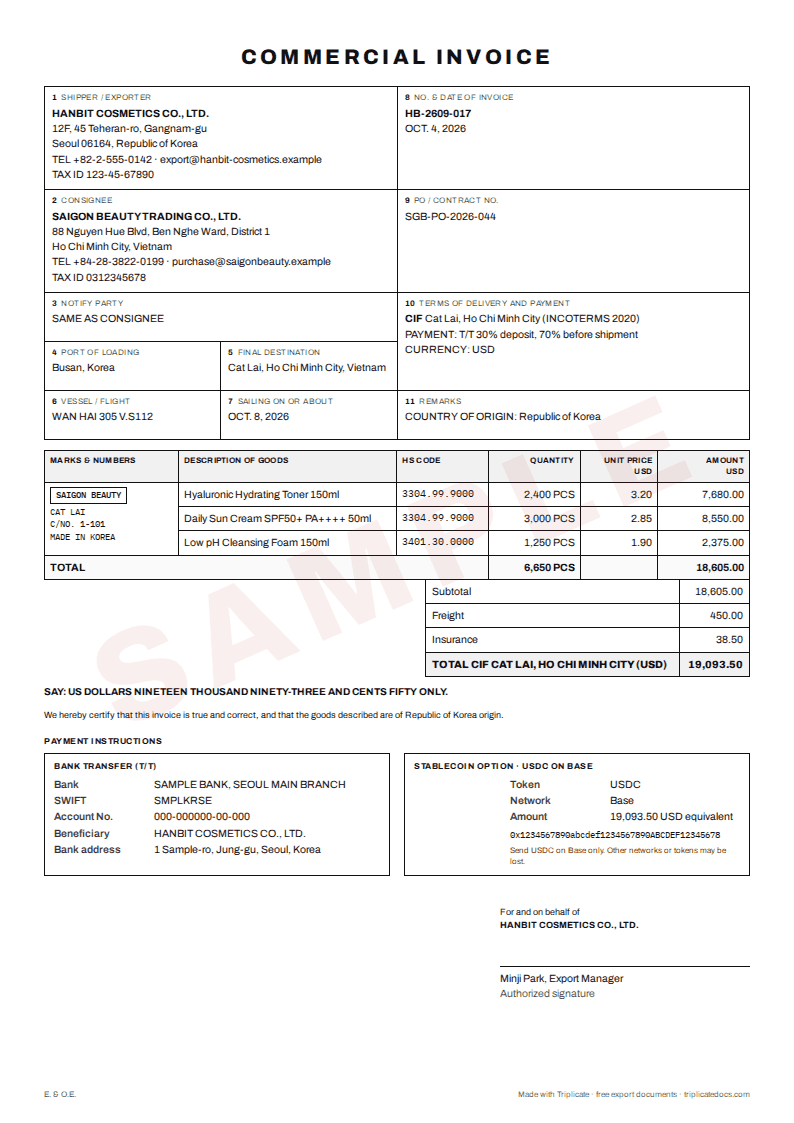
Under several trade agreements the exporter proves preferential origin itself, by typing a fixed sentence on the commercial invoice or another commercial document: an origin declaration (EU–Korea, EU–Vietnam, UK–Korea) or a statement on origin (EU–Japan, EU GSP). The buyer uses it to claim the lower duty. The sentence must follow the agreement's own text in one of its language versions, with the right number, origin and, for some agreements, an origin criterion code. Make it out only for goods that meet the agreement's rules of origin, and keep the evidence.
Checked against official sources: 2026-10
At a glance
Print it on your invoice in the generator →
EU–Korea FTA (and the same sentence under UK–Korea)
The Protocol on originating products to the EU–Korea agreement says the origin declaration is given by the exporter on an invoice, a delivery note or any other commercial document, by typing, stamping or printing the text of Annex III; a handwritten declaration must be in ink in capital characters (Articles 15 and 16). The English version of Annex III, as replaced when Croatia joined, reads: "The exporter of the products covered by this document (customs authorisation No ...) declares that, except where otherwise clearly indicated, these products are of ... preferential origin." It is followed by the place and date and by the signature of the exporter with the name of the person signing in clear script.
Any exporter may make out the declaration for a consignment whose originating products are worth no more than 6,000 euros; above that only an approved exporter may, and its authorisation number goes in the brackets. Without that number the words in brackets are left out. The origin is the country or territory, in practice Korea or EU. The declaration must bear the exporter's original signature by hand, unless an approved exporter has given customs a written undertaking. A proof of origin is valid for 12 months from the date of issue in the exporting country.
Korea Customs Service publishes the same sentence for the UK–Korea agreement, whose protocol keeps the 6,000 euro limit and the approved exporter rule, with the UK in place of the EU.
EU–Vietnam FTA (EVFTA)
The European Commission's EVFTA rules of origin guidance reproduces the origin declaration of Protocol 1, Annex VI with the same sentence as the EU–Korea text, followed by the place and date and the signature and name of the exporter. Any exporter may make it out for consignments up to 6,000 euros. For EU exporters to Vietnam the number in the brackets is the REX number; for Vietnamese exporters above the limit it is the approved exporter's authorisation number. Declarations by exporters in Vietnam are signed by hand.
EU–Singapore FTA: statement on origin (since 2023)
From 1 January 2023 (Decision (EU) 2023/202) the origin declaration is called a statement on origin, the approved exporter system was replaced by registered exporters and the signature was dropped: the text ends with the name of the exporter. The wording is: "The exporter of the products covered by this document (customs or competent governmental authorisation No ...) declares that, except where otherwise clearly indicated, these products are of ... preferential origin.", followed by the place and date and "(Name of the exporter)".
The number is the one assigned to the exporter: for EU exporters the REX number, for Singapore exporters the Unique Entity Number (UEN); it may be left blank if no number has been assigned. EU guidance lets any EU exporter make out a statement for a consignment up to EUR 6,000 without registering; above that only a REX-registered exporter can. Singapore exports use the English text. A retrospective statement must reach the importing side within two years (EU) or one year (Singapore) of the goods' entry.
EU–Japan EPA: statement on origin
Annex 3-D gives the text: "The exporter of the products covered by this document (Exporter Reference No ...) declares that, except where otherwise clearly indicated, these products are of ... preferential origin." Below it come the origin criteria used, the place and date, and the printed name of the exporter; there is no signature line. The origin is written as the European Union or Japan.
The criteria codes are A (wholly obtained), B (produced exclusively from originating materials), C with 1 to 4 for the product-specific rule applied (1 change in tariff classification, 2 value of non-originating materials or regional value content, 3 specific production process, 4 Section 3 of Appendix 3-B-1), D (accumulation) and E (tolerances). The Exporter Reference No. is the REX number for EU exporters, not needed for consignments up to EUR 6,000, and the Japan Corporate Number for Japanese exporters; it may be left blank if no number has been assigned. The statement is valid for 12 months from the date it was made out.
EU–UK TCA, EU–Canada CETA, UK–Japan and Korea–EFTA
Under the EU–UK Trade and Cooperation Agreement the statement on origin (Annex 7, ex ORIG-4) reads: "The exporter of the products covered by this document (Exporter Reference No ...) declares that, except where otherwise clearly indicated, these products are of ... preferential origin." It is followed by the place and date and the name of the exporter; there is no signature line and no criterion code. The origin is the United Kingdom or the Union. EU exporters enter their REX number, which EU rules do not require for consignments up to EUR 6,000; UK exporters enter their GB EORI number. The statement is valid for 12 months.
CETA (Annex 2 of its Protocol on rules of origin) uses the same sentence with "customs authorisation No ..." and the origin "Canada/EU". EU exporters put their REX number in the brackets above EUR 6,000 per consignment and leave the bracketed words out below it; Canadian exporters put their Business Number. The UK–Japan agreement (Annex 3-E) has the same text and A to E criterion codes as EU–Japan, with the origin "the United Kingdom or Japan".
The Korea–EFTA agreement (Appendix 3 to Annex I) reads: "The exporter of the products covered by this document (customs authorization No ...) declares that, except where otherwise clearly indicated, these products are of ... preferential origin." Any exporter may make it out with no value limit. It must be in English and bear the exporter's original signature, unless the exporter is an approved exporter. The origin is written as Icelandic, Norwegian, Swiss or Korean, or IS, NO, CH or KR. It is valid for 12 months.
EU GSP statement on origin (REX) and the UK DCTS
Under the EU's Generalised System of Preferences the registered exporter makes out the statement of Annex 22-07 to Implementing Regulation (EU) 2015/2447: "The exporter ... (Number of Registered Exporter) of the products covered by this document declares that, except where otherwise clearly indicated, these products are of ... preferential origin according to rules of origin of the Generalised System of Preferences of the European Union and that the origin criterion met is ...". The criterion is P for wholly obtained products or W followed by the HS heading, for example W 9618. Any exporter may make it out when the originating products consigned are worth no more than EUR 6,000; above that the REX number is required. The exporter does not have to sign it.
For the UK's Developing Countries Trading Scheme, GOV.UK publishes a similar origin declaration with the customs identification number, the words "in accordance with the rules of origin of the Developing Countries Trading Scheme of the UK", the same P or W criterion, the place and date, and the name and signature of the exporter. It must be in English.
Korea–Türkiye FTA: what is different
Under the Korea–Türkiye agreement every exporter makes out the origin declaration on the invoice, delivery note or another commercial document, in English, by typing, stamping or printing; there is no approved exporter and no value limit for the exporter. It must bear the exporter's original signature in manuscript, is valid for 12 months from the date of issue, and the exporter keeps a copy for five years (Protocol articles 16 to 18 and 22).
The text is in Annex III of the Protocol. Triplicate has no preset for it yet because the annex itself could not be checked word for word; use the Custom wording option with the text from Korea Customs Service or your customs broker, and sign the printed invoice by hand.
Step by step
- Check that each product meets the agreement's rules of origin for its HS code, and keep the cost breakdowns and supplier declarations.
- Pick the agreement that applies to the route, for example EU–Korea for goods from Korea to the EU.
- If the consignment's originating goods are worth more than EUR 6,000, use your approved exporter or REX number.
- Type the agreement's exact sentence on the commercial invoice, with the number, the origin and, for EU–Japan, EU GSP and the UK DCTS, the origin criterion.
- Add the place and date and sign where the agreement asks for a signature; mark clearly any items on the invoice that are not originating.
Documents you usually need
- Commercial invoice with the origin declaration or statement on origin
- Approved exporter authorisation or REX registration, when the value is above EUR 6,000
- Origin evidence: cost breakdowns, supplier declarations
- Packing list and transport document
Common problems and how to avoid them
What to do: Above the limit only an approved or registered exporter may make it out, with the number in the brackets. Below the limit, leave the bracketed words out.
What to do: Use the agreement's own sentence in one of its language versions. Small errors should not by themselves cause rejection under EU–Japan (Article 3.17), but other agreements have no such rule.
What to do: Enter A, B, C with 1 to 4, D or E for each product, as the footnote to Annex 3-D asks.
What to do: Mark them clearly on the invoice; the sentence says "except where otherwise clearly indicated".
Sources
- EU–Korea FTA, Protocol concerning the definition of originating products (Articles 15 to 18) EUR-Lex, OJ L 127, 14.5.2011
- Additional Protocol for the accession of Croatia, Annex I: text of the origin declaration Korea Ministry of Trade, Industry and Resources
- Korea–UK FTA: self-issued certificates of origin Korea Customs Service
- EU–Japan EPA, Annex 3-D: text of the statement on origin Ministry of Foreign Affairs of Japan
- EU–Japan EPA guidance: statement on origin European Commission, DG TAXUD
- Implementing Regulation (EU) 2015/2447, Annex 22-07: statement on origin European Commission, DG TAXUD
- EVFTA guidance on the rules of origin European Commission, DG TAXUD
- Using an origin declaration for the Developing Countries Trading Scheme GOV.UK
- EU–UK Trade and Cooperation Agreement, Annex 7: text of the statement on origin European Commission, OJ L 149, 30.4.2021
- Proving originating status for trade between the UK and EU GOV.UK
- CETA Protocol on rules of origin and origin procedures (Articles 18 and 19, Annex 2) Government of Canada
- UK–Japan EPA, Annex 3-E: text of the statement on origin Japan Customs
- EFTA–Korea FTA, Appendix 3 to Annex I: text of the origin declaration EFTA
- EFTA–Korea FTA, Annex I: rules of origin and customs procedures EFTA
- Decision (EU) 2023/202 of the EU–Singapore Committee on Customs: statement on origin, new Article 17 and Annex E amendments EUR-Lex, OJ L 27, 31.1.2023
- Circular No. 18/2019: Statement on Origin under the EU–Singapore FTA Singapore Customs
- Korea–Türkiye FTA, Agreement on Trade in Goods: Protocol on rules of origin and origin procedures Korea Ministry of Trade, Industry and Resources
Rules change often. This note is practical guidance based on the sources above, not legal advice. Confirm current requirements with the authority, your importer or a licensed customs broker before you ship.
Weekly email: trade rule changes
One short email a week: new and changed import and export rules from official sources, plus our new guides and tools. Free, unsubscribe at any time.
Trade notes
Common questions
Does the origin declaration replace a certificate of origin?
Under these agreements it is the proof of origin itself, so no certificate issued by an authority is needed. Agreements such as RCEP or ASEAN FTAs often use certificates issued by an authority instead, and a non-preferential certificate of origin is a different document.
Can Triplicate print the declaration?
Yes. In the generator, open "Statement on origin (FTA)" in section 2, pick the agreement and fill in the number, origin and criterion. The exact text is printed beside the signature on the commercial invoice, and the checks flag the EUR 6,000 limit, a missing criterion or a missing signer. It is a Pro feature with 3 invoices free.
Do I sign the declaration?
Under EU–Korea, UK–Korea, EU–Vietnam and Korea–EFTA the exporter signs by hand, with approved exporter exceptions. The EU–Japan, UK–Japan and EU–UK statements and the EU GSP statement need no signature; the UK DCTS declaration is signed, and under CETA the exporter signs unless the signature is waived.
More free tools
Triplicate is free and keeps getting better. Found it useful? Support Triplicate ♥
Prefer no ads? Pro removes all ads · $1/month