How to Get a Certificate of Origin: Chamber C/O vs FTA Proof
To get a certificate of origin (C/O), first find out which proof the buyer, the letter of credit or the importing country needs. A non-preferential C/O only states where the goods were made and is usually issued by a chamber of commerce against your invoice and shipping documents. A preferential proof claims a lower duty under a trade agreement and, depending on the agreement, is a certificate from customs or another issuing body or a statement you make yourself.
Checked against official sources: 2026-10
At a glance
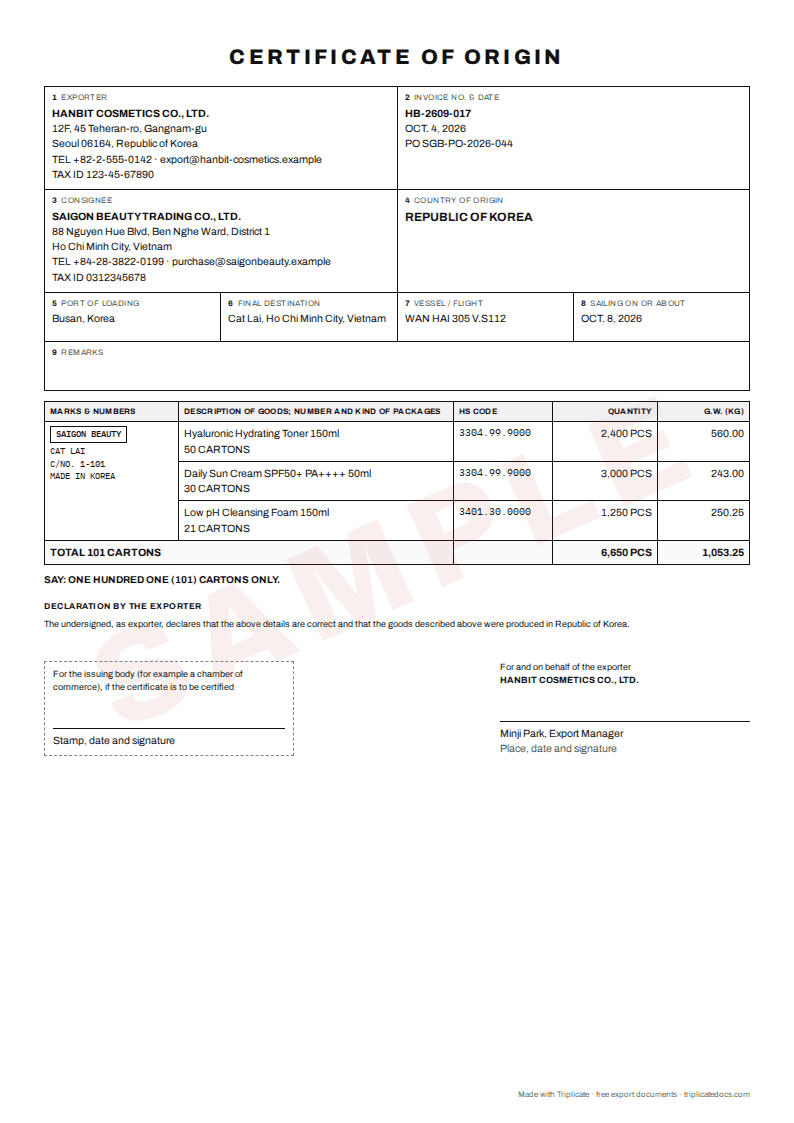
Non-preferential or preferential: which one do you need?
A non-preferential C/O states the country where the goods were produced. Customs and banks use it to see which tariffs and trade measures apply, and buyers, contracts and letters of credit (L/Cs) often call for one. It gives no duty reduction.
A preferential proof of origin claims the reduced or zero rate of a free trade agreement (FTA) or a preference scheme such as the EU's GSP. It works only for the agreement it is made under, and only if the goods meet that agreement's rules of origin. Before shipping, ask the buyer, its customs broker and the L/C which proof is needed, in which form, from which issuer, and whether it must be legalised.
Non-preferential C/Os: chambers, e-COs and letters of credit
In most countries chambers of commerce issue non-preferential C/Os. The ICC World Chambers Federation's International Certificate of Origin Guidelines (revised edition, 2019) set common issuing and verification procedures, and its International Certificate of Origin Accreditation Chain, created in 2012, accredits chambers that follow them. In a few countries a government body issues them: in Viet Nam the Ministry of Industry and Trade (MOIT) has been the only issuer since 5 May 2025, and since 6 May 2025 Malaysia's MITI issues them on request for shipments to the US.
The issuer decides origin under non-preferential rules, which usually give origin to the country of the last substantial transformation (in the EU, the last substantial, economically justified processing, Union Customs Code Article 60). Goods only repacked or relabelled in your country do not get its C/O. Many issuers take applications online and issue electronic C/Os (e-COs) printed on plain paper and checked with a QR code or reference number on the issuer's website; Japan's chambers have done so since September 2020. Ask whether the destination accepts an e-CO before you rely on one.
Under an L/C, ISBP 821 says the C/O must be signed, appear to relate to the invoiced goods and certify their origin. If the credit names an issuer, such as a chamber of commerce, only that issuer may issue it; if not, any entity, including the beneficiary, may. A consignor or exporter other than the beneficiary may be shown.
Legalisation, attestation and the Apostille
Some importing countries want more than a chamber stamp. The US International Trade Administration (ITA) notes that some countries require a C/O to be notarised, certified by a chamber of commerce and legalised by the commercial section of their consulate. Its Kuwait guide (April 2026) says the C/O should be legalised by a local chamber or the National U.S.-Arab Chamber of Commerce; its UAE guide asks for a C/O approved by a chamber in the country of origin and refers to the UAE Ministry of Foreign Affairs for attestation of invoices and shipping documents. Rules change often, so confirm them with the importer's broker for each shipment.
The Apostille Convention does not apply to administrative documents dealing directly with commercial or customs operations (Article 1(3)(b)). The Hague Conference (HCCH) says states treat such documents in three ways: some need no authentication, some issue apostilles for them anyway, and a small number refuse apostilles and require traditional legalisation. An apostille therefore replaces embassy legalisation of a C/O only where the destination says it accepts one.
Rules of origin: wholly obtained, tariff shift or value content
A preferential claim depends on the rules of origin of the agreement used, and each agreement has its own. Goods qualify if they are wholly obtained in a party (for example crops grown or minerals extracted there), made there only from originating materials, or made from non-originating materials that meet the product-specific rule for their HS code.
Look up that rule under the HS version the agreement uses, and keep a bill of materials with each material's HS code, origin and value. Triplicate's RCEP rules of origin note works through the tests in detail. Most product-specific rules use one of these, often as a choice:
- Change in tariff classification (CTC): non-originating materials must change chapter (CC), heading (CTH) or subheading (CTSH) in production.
- Regional value content (RVC): local or regional value must reach a set share of the price, such as 40% of FOB, calculated by the formula the agreement gives.
- Specific processes: some rules, for example for textiles or chemicals, require a named process to take place in the party.
- Minimal operations: packing, labelling, simple mixing or dilution do not give origin on their own, and many agreements require direct shipment or customs control in transit countries.
Preferential proofs: certificate or self-certification
Agreements use a certificate issued by a government body or authorised chamber, an origin declaration by an approved or registered exporter, or a certification by the exporter, producer or importer in free form. Some accept more than one. Common examples:
- ASEAN-China (ACFTA): Form E from the exporting party's issuing authority, with a 6-digit HS code, an origin criterion (WO, PE, RVC, CTH or PSR), the FOB value only when RVC is used, and boxes for third-party invoicing and retroactive issue.
- RCEP: Form RCEP from an issuing body, or a declaration of origin by an approved exporter; among Australia, Japan, Korea and New Zealand, any exporter or producer can declare.
- EU agreements: a EUR.1 movement certificate endorsed by customs under many agreements (in the UK, issued by chambers or the Institute of Chartered Shipbrokers); an origin declaration by an approved exporter, as under EU-Korea; or a statement on origin (EU-Japan, EU-UK) or origin declaration (EU-Canada) by an exporter registered in REX. Without approved or REX status, declarations are limited to consignments of up to EUR 6,000, or GBP 5,400 for UK exporters under some agreements.
- EU GSP: exporters in beneficiary countries register in REX and make out statements on origin; since 1 January 2021 their authorities may no longer issue Form A for the EU.
- USMCA/CUSMA: a certification of origin by the importer, exporter or producer, in any format, on the invoice or another document, with the nine minimum data elements of Annex 5-A. It can cover identical shipments for up to 12 months and is valid for four years; the US does not require one for commercial imports whose originating value is USD 2,500 or less.
- KORUS: a free-form certification by the US importer or the Korean exporter or producer, with the data listed in 19 CFR 10.1004; the importer can also claim on the basis of its own knowledge.
- CPTPP: a certification of origin by the exporter, producer or importer, in any format with the minimum data of Annex 3-B, valid for one year and able to cover shipments for up to 12 months.
How to apply in the main exporting countries
Fees, processing times and accepted formats vary by country and issuer, so check the issuer's current tariff and rules before the first application.
- Korea: chambers issue non-preferential C/Os through the Korea Chamber of Commerce and Industry (KCCI) online certificate centre (cert.korcham.net) after signature registration with a digital certificate. FTA certificates that need an issuing body, as under the Korea-China, Korea-ASEAN and Korea-India agreements or Form RCEP, come from Korea Customs Service or KCCI. Under agreements such as KORUS and Korea-EU the exporter makes the proof, and Korea Customs designates approved exporters.
- China: both customs (GACC) and the China Council for the Promotion of International Trade (CCPIT) issue certificates of origin. Exporters apply through the China International Trade Single Window or the "Internet + Customs" portal, and many certificates can be self-printed with an electronic signature, which the WCO reports can take only minutes.
- India: apply on DGFT's Trade Connect e-platform (eCoO 2.0), live for non-preferential C/Os since 28 August 2024 and for preferential ones since 21 December 2024. Chambers and export promotion councils issue non-preferential C/Os; agencies listed for each agreement in Appendix 2B of the Foreign Trade Policy, such as the Export Inspection Council, issue preferential ones. An Open API for linking ERP systems followed on 7 September 2026.
- Japan: local chambers issue non-preferential C/Os, since September 2020 also as PDFs with a QR code. For EPAs that require a certificate, such as Japan-ASEAN, Japan-India or Form RCEP, the Japan Chamber of Commerce and Industry (JCCI) issues it after the goods' origin is determined; CPTPP and the Japan-EU and Japan-UK EPAs use self-certification.
- Viet Nam: apply on MOIT's eCoSys (ecosys.gov.vn). Since 5 May 2025 MOIT, through its regional import-export management offices and authorised provincial authorities, issues both preferential and non-preferential C/Os (Form B) and registers exporters in REX for GSP schemes, taking over from VCCI. A decree to replace Decree 31/2018/ND-CP and add self-certification of origin was in preparation in 2026.
- United States: local chambers of commerce, not a government agency, certify generic C/Os, also in electronic form; some Middle East buyers ask for the National U.S.-Arab Chamber of Commerce. FTA proofs are self-certified by the exporter, producer or importer.
- EU and UK: chambers issue non-preferential C/Os, many through online systems; UK chambers also issue Arab-British certificates of origin and EUR.1s. EU customs endorse EUR.1s.
Step by step
- Ask the buyer, its customs broker and any L/C which proof is needed: a non-preferential C/O, a named FTA certificate or a self-certification, and whether legalisation is required.
- For a preferential claim, check that an agreement covers the route and lowers the duty for your HS code, then read its product-specific rule.
- Gather the origin evidence: a bill of materials with HS codes, origins and values, cost data if you use RVC, and suppliers' declarations for materials or bought-in goods.
- Finalise the commercial invoice and packing list first, then copy descriptions, HS codes, quantities, marks and the invoice number onto the C/O exactly; Triplicate's free certificate of origin guide and the generator's commercial invoice help keep them consistent.
- Register with the issuer or system: chamber membership or signature registration, the national portal (Trade Connect, eCoSys, Single Window) or approved exporter or REX status.
- Apply before or at shipment with the invoice, packing list, transport document and origin evidence, and pay the issuer's fee.
- Check the issued C/O against the invoice and the L/C: origin criterion, signature, stamp, dates and any retroactive-issue box.
- Arrange chamber certification, legalisation or attestation if the destination asks, and send the original or the e-CO details to the buyer before the goods arrive.
- Keep the origin records for as long as the agreement and national law require, typically three to five years under FTAs.
Documents you usually need
- Commercial invoice with the same descriptions, HS codes and quantities as the C/O
- Packing list
- Bill of lading, air waybill or booking confirmation
- Export declaration or clearance record, where the issuer asks for it
- Bill of materials and cost breakdown with HS codes, origins and values (preferential claims)
- Suppliers' or manufacturer's declarations of origin
- Issuer registration: signature registration, portal account, or approved exporter or REX number
- L/C or buyer's instructions naming the form, issuer and any legalisation
Common problems and how to avoid them
What to do: Finalise the invoice first and copy its data; if the C/O is already issued, ask the issuer to correct or replace it.
What to do: Check the product-specific rule for the HS code in the agreement's HS version and enter the criterion your bill of materials proves, such as WO, PE, CTH or RVC.
What to do: Form E and Form RCEP can be issued retroactively for valid causes, with the box ticked (RCEP: within 1 year of shipment); EUR.1s can be issued retrospectively. For non-preferential C/Os, ask the chamber, as practice varies.
What to do: Under ISBP 821, when the credit names an issuer only that issuer may issue it; apply to the chamber or ask the buyer to amend the credit.
What to do: Ask the importer's broker which originals, stamps and legalisation are needed, and allow time for chamber and embassy steps.
What to do: Register in REX or get approved exporter status before shipping, or use a certificate such as a EUR.1 where the agreement provides one.
Sources
- Certificates of Origin Guidelines (International Certificate of Origin Guidelines, revised edition) ICC World Chambers Federation
- Background Note on Article 1(3) Exclusions (Apostille Convention) Hague Conference on Private International Law (HCCH)
- Proof of origin European Commission, DG Taxation and Customs Union
- Get proof of origin for your goods GOV.UK (HM Revenue & Customs)
- USMCA Frequently Asked Questions US Customs and Border Protection
- Claiming preferential tariff treatment under the CPTPP Global Affairs Canada
- Trade Notice No. 25/2026-27: Open API for issuance of Certificates of Origin on the Trade Connect e-Platform Directorate General of Foreign Trade (DGFT), Government of India
- Recent changes in China rules of origin (WCO News 96) World Customs Organization
- MoIT takes over as sole C/O issuing body from May 5 Viet Nam News
- Certificate of Origin International Trade Administration, US Department of Commerce
Rules change often. This note is practical guidance based on the sources above, not legal advice. Confirm current requirements with the authority, your importer or a licensed customs broker before you ship.
Trade notes
Common questions
Who issues a certificate of origin?
A non-preferential C/O usually comes from a chamber of commerce, in a few countries from a government agency such as Viet Nam's MOIT. Preferential proofs come from customs, a ministry or an authorised chamber, or from the exporter, producer or importer itself, depending on the agreement.
Do I need a certificate of origin for every shipment?
No. A non-preferential C/O is needed only when the importing country, the contract or an L/C asks for one, and a preferential proof only when the importer claims an FTA or GSP rate. Some agreements waive the proof for low values, such as up to USD 200 under RCEP (more in some countries) or USD 2,500 for USMCA imports into the US.
Can I get a certificate of origin after the goods have shipped?
Often, within limits. Form E and Form RCEP can be issued retroactively for valid causes (RCEP within 1 year of shipment), and EUR.1s retrospectively after an error or omission. Chambers differ for non-preferential C/Os. Under many agreements the importer can also claim a refund after import within the period its law allows.
Does a certificate of origin need an apostille or embassy legalisation?
Only if the destination asks. The Apostille Convention excludes documents dealing directly with commercial or customs operations, and states differ: some need no authentication, some issue apostilles anyway, a few require legalisation. Countries that want legalisation usually expect chamber certification first.
More free tools
Triplicate is free and keeps getting better. Found it useful? Support Triplicate ♥
Prefer no ads? Pro removes all ads · $1/month