Free purchase order template for importers
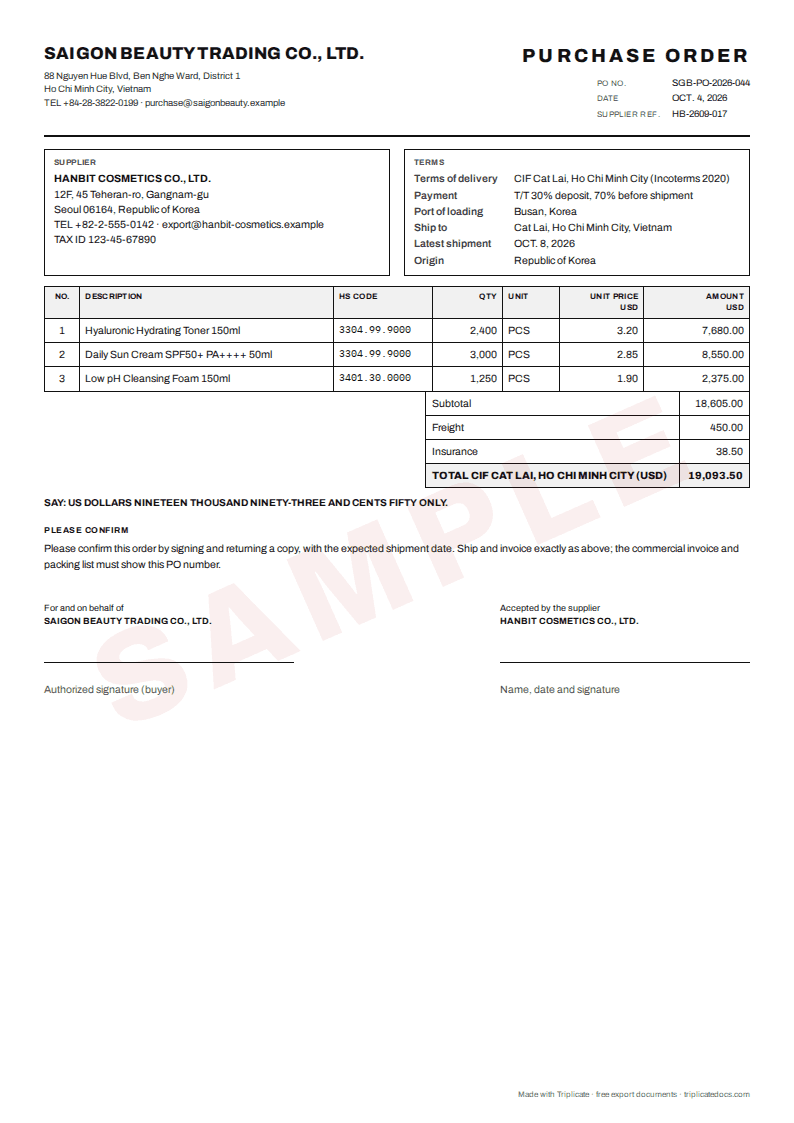
Place a clear order with an overseas supplier: what you buy, at what price and on which Incoterms rule, when it must ship, how it must be packed and marked, and which documents you need for customs and the bank.
What the template covers
- Buyer and supplier details, PO number, date and currency
- Supplier's quotation reference and buyer contact
- Incoterms 2020 rule and named place, payment terms
- Latest shipment date and whether partial shipments are allowed
- Items: description, HS code, quantity, unit, unit price and amount, with totals by formula
- Ship-to address, packing and marking requirements
- Documents required (commercial invoice, packing list, bill of lading, certificate of origin)
- Signature of the buyer and acceptance by the supplier
Download .xlsxInvoice & packing list generator →All free templates →
Guides on this topic
Purchase order, proforma invoice, contract
The purchase order is the buyer's offer to buy on stated terms. The supplier usually answers with a proforma invoice or an order confirmation; once both sides agree on the same items, prices and terms, that is the contract. Check that the proforma matches your PO before you pay a deposit or open a letter of credit.
What to put on an import purchase order
Name the Incoterms 2020 rule with a place (for example FOB Ningbo or CIF Rotterdam), the currency, the payment terms and the latest shipment date. Say how the goods must be packed and marked, and list the documents you need: your customs broker and, for a letter of credit, your bank will ask for them.
Common mistakes
No Incoterms rule or no named place, a delivery date without saying whether it is the shipment date or the arrival date, product descriptions too vague for customs, and missing document requirements, such as a certificate of origin needed to claim a lower duty under a trade agreement.
Common questions
Is a purchase order legally binding?
A purchase order is an offer. It usually becomes binding when the supplier accepts it, for example by signing it or by issuing a matching order confirmation or proforma invoice. Keep the accepted version with your shipment records.
Should the PO include the HS code?
It helps: it lets the supplier describe the goods the same way on the commercial invoice, and you can check the import duty in advance. The final classification at import is your responsibility as the importer.
Who fills in the shipment details?
The buyer states the Incoterms rule, the named place and the latest shipment date. The supplier then books or hands over the goods accordingly and confirms the vessel and dates in its shipping advice.
More free tools
Triplicate is free and keeps getting better. Found it useful? Support Triplicate ♥
Prefer no ads? Pro removes all ads · $1/month