Proforma Invoice Meaning and How It Differs from a Commercial Invoice (Customs Rules)
A proforma invoice is the seller's offer or price confirmation, sent before shipment so the buyer can approve the order, pay in advance or open a letter of credit. A commercial invoice is the final bill for the goods actually shipped, and it is the document banks pay against and customs uses to check value and assess duty. A proforma replaces it only in limited cases: in the US, for example, when the invoice is unavailable, with a bond and the real invoice due within 120 days.
Checked against official sources: 2026-10
At a glance
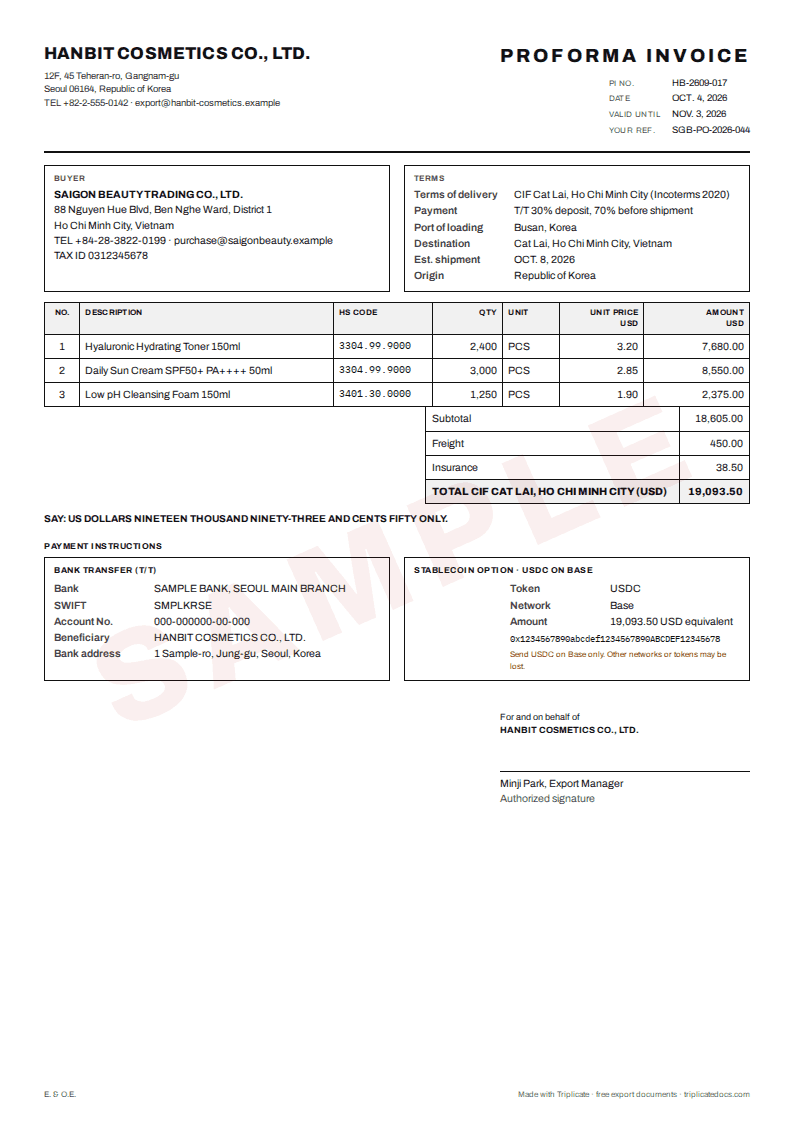
Two invoices, two jobs
A proforma invoice is a draft invoice the seller sends before shipment. It sets out what will be shipped, at what price and on what terms, so the buyer can approve the deal, pay a deposit or the full price in advance, or apply for a letter of credit (L/C). It is an offer or price confirmation, not a bill for goods already supplied.
A commercial invoice is the final bill for the goods actually shipped. The buyer pays against it, banks examine it under an L/C, and customs in the importing country uses it to check the description, quantity and value of the goods and to assess duty and import taxes. US rules describe a pro forma invoice as the importer's own statement of value, used when the seller's invoice is missing (19 CFR 141.85).
- When: the proforma before the order is confirmed or before production; the commercial invoice at or after shipment, one for each shipment.
- Purpose: the proforma quotes, confirms price and terms and triggers payment or the L/C; the commercial invoice bills the buyer and supports the customs declaration.
- Quantities: the proforma shows what was ordered; the commercial invoice shows what was actually loaded.
- Customs: the commercial invoice is the standard document; a proforma is accepted only in limited cases, which vary by country.
- Letters of credit: the proforma is often named in the credit; only a commercial invoice is presented to get paid.
- Changes: a proforma can be revised before shipment; a commercial invoice already sent is corrected with a new document, such as a credit or debit note.
What the proforma invoice is used for
Exporters use the proforma at several points before anything is shipped. Because it becomes the reference for payment and for the credit, write the Incoterm with its named place, the payment term and the currency on it, and repeat them unchanged on the commercial invoice.
- Quotation or offer: the buyer sees exactly what it will get, for how much and on what terms, ideally with a validity date.
- Advance payment: a buyer paying a deposit or the full price by T/T usually pays against the proforma, so show the amount, the currency and your bank details.
- Letter of credit: the buyer gives the proforma to its bank to apply for the credit, and many credits describe the goods "as per proforma invoice No. ... dated ...". Check the credit against your proforma as soon as it arrives.
- Licences, permits and foreign currency: in some countries the buyer needs a proforma to apply for an import licence or permit, to register the import with its bank or to buy foreign currency to pay you. Rules differ by country, so ask the buyer which details its bank or authority needs, such as HS codes, country of origin or a validity date.
- Price confirmation: it fixes the agreed prices and terms in writing, so both sides can check the order before production starts.
The commercial invoice: final bill and customs document
Most countries value imports on the transaction value: the price actually paid or payable for the goods sold for export, with certain costs added. The commercial invoice is the main evidence of that price, so duty and import VAT depend on it. HMRC calls this Method 1 and notes it cannot normally be used for goods supplied free of charge, because nothing is paid.
Required contents vary. US rules (19 CFR 141.86) ask for the port of entry; the time, place and parties of the sale; a detailed description with grade or quality; quantities; the purchase price of each item in the currency of purchase; all charges itemized by name and amount, such as freight, insurance, commission and packing; rebates; the country of origin; and any goods or services supplied for production but not included in the price. The invoice must be in English or come with an English translation. Brazil (Customs Regulation, art. 557) also asks for package marks and numbers, gross and net weight, the countries of origin, acquisition and procurement, the payment terms and the Incoterm, with the goods described in Portuguese or an official language of the GATT (English, French or Spanish).
The packing list is the companion document. US rules require the invoice to state in adequate detail what each package contains (19 CFR 141.86(e)), and a packing list is the usual way to give package numbers and marks, contents, net and gross weights and dimensions. Make it from the same shipment data as the invoice so its totals agree with the invoice and the transport document.
When customs will not accept a proforma
In the United States a commercial invoice must be filed for each shipment unless an exemption applies (19 CFR 141.83). If it is not available in proper form, CBP accepts the entry only if it is satisfied that the cause is beyond the importer's control, and the importer files a written declaration, any seller's or shipper's invoices or else a pro forma invoice in the form set out in 19 CFR 141.85, and a bond of one and a half times the invoice value. The required invoice must then be produced within 120 days after the entry summary is filed or, if it is needed for statistics, within 50 days after the entry summary is due, unless CBP extends that time for good cause (19 CFR 141.91). CBP may instead waive the invoice, but the importer still files an executed pro forma invoice (19 CFR 141.92).
Elsewhere the rules differ. Brazil requires the import declaration to be supported by the original commercial invoice signed by the exporter; an invoice issued electronically that says so, and digital signatures that guarantee authenticity, are accepted. In the UK, HMRC's declaration guidance says that if the declared value is based on a proforma invoice and the final invoice value differs, the declarant must request a post-clearance adjustment. Ask the buyer or its broker before you ship on a proforma alone.
Goods sent free of charge still need a value. For goods not shipped under a purchase, US rules ask the invoice to show the value of each item or, failing that, the price the seller would have received in the ordinary course of trade in usual wholesale quantities (19 CFR 141.86(a)(6)). A US commercial invoice is not required for goods not intended for sale or any commercial use, but any available invoice, or else a pro forma, must still be filed (19 CFR 141.83(d)). UK export guidance says to use the market value if you are not selling the goods, and HMRC normally values free-of-charge imports by Methods 2 to 6, for example on the price the importer would have paid. Show a realistic value for each item and a statement such as "No charge. Value for customs purposes only." (see Triplicate's note on shipping samples).
Letters of credit: the invoice the bank pays against
Under UCP 600 Article 18, a commercial invoice must appear to have been issued by the beneficiary, must be made out in the name of the applicant and in the same currency as the credit, and need not be signed unless the credit asks for it; Article 38 gives exceptions for transferred credits. The description of the goods in the invoice must correspond with the description in the credit. A bank may accept an invoice for more than the credit allows, provided it has not paid or negotiated more than that amount.
A document titled "Proforma invoice" does not meet this. The ICC's International Standard Banking Practice (ISBP) says an invoice presented under a credit is not to be identified as "provisional", "pro-forma" or the like, so present a final commercial invoice even when the credit asks only for an "invoice". If the credit describes the goods "as per proforma invoice No. ...", repeat that reference on the commercial invoice. Triplicate's note on L/C discrepancies covers the other checks banks make.
What must match, what may change, and how to number them
The commercial invoice should tell the same story as the accepted proforma, the contract and any letter of credit. Differences are fine where the shipment itself differs, as long as they are explained and agreed with the buyer. Triplicate's free generator makes the proforma invoice, commercial invoice and packing list from the same data, so prices, terms and descriptions match across all three.
- Must match: seller and buyer, the goods description, unit prices, currency, the Incoterm with its named place, the payment term, and the proforma, order or L/C reference.
- May differ: the quantities and weights actually shipped, within any tolerance in the contract or credit; partial shipments, each with its own commercial invoice; the vessel or flight, dates and transport document number.
- Freight and insurance: freight is in your price on CFR, CIF, CPT and CIP, and insurance too on CIF and CIP; on FOB or FCA the buyer pays the main carriage. Where the invoice includes them, show them separately: US rules want all charges itemized and UK guidance asks for freight and insurance listed separately.
- Numbering: give the proforma its own number with a revision suffix (for example PI-0123 Rev. 2), date every version and mark old versions superseded. Give each commercial invoice a new number from your sales sequence and quote the proforma, order and L/C numbers on it.
- Corrections: never re-use a number or quietly edit a commercial invoice already sent. Issue a corrected invoice or a credit or debit note and tell the buyer, whose broker may need to amend the declaration.
- Records: keep every version. In the UK, HMRC requires records of traded goods declared to it to be kept for 4 years, and VAT records for at least 6 years.
Step by step
- Issue a numbered proforma with the goods, unit prices, currency, Incoterm and named place, payment term, validity date, HS codes, origin and your bank details.
- Ask the buyer what its bank or authorities need on the proforma for an import licence, foreign currency or the letter of credit before it applies.
- When anything changes, issue a revised proforma with a new revision number and date, and get the buyer's written confirmation.
- Check the letter of credit against the final proforma as soon as it arrives, and ask for amendments before you ship.
- After loading, issue one commercial invoice per shipment from the final data: actual quantities and weights, prices, Incoterm, currency and any charges shown separately.
- Make the packing list from the same data: package numbers and marks, contents of each package, net and gross weights and dimensions.
- For goods sent free of charge, still show a realistic value for each item and state that no payment is due.
- Send the commercial invoice and packing list to the buyer or its broker before the goods arrive; under a letter of credit, present them to the bank with the other documents.
- If anything changes after shipment, issue a corrected invoice, credit note or debit note instead of editing the old one, and tell the buyer at once.
Documents you usually need
- Proforma invoice: the final revision accepted by the buyer
- Buyer's purchase order or signed sales contract
- Letter of credit and any amendments, when paying by L/C
- Commercial invoice for each shipment
- Packing list matching the commercial invoice
- Bill of lading, air waybill or courier waybill
- Certificate of origin, if the buyer, the credit or the destination requires one
- Credit or debit notes for any changes after shipment
Common problems and how to avoid them
What to do: The importer can enter them only if CBP accepts the invoice is unavailable for reasons beyond its control, with a written declaration, a pro forma and a bond of 1.5 times the invoice value. Send the commercial invoice quickly: it is due within 120 days of the entry summary.
What to do: Present a commercial invoice issued by the beneficiary, made out to the applicant, in the credit's currency, with the goods description from the credit.
What to do: Send the final invoice to the importer: HMRC guidance says the declarant must request a post-clearance adjustment.
What to do: Show a realistic value per item, such as the price you would charge or its market value, and mark it "No charge. Value for customs purposes only."
What to do: Send the original commercial invoice signed by the exporter, or an electronic invoice marked as the original with a valid digital signature.
What to do: Number each revision, mark old versions superseded, and quote the final revision number on the commercial invoice.
Sources
- 19 CFR 141.83 – Type of invoice required Electronic Code of Federal Regulations (eCFR)
- 19 CFR 141.85 – Pro forma invoice Electronic Code of Federal Regulations (eCFR)
- 19 CFR 141.86 – Contents of invoices and general requirements Electronic Code of Federal Regulations (eCFR)
- 19 CFR 141.91 – Entry without required invoice Electronic Code of Federal Regulations (eCFR)
- 19 CFR 141.92 – Waiver of invoice requirements Electronic Code of Federal Regulations (eCFR)
- Fatura comercial – Manual de Despacho de Importação (Regulamento Aduaneiro, arts. 553 and 557) Receita Federal do Brasil
- CDS Declaration Completion Instructions for Imports – Group 4: Valuation Information and Taxes GOV.UK (HM Revenue & Customs)
- Valuing imported goods that are free of charge, used, rented or leased GOV.UK (HM Revenue & Customs)
- Export goods from the UK: step by step GOV.UK
- Archiving your trade documents GOV.UK (HM Revenue & Customs)
Rules change often. This note is practical guidance based on the sources above, not legal advice. Confirm current requirements with the authority, your importer or a licensed customs broker before you ship.
Trade notes
Common questions
Can I use a proforma invoice for customs clearance?
Usually only as a stopgap. Customs expects the commercial invoice for goods that are sold. The US accepts a pro forma when the invoice is unavailable for reasons beyond the importer's control, with a bond and the real invoice due within 120 days, and for goods not intended for sale or commercial use. Brazil requires the original commercial invoice signed by the exporter.
Can the commercial invoice differ from the proforma?
Yes, where the shipment differs: actual quantities and weights, partial shipments, dates and transport details. Prices, currency, Incoterm and payment term should match unless the buyer agreed a change. In the UK, if goods were cleared on a proforma value and the final value differs, the declarant must request a post-clearance adjustment.
Will a bank accept a proforma invoice under a letter of credit?
Normally not. UCP 600 Article 18 sets the rules for the commercial invoice, and ICC banking practice says an invoice is not to be identified as pro-forma or provisional. Present a commercial invoice issued by the beneficiary, made out to the applicant and in the credit's currency.
Do free samples need a commercial invoice?
They need an invoice that shows a realistic value per item and says no payment is due. The US does not require a commercial invoice for goods not intended for sale or any commercial use, but still needs an invoice or pro forma with enough information to value them. Samples sent to win orders may count as commercial use, so a commercial invoice is the safer choice.
More free tools
Triplicate is free and keeps getting better. Found it useful? Support Triplicate ♥
Prefer no ads? Pro removes all ads · $1/month