Commercial Invoice Requirements for Customs: A Worldwide Checklist
A commercial invoice for customs must name the seller and buyer, describe each item in plain trade language, and give the quantity, unit price, total, currency, Incoterms rule with named place, and country of origin, with packages and weights that match the packing list. Some countries add rules of their own: the US lists required contents in 19 CFR 141.86, Canada wants the data of its Canada Customs Invoice, and Brazil requires the exporter's signature. Show freight, insurance and other charges separately, because countries treat them differently when they work out duty.
Checked against official sources: 2026-10
At a glance
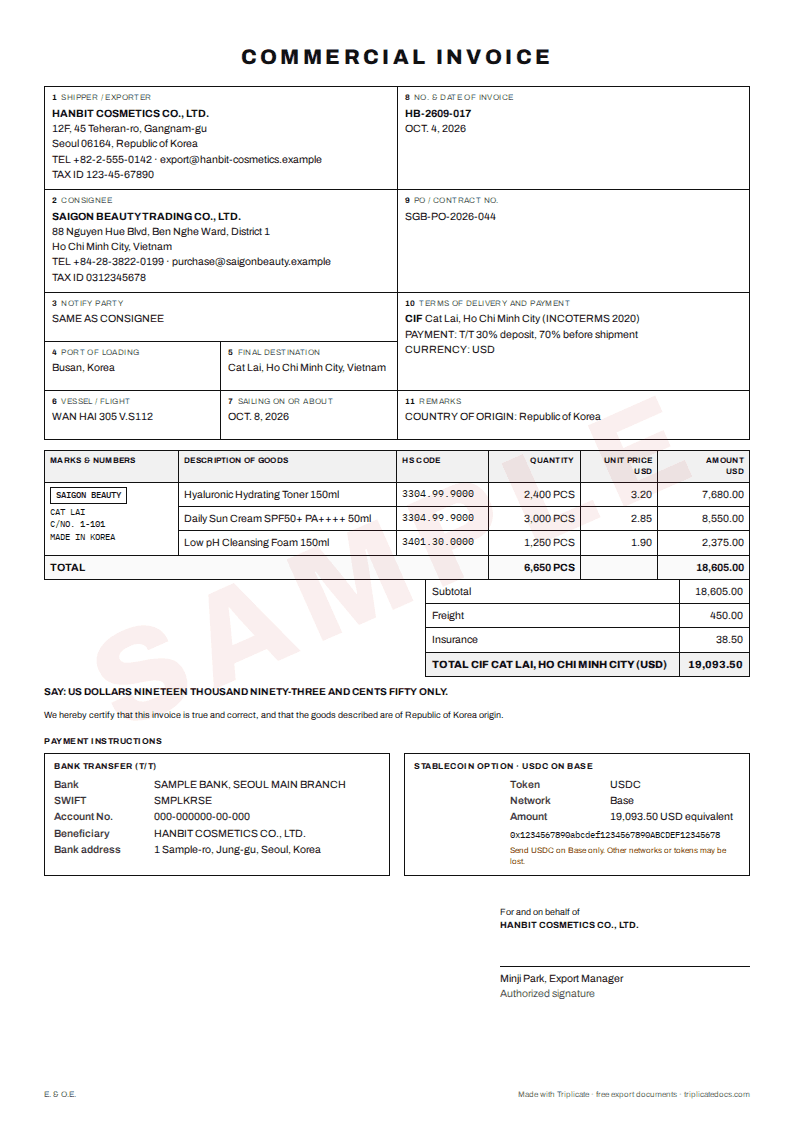
The fields every customs authority expects
Customs uses the commercial invoice to check what the goods are, what they are worth and where they come from, and the importer's broker usually copies its data into the import declaration. Countries word their rules differently, but an invoice with the fields below meets the common core almost everywhere. US rules let any required information go on an attachment to the invoice instead.
- Seller or exporter, and buyer, with full names and addresses. Add the consignee if the goods go elsewhere, the importer of record if different, and tax, EORI or importer numbers where the destination uses them.
- Invoice number and date, and references such as the order or contract number.
- A description of each line in plain trade language: what the item is, its material, use, grade and model, for example "women's knitted cotton T-shirts", not "garments". DHL warns that "samples" or "parts" alone is not an adequate description, and a model number alone tells customs nothing.
- HS code for each line: few countries require it on the invoice, but brokers copy it, so give a code you have checked against the destination tariff.
- Quantity and unit of measure, unit price, line total and invoice total, with the currency as an ISO code such as USD or EUR, not just "$".
- Delivery terms: the Incoterms 2020 rule and named place, such as "FOB Busan, Incoterms 2020".
- Country of origin for each line.
- Packages: number and kind, marks and numbers, net and gross weights, matching the packing list and the transport document.
- Payment terms and discounts, with freight, insurance, packing and commissions shown as separate amounts.
- The reason for export when there is no sale (sample, repair, return, gift), the name of a person who knows the transaction, and any signature or statement the destination requires.
Customs value: what to show separately and what to add
Under the WTO Customs Valuation Agreement, customs value is normally the transaction value: the price actually paid or payable for goods sold for export, adjusted under Article 8. Costs the buyer bears that the price leaves out are added: selling commissions, containers and packing, assists such as moulds, tools or engineering supplied by the buyer free or at a reduced cost, royalties and licence fees paid as a condition of sale, and any resale proceeds that go back to the seller.
Article 8.2 lets each country decide whether transport, loading and insurance to the place of importation are part of the value. The EU and UK include them up to the point where goods enter their territory, a CIF-type value (Union Customs Code, Article 71). The US leaves out international freight and insurance, which is why 19 CFR 141.86 asks for every charge itemized by name and amount. Japan, China and India also use CIF-type values, and Canada and Australia FOB-type values.
So show freight, insurance, packing and other charges as separate amounts, even on a CIF or DDP invoice. HMRC, for example, lets importers leave out costs after arrival only with evidence such as the amount shown separately on the seller's invoice. List every discount, and never issue a second, lower invoice for customs: customs can ask for the contract and payment records, and undervaluation leads to holds, extra duty and penalties.
United States: 19 CFR 141.81 to 141.92
A commercial invoice must be presented for each shipment when the entry summary is filed, and one invoice may not cover more than one shipment by one consignor to one consignee on one vessel or conveyance, except installment shipments arriving within 10 days (19 CFR 141.81, 141.82). The exemptions in 19 CFR 141.83, such as goods not for sale or consigned to a US government agency, set no value threshold, and since the USD 800 de minimis exemption was suspended on 29 August 2025, low-value courier parcels need an entry too.
The importer or broker adds the HTSUS subheading unless invoice data goes to CBP electronically (19 CFR 141.90), and 19 CFR 141.89 asks for extra details for about 45 classes of goods, such as footwear, textiles, machinery and iron or steel. If the commercial invoice is not ready at entry, a pro forma invoice can be filed under a bond, and the invoice must follow within 120 days (19 CFR 141.85, 141.91). US exporters of items on the Commerce Control List other than EAR99 must also put the destination control statement on the invoice (15 CFR 758.6).
Under 19 CFR 141.86 the invoice itself must show:
- The port of entry, and when, where, by whom and to whom the goods were sold; for goods not sold, where, when, by whom and to whom they were shipped.
- A detailed description: the name each item is known by, its grade or quality, the marks, numbers and symbols under which it is sold, and the marks and numbers of the packages.
- Quantities in the weights and measures of the shipping country or the US.
- The purchase price of each item in the currency of the purchase; for goods not sold, the value each item would fetch in usual wholesale quantities in the country of exportation.
- All charges itemized by name and amount: freight, insurance, commission, cases, containers, coverings and packing. Packing and inland freight to the port of export may stay in the price if the invoice says so.
- Rebates, drawbacks and bounties allowed on export, the country of origin, and assists (dies, molds, tools, engineering work) not included in the price.
- What each package contains, every discount from list price, page numbering on paper invoices, English or an accurate English translation, and the name of a responsible employee of the exporter who knows the transaction.
European Union and United Kingdom
EU law sets no invoice format. The invoice is a supporting document that must be in the declarant's possession and available to customs when the declaration is lodged, and handed over when EU law requires it or customs asks (Union Customs Code, Article 163). The broker takes the price, currency, delivery terms, origin and charges from it, so the core fields are what it needs, with EORI numbers where the parties have them. The new Union Customs Code, Regulation (EU) 2026/2108, entered into force in September 2026 and applies in stages, so watch for changes.
A lower duty rate usually depends on a statement on origin written on the invoice or another commercial document, in the exact wording the agreement sets. Under the EU GSP the exporter must be registered in REX unless the originating goods in the consignment are worth EUR 6,000 or less; under the EU–UK Trade and Cooperation Agreement, a statement for a consignment over EUR 6,000 carries the exporter's REX number (EU) or EORI number (UK).
In the UK, HMRC uses the seller's invoice, or whatever document asks for payment, as evidence of the transaction value, and adds delivery costs up to the place where goods enter the UK. Under the Developing Countries Trading Scheme, any exporter in a beneficiary country can make an origin declaration on an invoice or other commercial document that describes the goods well enough to identify them. A business not established in the UK imports into Great Britain only through someone acting for it indirectly.
Canada, Brazil and other markets
For commercial shipments, Canada requires either a Canada Customs Invoice (form CI1) or a commercial invoice with the same information, in English or French (CBSA Memorandum D1-4-1). The data include the vendor, consignee and purchaser, the country of origin, the place of direct shipment to Canada, the conditions of sale and terms of payment, the currency of settlement, packages, a description that states the condition of goods that are not new, quantity, unit price, weights, and the transport, insurance and export packing costs included in or left out of the total. The exporter, importer or an agent can add some of these. CBSA can ask for supporting documents, due within seven days, and import records are kept for six years.
Some countries set stricter rules. Brazil's customs regulation lists the invoice contents, including the countries of origin, acquisition and provenance, gross and net weights, freight, payment terms and the Incoterm. It accepts Portuguese, English, French or Spanish, and the original must be signed by the exporter, by hand or with a digital certificate (Regulamento Aduaneiro, Article 557 and related articles).
In Australia, Japan, China and India the importer or its broker files the declaration from your invoice data, so the core fields apply. Rules on certified or legalized invoices, local-language translations and HS codes on the invoice differ by country, especially in the Middle East and Latin America, so ask the importer or its broker before the first shipment.
Courier shipments, samples and goods sent free of charge
Express carriers clear goods using your invoice, so the same rules apply. UPS requires a commercial invoice, or pro forma invoice, for all cross-border shipments except documents with no commercial value. FedEx accepts a pro forma invoice for free goods such as samples, but notes that not all countries accept one and recommends a commercial invoice in every case.
"No commercial value" means no payment, not no value. FedEx says a customs value is required even without a transaction value and that zero is not acceptable, and US rules ask for the value each item would fetch in usual wholesale quantities. Add a statement such as "Samples of no commercial value, not for resale. Value for customs purposes only" (see Triplicate's note on shipping samples).
Low-value relief has narrowed: the US suspended its USD 800 de minimis exemption on 29 August 2025, and since 1 July 2026 EU distance sales in consignments up to EUR 150 pay a EUR 3 customs duty per item. Expect courier parcels to be checked against the invoice like any other import. Rules change often; this is practical guidance, not legal advice, so confirm with the destination customs authority or a licensed customs broker.
Step by step
- Agree the Incoterms rule and named place, the invoice currency and who will be importer of record before you issue the invoice.
- Collect full names and addresses, and tax, EORI or importer numbers, for the seller, buyer, consignee and importer.
- Describe each line in plain trade language (what it is, material, use, grade or model) and add an HS code checked against the destination tariff.
- Enter quantity and unit, unit price, line total and the currency as an ISO code, and list every discount.
- Show freight, insurance, packing and commissions as separate amounts, and record any assists or royalties not included in the price.
- Give the country of origin for each line and add any statement on origin a preference claim needs, in the agreement's exact wording.
- Add package count, marks and numbers and net and gross weights, then make the packing list from the same data; Triplicate's free generator makes both from one data set and checks for missing fields.
- Add the reason for export, payment terms, the name of a responsible person and any signature, translation or data the destination requires, such as Canada's CI1 data or Brazil's signed original.
- Check the invoice against the packing list and the bill of lading or air waybill, send it to the carrier and the importer's broker before arrival, and file it with the contract and payment records.
Documents you usually need
- Commercial invoice, in English for the US, English or French for Canada, or with a translation
- Packing list made from the same data
- Bill of lading, air waybill or courier waybill
- Sales contract or purchase order and proof of payment
- Freight and insurance invoices, when those costs are not on the commercial invoice
- Statement on origin or certificate of origin, when claiming a preferential rate
- Canada Customs Invoice (CI1), or its data on the commercial invoice, for Canada
- Licences, permits or certificates for regulated goods
Common problems and how to avoid them
What to do: Say what the item is, its material and use, plus grade or model, for example "stainless steel hex bolts, M10, for machinery", and add the HS code.
What to do: Invoice the price actually paid or payable. Customs can ask for the contract and payment records, and undervaluation brings holds, extra duty and penalties.
What to do: State the origin of each line; it decides the duty rate, marking and any preference claim.
What to do: Make all documents from one data set and check them before the carrier files its manifest.
What to do: Itemize freight, insurance and other charges so the US can leave them out and the EU or UK can count only the costs up to their border.
What to do: Put an ISO code such as USD, CAD or AUD on every amount; US rules ask for prices in the currency of the purchase.
Sources
- 19 CFR 141.86 – Contents of invoices and general requirements Electronic Code of Federal Regulations (eCFR)
- 19 CFR Part 141, Subpart F – Invoices (§§ 141.81 to 141.92) Electronic Code of Federal Regulations (eCFR)
- Agreement on Implementation of Article VII of the GATT 1994 (Customs Valuation Agreement) World Trade Organization (WTO)
- Regulation (EU) No 952/2013 laying down the Union Customs Code (Articles 70, 71 and 163) EUR-Lex, Publications Office of the EU
- Valuing imported goods using Method 1 (transaction value) GOV.UK (HM Revenue & Customs)
- Delivery costs to include in the customs value GOV.UK (HM Revenue & Customs)
- Using an origin declaration for the Developing Countries Trading Scheme GOV.UK (HM Revenue & Customs)
- Memorandum D1-4-1: CBSA Invoice Requirements Canada Border Services Agency (CBSA)
- Fatura comercial (commercial invoice) – import clearance documents Receita Federal do Brasil
- How to complete international shipping documentation FedEx
Rules change often. This note is practical guidance based on the sources above, not legal advice. Confirm current requirements with the authority, your importer or a licensed customs broker before you ship.
Trade notes
Common questions
Does a commercial invoice need an HS code?
Usually not by law. In the US the importer or broker notes the HTSUS subheading on the invoice (19 CFR 141.90), and the EU sets no invoice format. Brokers still copy codes from invoices, so give one you have checked against the destination tariff.
Does a commercial invoice have to be signed?
Not under US or EU rules, but the US requires the name of a responsible employee of the exporter. Some countries do require a signature: Brazil needs the original signed by the exporter, by hand or with a digital certificate. A letter of credit may also call for a signed invoice.
Can I use a pro forma invoice for customs clearance?
Only as a fallback. In the US a pro forma invoice can be filed under a bond when the commercial invoice is not available, and the invoice must follow within 120 days. Couriers accept pro forma invoices for free goods such as samples, but FedEx recommends a commercial invoice in every case.
Should the invoice show freight and insurance?
Yes, as separate amounts whenever the price includes them. The EU and UK add transport and insurance up to their border to the customs value, while the US leaves out international freight and insurance, so customs needs to see each amount.
More free tools
Triplicate is free and keeps getting better. Found it useful? Support Triplicate ♥
Prefer no ads? Pro removes all ads · $1/month