Packing List Meaning and Format: What an Export Packing List Must Include and Match
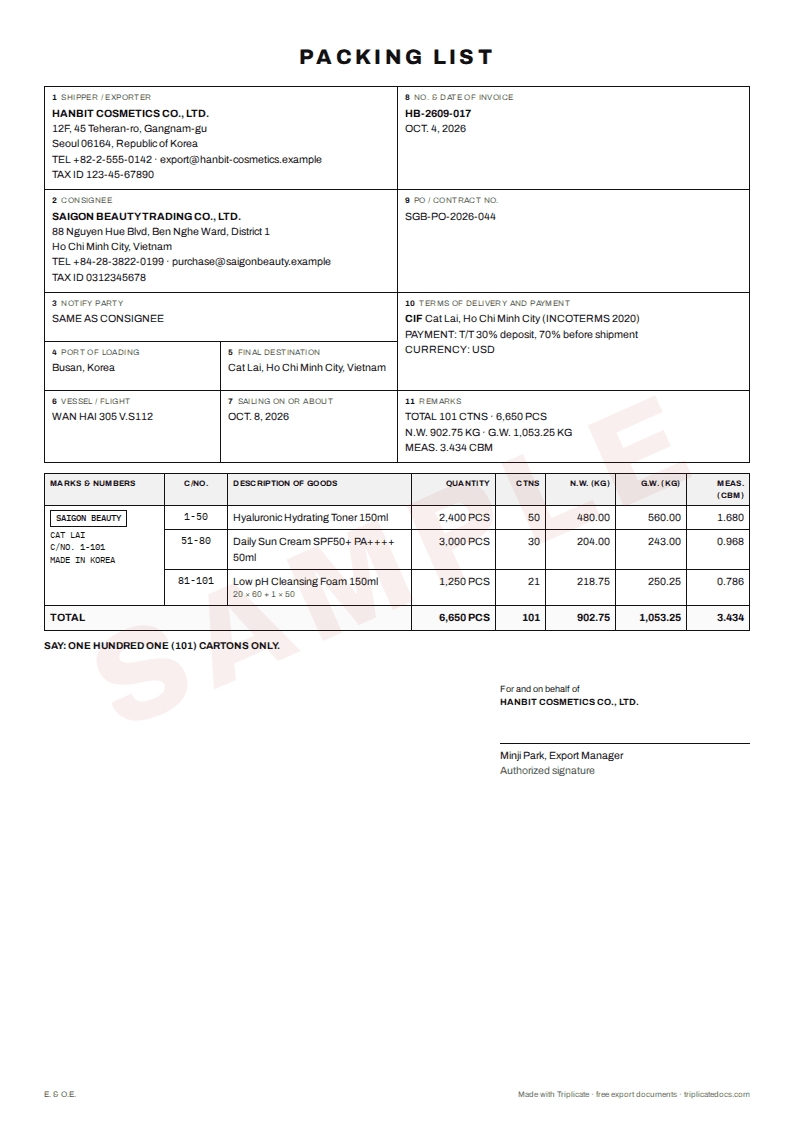
A packing list shows what is in each package of a shipment: carton numbers, contents, quantities, net and gross weights, dimensions and marks. Customs uses it to find and examine goods, the forwarder and carrier use it for the bill of lading and booking, and banks check it against the other documents when a letter of credit calls for it. Its totals of packages, weight and volume must agree with the commercial invoice and the bill of lading.
Checked against official sources: 2026-10
At a glance
Who uses the packing list, and for what
The commercial invoice states what was sold and for how much; the packing list states how the goods are packed. Each user reads it for something different, so one wrong figure can cause trouble in several places at once.
- Customs: to see what is in each package, pick packages to open and check quantities and weights. US rules require each invoice to state in adequate detail what is in each individual package, and allow that information on an attachment such as a packing list (19 CFR 141.86(e) and (i)).
- Forwarder and carrier: to book space, plan stowage and issue the bill of lading or air waybill from your shipping instructions, which take the package count, weights and volume from the packing list.
- Warehouse and consignee: to receive the goods, check each carton against the list, report shortages or damage and put the goods away.
- Banks: when a letter of credit calls for a packing list, the bank checks it against the credit and the other documents presented.
- Insurer: in a claim, to show what was in a lost or damaged package.
What to put on a packing list
There is no single international form. Customs, carriers and buyers look for the details below, and banks accept any document that does the job of a packing list unless the credit asks for more. Show:
- Header: shipper (exporter) and consignee with addresses, notify party if any, packing list number and date, and the number and date of the commercial invoice it belongs to.
- Shipment: place of loading and destination, vessel or flight if known, Incoterm, and the B/L or air waybill number once issued.
- Marks and numbers: the shipping marks exactly as printed on the packages.
- Each line: carton number range (for example C/No. 1-20), number and type of packages (cartons, pallets, crates, drums), description of goods matching the invoice, quantity per package and total quantity.
- Weights: net and gross weight per package and per line, normally in kilograms, and the totals.
- Measurements: outer dimensions of each package type (L × W × H) and volume in cubic metres (CBM), per line and in total.
- Totals: number of packages in figures and words, total net weight, total gross weight and total CBM.
- Full container loads (FCL): container number, size and type, and seal number.
- If asked for: HS codes, country of origin, batch or lot numbers, expiry dates, the wood packaging status (ISPM 15) and handling marks. Prices usually belong on the invoice only.
Weights, dimensions and mixed cartons
Net weight is the goods alone; gross weight is the goods plus all packing, such as inner boxes, cartons and pallets. Use one unit, normally kilograms, with the same number of decimals on every document. Round each package weight to the precision you print, multiply by the number of packages and add up the printed lines, so anyone checking with a calculator gets the same totals.
CBM per carton is length × width × height in metres; multiply by the number of cartons and add the lines. Measure the outer carton, bulges included, and for pallets the loaded pallet, base included. Triplicate's free CBM calculator does this arithmetic and shows how the cartons fit a container.
When one carton holds several products, give it one carton number and list each product on its own line under that number, with its quantity, but show the carton's gross weight and size only once so the totals do not count it twice. A part-filled last carton has its own line with the lower quantity and weight.
Matching the invoice, bill of lading and VGM
The packing list, commercial invoice, shipping instructions and bill of lading should show the same shipper, consignee, marks, goods description, number and kind of packages, gross weight and volume. The carrier copies these particulars from your instructions and does not check what is inside a sealed container, so the B/L usually carries clauses such as "shipper's load, stow and count" or "said to contain" (STC). UCP 600 Article 26(b) makes such clauses acceptable under a letter of credit.
For palletized cargo, show both units everywhere, for example "4 PALLETS STC 160 CARTONS". Under the Hague-Visby Rules, which many countries apply, packages listed on the B/L as packed in a container or on a pallet count as the packages for the carrier's liability limit; if only pallets are listed, each pallet counts as one package.
The verified gross mass (VGM) is a separate declaration required by SOLAS Chapter VI, Regulation 2 since 1 July 2016: a packed container may not be loaded without it. The shipper weighs the packed container (Method 1), or weighs all packages and cargo, including pallets, dunnage and securing material, and adds the container's tare mass (Method 2, using a method approved where the container is packed). The VGM is therefore higher than the packing list gross weight, but the two must be consistent. Dangerous goods also need their own dangerous goods declaration (under the IMDG Code by sea, the IATA Shipper's Declaration for Dangerous Goods by air); a packing list does not replace it.
Letters of credit: UCP 600 and ISBP 821
Banks examine a packing list only if the credit asks for one. Under UCP 600 Article 14(d), its data, read in context, need not be identical to, but must not conflict with, the credit, the document itself or any other stipulated document. Under Article 14(e), documents other than the commercial invoice may describe the goods in general terms that do not conflict with the credit, so the packing list may use a shorter description than the invoice.
If the credit does not say who issues the packing list or what it must contain, banks accept it as presented if it appears to fulfil its function and its data do not conflict (Article 14(f)); the shipper shown need not be the beneficiary (Article 14(k)). ISBP 821, the ICC's 2023 guide to international standard banking practice, applies this to packing lists: a document titled packing list, titled similarly or untitled is acceptable if it gives packing information, and totals such as quantities, weights, measurements and packages must not conflict with the credit or the other documents.
If the credit sets packing requirements, such as export cartons on pallets, or asks for a statement on the packing list, the packing list must not contradict them and must include that statement.
Is a packing list legally required?
It depends on the country, and where the law does not demand one, the importer's broker, the carrier or the buyer usually does.
- United States: "a packing list, where appropriate" is part of the entry documentation needed to release goods (19 CFR 142.3(a)(4)). The invoice must state what is in each package, which an attached packing list can do; if the weight or measure needed to assess duty is missing, the consignee pays for weighing or measuring before release (19 CFR 141.86(e), (f) and (i)).
- European Union: the supporting documents for the customs procedure, which in practice include the invoice and packing list, must be in the declarant's possession and available to customs when the declaration is lodged, and must be provided where EU law requires it or customs controls need them (Union Customs Code, Article 163).
- China: customs declaration rules list the contract, invoice and packing list (装箱清单) among the documents supporting an import or export declaration. With paperless declaration they are usually uploaded or produced when customs asks; check with the importer's broker.
- India: the Foreign Trade Policy 2023 lists a commercial invoice cum packing list among the mandatory documents for exports and imports, with the transport document and the shipping bill or bill of entry; a separate invoice and packing list are also accepted.
- Other markets: many customs authorities and brokers expect a packing list with the declaration, especially for shipments of several packages or mixed goods. Ask the importer before shipping.
Step by step
- Build the packing list from the same data as the commercial invoice: same invoice number, parties, marks and product names. Triplicate's free generator makes both from one entry and adds up cartons, net and gross weight and CBM.
- Weigh and measure one packed carton of each product, and the loaded pallet if you use pallets, in kilograms and centimetres.
- Number the cartons in one sequence for the whole shipment (1 to N), print the numbers on the cartons and give each packing list line its range, such as C/No. 1-20.
- Enter contents per carton, net and gross weight per carton and per line, dimensions and CBM; list mixed cartons product by product under one carton number.
- Check that total packages, net weight, gross weight and CBM equal the sum of the lines, and that gross weight is above net weight.
- Copy the totals, marks and description into the shipping instructions, so the B/L or air waybill shows the same package count, gross weight and volume; for pallets, state pallets and cartons.
- For FCL, add the container and seal numbers after loading, and give the carrier the VGM before its cut-off.
- Under a letter of credit, check what the credit says about the packing list, its issuer and any packing statement, and compare totals with the invoice and B/L draft before presenting.
- Send the packing list with the invoice to the importer or broker before the goods arrive, and keep a copy in the shipment file.
Documents you usually need
- Packing list
- Commercial invoice
- Shipping instructions to the forwarder or carrier
- Bill of lading, air waybill or courier waybill
- Verified gross mass (VGM) declaration, for sea containers
- Dangerous goods declaration, if the goods are dangerous
- Letter of credit and any packing requirements in it, if paid by credit
- Weight or measurement certificate, only if the buyer or credit asks for one
Common problems and how to avoid them
What to do: Send shipping instructions copied from the final packing list, check the B/L draft line by line and have the carrier correct it before issue.
What to do: Round each package weight first, multiply and add the printed figures, and use the same decimals on every document.
What to do: Number every carton 1 to N, print the number on the carton and give each packing list line its carton range.
What to do: Use the invoice's product names, or a general description that does not conflict with it; under a credit, only the invoice must match the credit's description.
What to do: Show both units, for example 4 PALLETS STC 160 CARTONS, on the packing list, shipping instructions and B/L.
What to do: Submit the VGM before the carrier's cut-off and check that cargo gross weight plus dunnage and container tare matches it.
Sources
- 19 CFR 141.86 – Contents of invoices and general requirements (paragraphs (e) packing list, (f) weights and measures, (i) attachments) Electronic Code of Federal Regulations (eCFR)
- 19 CFR 142.3 – Entry documentation required Electronic Code of Federal Regulations (eCFR)
- Regulation (EU) No 952/2013 laying down the Union Customs Code (Article 163, supporting documents) EUR-Lex, Publications Office of the EU
- Foreign Trade Policy 2023, Chapter 2 (mandatory documents for export and import) Directorate General of Foreign Trade (DGFT), Government of India
- Moving dangerous goods (IMDG Code, IATA Shipper's Declaration for Dangerous Goods) GOV.UK (Department for Transport)
- ICC Uniform Customs and Practice for Documentary Credits (UCP 600) International Chamber of Commerce (ICC)
- International Standard Banking Practice (ISBP) ICC Academy
Rules change often. This note is practical guidance based on the sources above, not legal advice. Confirm current requirements with the authority, your importer or a licensed customs broker before you ship.
Trade notes
Common questions
Is a packing list the same as a commercial invoice?
No. The invoice states the goods, prices and terms of sale and is used to value the goods; the packing list shows how they are packed, with weights and sizes, and usually has no prices. Some countries, such as India, accept a combined invoice cum packing list.
Does customs require a packing list?
Often. US rules list a packing list, where appropriate, among entry documents; India lists an invoice cum packing list as mandatory; in the EU and China it is a supporting document customs can ask for. Brokers and carriers usually want one anyway.
Should the packing list show net or gross weight?
Both, per package and in total. Net is the goods alone; gross adds inner packing, cartons and pallets. The B/L normally shows the gross weight, which must match the packing list total.
Must the packing list gross weight equal the VGM?
No. The VGM also includes the container's tare mass and any dunnage and securing material. After deducting those, it should be consistent with the packing list gross weight, which should include pallets.
More free tools
Triplicate is free and keeps getting better. Found it useful? Support Triplicate ♥
Prefer no ads? Pro removes all ads · $1/month