Free certificate of origin template
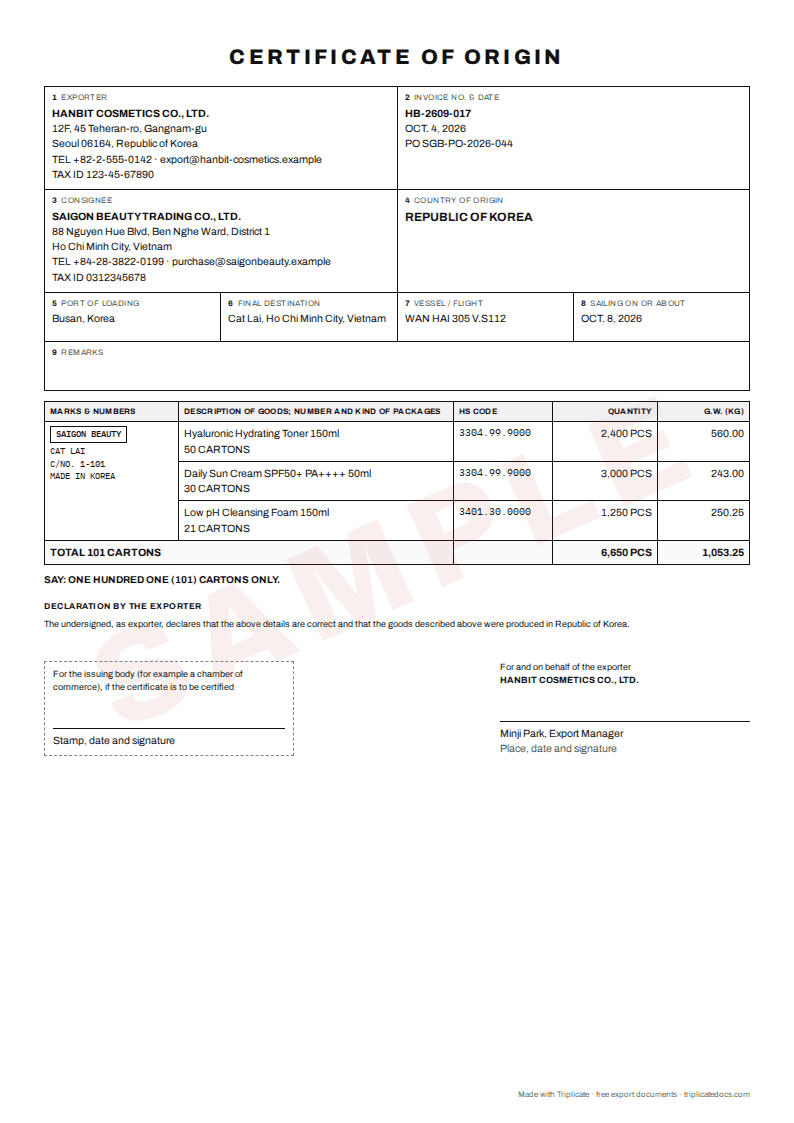
A certificate of origin states the country where the goods were produced. This general (non-preferential) template lists the shipment the way the chamber of commerce or your buyer will check it, with the exporter's declaration and an empty space for the issuing body's stamp.
What the template covers
- Exporter and consignee
- Invoice number and date
- Country of origin
- Port of loading, final destination, vessel or flight and sailing date
- Marks and numbers
- Description of goods, number and kind of packages, HS code, quantity and gross weight
- Declaration by the exporter, with place, date and signature
- Space for the issuing body's stamp, date and signature
Download .xlsxInvoice & packing list generator →All free templates →
Guides on this topic
Preferential or non-preferential?
This template is for a non-preferential certificate, which states the origin without claiming a tariff preference; it is often required by the importing country's customs, a letter of credit or the buyer's contract. To claim lower duty under a free trade agreement or a preference scheme, use that agreement's own form or origin statement, such as Form A under GSP or EUR.1 for EU agreements.
How to fill it in
Copy the details from your commercial invoice and packing list: the goods description and HS code should match the invoice exactly, and the number of packages and gross weight the packing list. State the country where the goods were produced, not the country they were shipped from. If items come from different countries, show the origin against each item.
Getting it certified
A non-preferential certificate is usually issued by a chamber of commerce on the basis of the exporter's supporting documents, such as the commercial invoice and proof of origin. Some chambers certify a general form like this one; others issue their own form or an online certificate, and then you can copy these details into it. Ask the issuing body before shipping, because some will not issue a certificate after the goods have left.
Common questions
Can I issue a certificate of origin myself?
For a non-preferential certificate, the exporter fills in and signs the declaration, and a chamber of commerce usually certifies it when the buyer, the bank or the importing country asks for a certified one. Some trade agreements, such as USMCA, CPTPP and RCEP in some member states, let the exporter or producer make an origin declaration instead of a stamped certificate.
Does the certificate of origin have to match the invoice?
Yes. The goods description, HS code, quantities and marks should match the commercial invoice and packing list exactly. A mismatch is a common mistake and can lead to questions from customs or problems under a letter of credit.
Can I fill in the certificate of origin from my invoice data?
Yes. In the free generator, fill in the form once and open the Certificate of origin tab: the exporter, consignee, transport details, marks, goods, HS codes, cartons and weights come from the same data, with the exporter's declaration and space for the issuing body. Save it as PDF, or copy the details into the chamber's own form.
More free tools
Triplicate is free and keeps getting better. Found it useful? Support Triplicate ♥
Prefer no ads? Pro removes all ads · $1/month