Free manufacturer's declaration of origin template (non-preferential)
Many chambers of commerce ask for a declaration from the manufacturer before they issue a non-preferential certificate of origin, especially when the exporter is a trader that did not make the goods. This template states what was made, where and on what basis, for one invoice or a set period, signed by the manufacturer. It is not a proof of preferential origin.
Download .xlsxAll free templates →
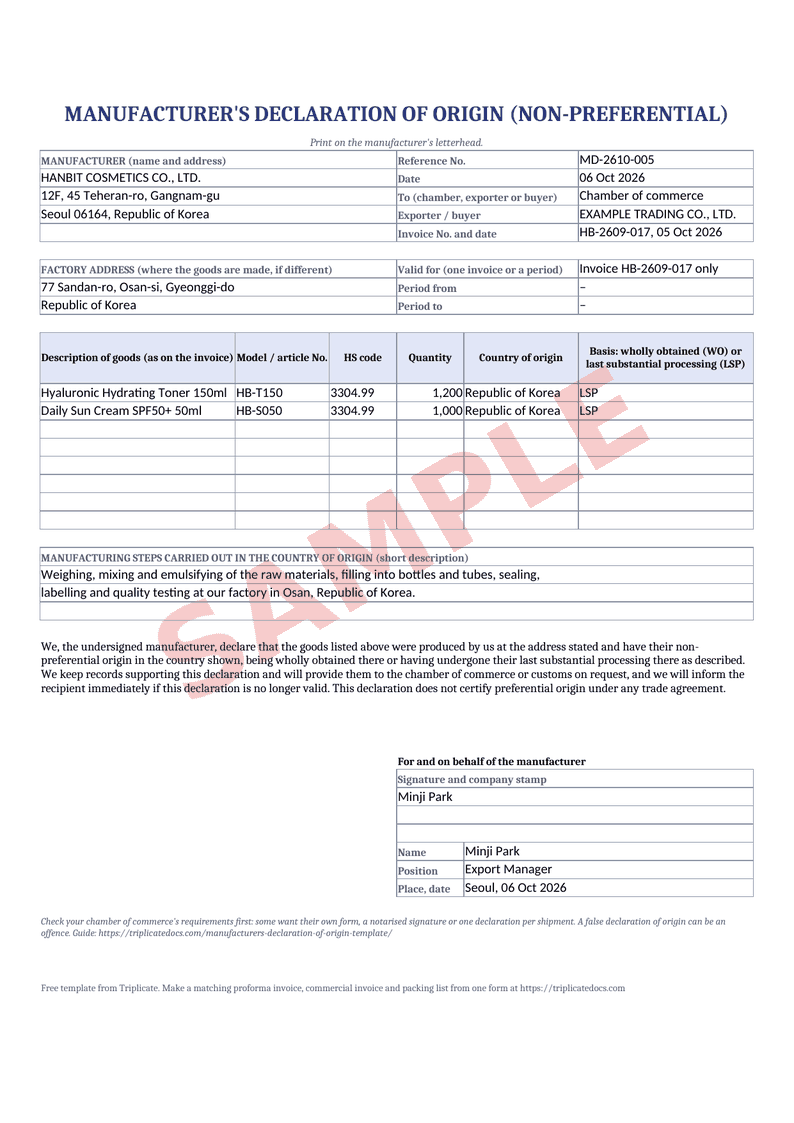
What the template covers
- Manufacturer's name and address on its letterhead, and the factory address
- Addressee: the chamber of commerce, the exporter or the buyer
- Exporter or buyer, and the invoice number and date or a validity period
- Goods: description as on the invoice, model or article number, HS code and quantity
- Country of origin and its basis: wholly obtained there, or last substantial processing there
- A short description of the manufacturing steps carried out in that country
- Undertakings: the statement is true, supporting records are kept and the recipient is told if it stops being valid
- Place, date, name, position, signature and company stamp
Sources
- European Commission, Non-preferential rules of origin
- Regulation (EU) No 952/2013, Union Customs Code, articles 59 to 61 (EUR-Lex)
- WCO, Revised Kyoto Convention, Specific Annex K: Origin
- US Court of International Trade, Substantial transformation
- London Chamber of Commerce and Industry, UK certificates of origin
- Canadian Chamber of Commerce, Documents certified by the Canadian Chamber
- DIHK / IHK, (Long-term) supplier's declaration (CCI) for non-preferential origin, form (December 2021)
- Singapore Chinese Chamber of Commerce & Industry, Letter of declaration by a manufacturer (Annex IV-1)
- KVK, Supplier's declaration of origin (LVO)
Guides on this topic
When a chamber asks for it
Chambers of commerce issue non-preferential certificates of origin on the evidence the exporter gives them, and each chamber decides what it accepts. Many accept or ask for a signed declaration from the manufacturer on its letterhead, for example the London Chamber of Commerce, Canadian chambers and the Singapore Chinese Chamber of Commerce; German chambers (IHK) and the Dutch KVK have their own supplier's declaration forms. Check your chamber's requirements first: some want their own form, a notarised signature or one declaration per shipment.
What decides the country of origin
Goods wholly obtained in one country, such as crops grown or minerals extracted there, originate in that country. Goods made from materials of more than one country originate where they underwent their last substantial transformation. In the EU this is the last substantial, economically justified processing in an undertaking equipped for it, resulting in a new product or an important stage of manufacture (Union Customs Code, article 60); in the US the processing must create a new article with a different name, character or use. Simple operations such as packing, labelling or simple assembly are generally not enough.
Non-preferential, not preferential
A non-preferential declaration supports a certificate of origin asked for by a buyer, a bank or the importing country, for example for marking, statistics or trade measures. It does not give the goods a lower duty rate under a free trade agreement: that needs the agreement's own proof, such as an EUR.1, a statement on origin or a USMCA certification, under that agreement's rules, so do not use this template for those. A false declaration of origin can be an offence: sign only what the manufacturer can support with records.
Common questions
What is a manufacturer's declaration of origin?
A signed statement by the company that made the goods, saying in which country they were produced and on what basis. Exporters, especially traders, give it to a chamber of commerce as supporting evidence when they apply for a non-preferential certificate of origin.
Can one declaration cover several shipments?
Some chambers accept a long-term declaration: the German chambers (IHK) for up to 24 months, or 12 months if the chamber certifies it, and Canadian chambers for two years on their own template. Others ask for one declaration per invoice or shipment. The template has room for either: fill in the invoice or the period.
Who should sign it?
An authorised person at the manufacturer, such as a director or export manager, on the company's letterhead, with name, position, date and the company stamp if one is used. Many chambers want the declaration from the actual manufacturer, or at least the manufacturer's name and address if a supplier writes it.
Is it the same as the EU supplier's declaration?
No. The supplier's declarations in Implementing Regulation (EU) 2015/2447 belong to preferential origin: a supplier uses them to tell an EU exporter how the goods stand under a trade agreement's rules. The German IHK and Dutch KVK forms for non-preferential origin are separate documents. This template is for non-preferential origin only.
What records should the manufacturer keep?
Records that support the declared origin, such as bills of materials, purchase invoices for the materials and production records showing where each manufacturing step took place. A chamber or customs may ask for them: under the EU Union Customs Code (article 61), customs can ask for further evidence of origin when there is reasonable doubt.
More free tools
Triplicate is free and keeps getting better. Found it useful? Support Triplicate ♥
Prefer no ads? Pro removes all ads · $1/month