Free beneficiary's certificate template (letter of credit)
A beneficiary's certificate is a signed statement by the exporter that something the letter of credit requires has been done, most often that copy documents were sent to the buyer within a set number of days after shipment. Download the Excel template, replace the example wording with what your credit asks for, sign it and present it with the other documents.
Download .xlsxAll free templates →
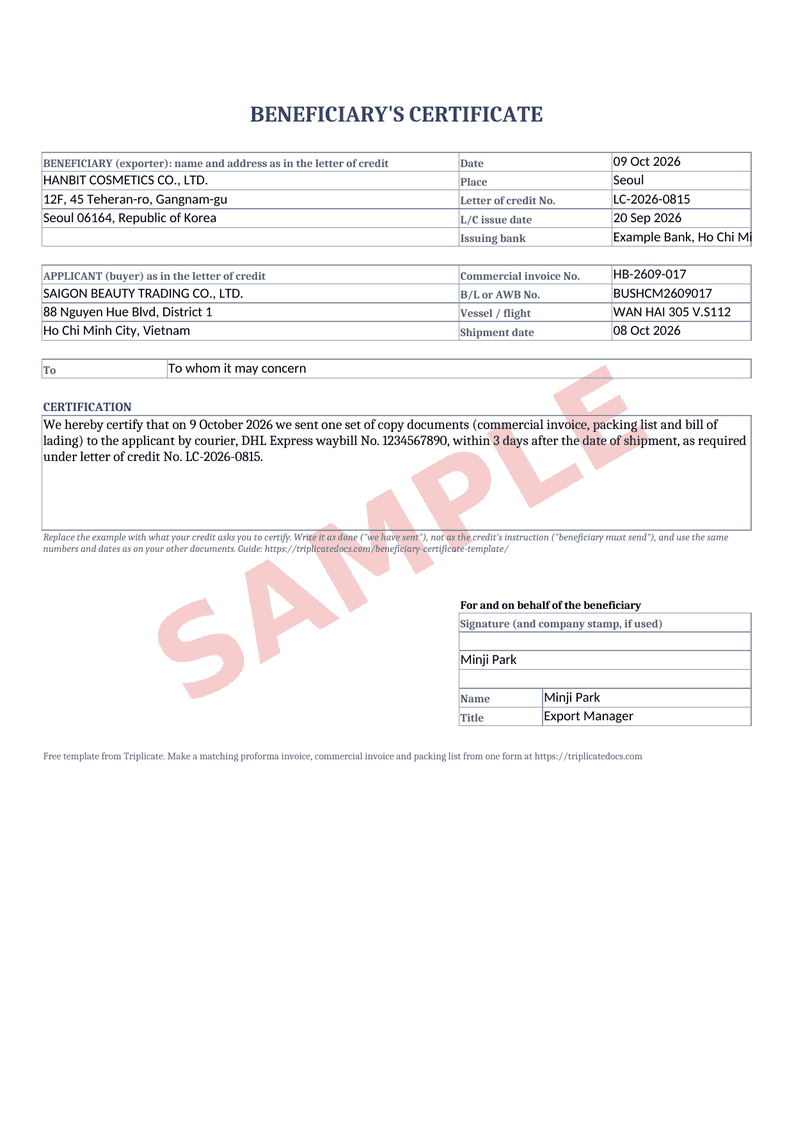
What the template covers
- Beneficiary (exporter) name and address, as in the credit
- Date and place
- Letter of credit number, issue date and issuing bank
- Applicant (buyer)
- Commercial invoice number, bill of lading or air waybill number, vessel or flight and shipment date
- Addressee, for example "To whom it may concern"
- The certification, with an example: copy documents sent to the applicant by courier, with the date and waybill number
- Name, title and signature of an authorised person, and the company stamp if you use one
Sources
- ICC Banking Commission, Technical Advisory Briefing No. 8: Handling of Certificates under Documentary Credits subject to the UCP 600 (2023)
- ICC Academy, ISBP insights: avoiding common LC discrepancies
- UCP 600 articles 3, 14(d) and 14(f) as quoted in Deutsche Bank AG v CIMB Bank Berhad [2017] EWHC 3380 (Comm)
- ICC DC Insight: dating of documents under UCP 600 article 14(i)
- ICC, Notes on the Principle of Strict Compliance (opinion R408)
- US Bureau of Industry and Security, Examples of boycott requests
- 15 CFR Part 760, Restrictive trade practices or boycotts (eCFR)
Guides on this topic
Certify what you did, not what the credit says
The ICC Banking Commission's guidance on certificates (Technical Advisory Briefing No. 8, 2023) points to a frequent problem: the beneficiary repeats the credit's instruction, such as "Beneficiary must send one set of copy documents to the applicant, by courier, within 3 days after the date of shipment", instead of certifying that it was done. Write it as a fact, with the details: "We certify that on 14 October 2026 we sent one set of copy documents (commercial invoice, packing list and bill of lading) to the applicant by courier, waybill no. ...". The wording does not have to copy the credit word for word, but it must clearly show that the requirement was met.
Signed, consistent and from the right party
A certificate must be signed even when the credit does not say so (ISBP 821, paragraph A3), and UCP 600 article 3 accepts a handwritten or facsimile signature, a stamp, a symbol or an electronic method. A title is not required, but "Beneficiary's certificate" or the title used in the credit makes its purpose clear. Its data need not be identical to the credit and the other documents but must not conflict with them (UCP 600 article 14(d)), so use the same credit number, invoice number, transport document number, vessel and dates.
Dates and supporting documents
Whether a certificate needs a date depends on what it certifies (ISBP 821, paragraph A4), so dating it is the safe choice. Under UCP 600 article 14(i) a document may be dated before the credit was issued but not later than the day it is presented. It is safest to date the certificate on or after the day of the action it describes. If the credit asks for the certificate to be supported by a courier receipt or a copy of an email or fax, present that as well, with matching dates.
Common questions
What is a beneficiary's certificate in a letter of credit?
A document signed by the beneficiary, usually the exporter, stating that it has done something the credit requires. Banks examine it like the other documents: it must be signed, it must appear to do the job the credit asks for, and its data must not conflict with the credit or the other documents.
What do letters of credit usually ask the beneficiary to certify?
Most often that one set of copy or non-negotiable documents was sent to the applicant by courier, fax or email within a number of days after shipment. Other examples in ICC opinions and bank guides: that a shipment advice was sent to the applicant, that an extra set of documents travelled with an air shipment, that the original CMR went with the goods, or that the beneficiary has performed its obligations. Certify exactly what your credit asks for, with the details.
Does the certificate need the L/C number and a goods description?
Add them when the credit asks for them. Showing the credit number and invoice number is common practice and helps the bank match the documents, but every detail you add must agree with the other documents.
Why do banks refuse beneficiary's certificates?
Common reasons are a missing signature, a certificate issued by someone other than the party the credit names, wording that repeats the instruction instead of confirming that it was carried out, and data that conflict with the invoice, the transport document or the credit. A typing error in information the credit did not ask for, such as a misspelt vessel name, was not treated as a discrepancy in an ICC opinion (R408).
What if the credit asks me to certify that goods are not of a certain origin or that the vessel is not blacklisted?
US persons, which can include foreign subsidiaries controlled by US companies, may not give negative certificates of origin or certify that a carrier is not blacklisted, and must report such requests to the US Bureau of Industry and Security (15 CFR Part 760). Origin may be stated only in positive terms, for example "goods of Korean origin". Ask the buyer and the bank to amend the credit before you sign, and get advice if you are unsure.
More free tools
Triplicate is free and keeps getting better. Found it useful? Support Triplicate ♥
Prefer no ads? Pro removes all ads · $1/month