Free shipper's letter of instruction (SLI) template
A shipper's letter of instruction is the document a US exporter (the USPPI) gives its freight forwarder: the shipping instructions, the data for the Electronic Export Information (EEI) filed in AES, and the authorization to file it. Forwarders use their own SLI forms and the NCBFAA publishes a model for companies to adapt; this template follows the fields they share.
Download .xlsxAll free templates →
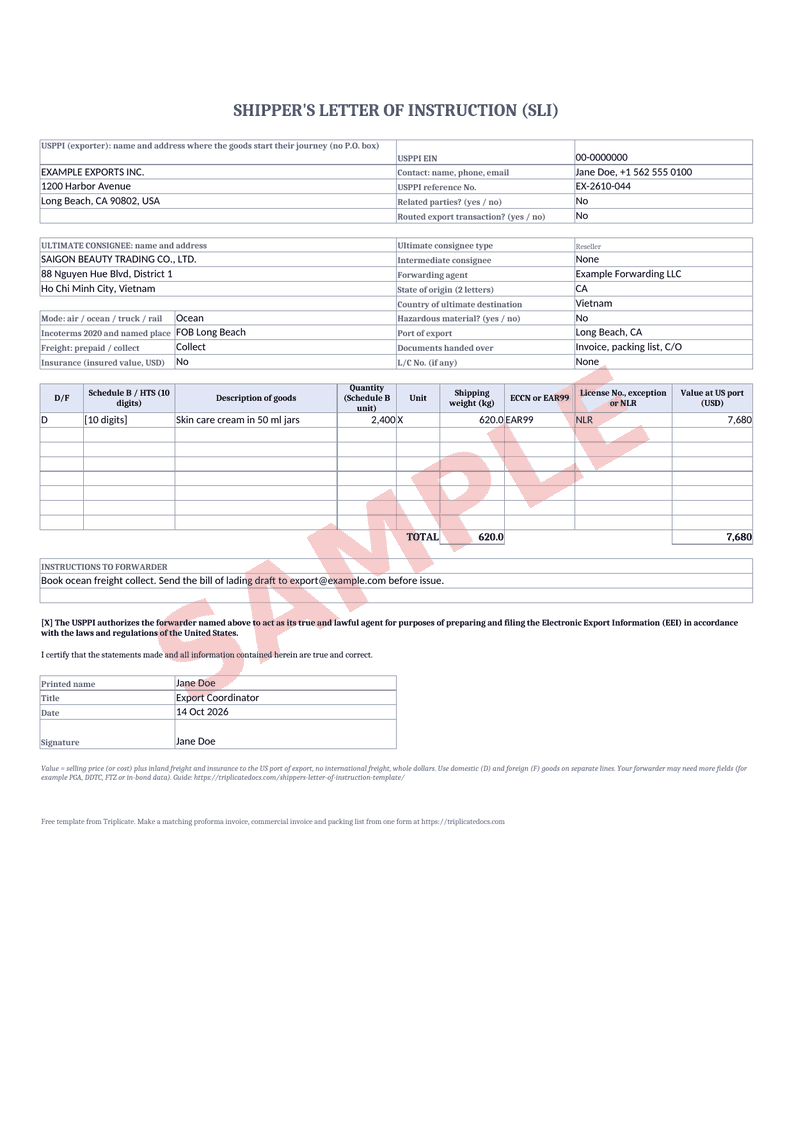
What the template covers
- USPPI (exporter) name, address where the goods start their journey (no P.O. box), EIN, contact and reference number
- Ultimate consignee and its type, intermediate consignee, and whether the parties are related
- Routed export transaction (yes or no), forwarding agent, state of origin and country of ultimate destination
- Incoterms 2020 and named place, prepaid or collect, insurance and mode of transport
- Hazardous material (yes or no) and the documents handed over: commercial invoice, packing list, certificate of origin
- Each line: domestic or foreign, 10-digit Schedule B or HTS number, description, quantity in Schedule B units, shipping weight in kg, value at the US port of export in US dollars
- ECCN or EAR99, and the license number, license exception or NLR
- Authorization to file the EEI as your true and lawful agent, certification, name, title, date and signature
Sources
- 15 CFR 30.3: Electronic Export Information filer requirements, parties to export transactions and responsibilities (Cornell LII)
- 15 CFR 30.6: Electronic Export Information data elements (eCFR)
- 15 CFR 30.37: Miscellaneous exemptions (Cornell LII)
- US Census Bureau, Quick Guide to Title 15, Part 30, Foreign Trade Regulations
- US International Trade Administration, Special documents (shipper's letter of instruction)
- NCBFAA, Shipper's Letter of Instruction model
- Shapiro, How to Complete the SLI Form (2026)
Guides on this topic
What the SLI does
It carries three things to your forwarder: how to move and document the shipment, the EEI data elements listed in 15 CFR 30.6, and the authorization to file. When an agent files EEI for you, you must give it a power of attorney or written authorization and accurate, timely information, and keep the records behind that information (15 CFR 30.3(c)(1)(ii)). The authorization should say that the agent acts as your true and lawful agent for creating and filing EEI (30.3(f)). The Census Bureau points out that a power of attorney only for moving cargo is not an authorization to file EEI.
Value, Schedule B and the USD 2,500 rule
Report the value at the US port of export in US dollars: the selling price (or the cost if the goods are not sold) plus inland freight, insurance and other charges to the port, without international freight, rounded to the nearest dollar (30.6(a)(17)). Give the full 10-digit Schedule B or HTS number and describe the goods in enough detail to verify it, rather than copying the Schedule B text. EEI is required when a Schedule B number in the shipment is over USD 2,500, and for licensed shipments regardless of value (30.1, 30.37(a), 30.2(a)(1)(iv)). Put domestic and foreign goods on separate lines.
Mistakes forwarders flag
The USPPI is the US seller or manufacturer, not the forwarder or one company "in care of" another, and using another company's EIN is prohibited (30.6(a)(1)). The reference number on the SLI is not the shipment reference number that the filer assigns. Mark the shipment as a routed export transaction only when the foreign buyer's agent controls the export; the buyer then authorizes that agent and you still supply the data (30.3(e)). Fill in the ECCN or EAR99 yourself, because the licensing decision is yours, and remember that EAR99 does not always mean NLR.
Common questions
What is a shipper's letter of instruction (SLI)?
A document a US exporter issues to its freight forwarder with instructions for an air or ocean shipment (US International Trade Administration). It also gives the forwarder the data needed to file the Electronic Export Information in AES and, when the authorization is signed, the written authorization to file it.
Is an SLI the same as a shipping instruction?
No. A shipping instruction (SI) tells the carrier or forwarder how to issue the bill of lading. An SLI is used for US exports and adds the EEI data and the authorization to file in AES. Triplicate has a separate shipping instruction template.
Who signs the SLI?
An officer or employee authorized to act for the USPPI, with printed name, title and date. Some forwarders accept the full name typed as an electronic signature, or the email that sends the SLI.
Do I need an SLI for a shipment under USD 2,500?
EEI is not required when each Schedule B number in the shipment is USD 2,500 or less, unless a license or another case in 15 CFR 30.2(a)(1)(iv) applies. Your forwarder may still ask for an SLI for the shipping instructions, and many SLI forms have a box for non-licensable items of USD 2,500 or less.
What is a routed export transaction?
A transaction in which the foreign buyer (the FPPI) authorizes a US agent to facilitate the export and file the EEI (15 CFR 30.3(e)). The US seller does not have to give that agent a power of attorney, but it must provide the export data listed in Appendix C to Part 30 and keep the supporting records.
More free tools
Triplicate is free and keeps getting better. Found it useful? Support Triplicate ♥
Prefer no ads? Pro removes all ads · $1/month