Free USMCA certification of origin template (CUSMA / T-MEC)
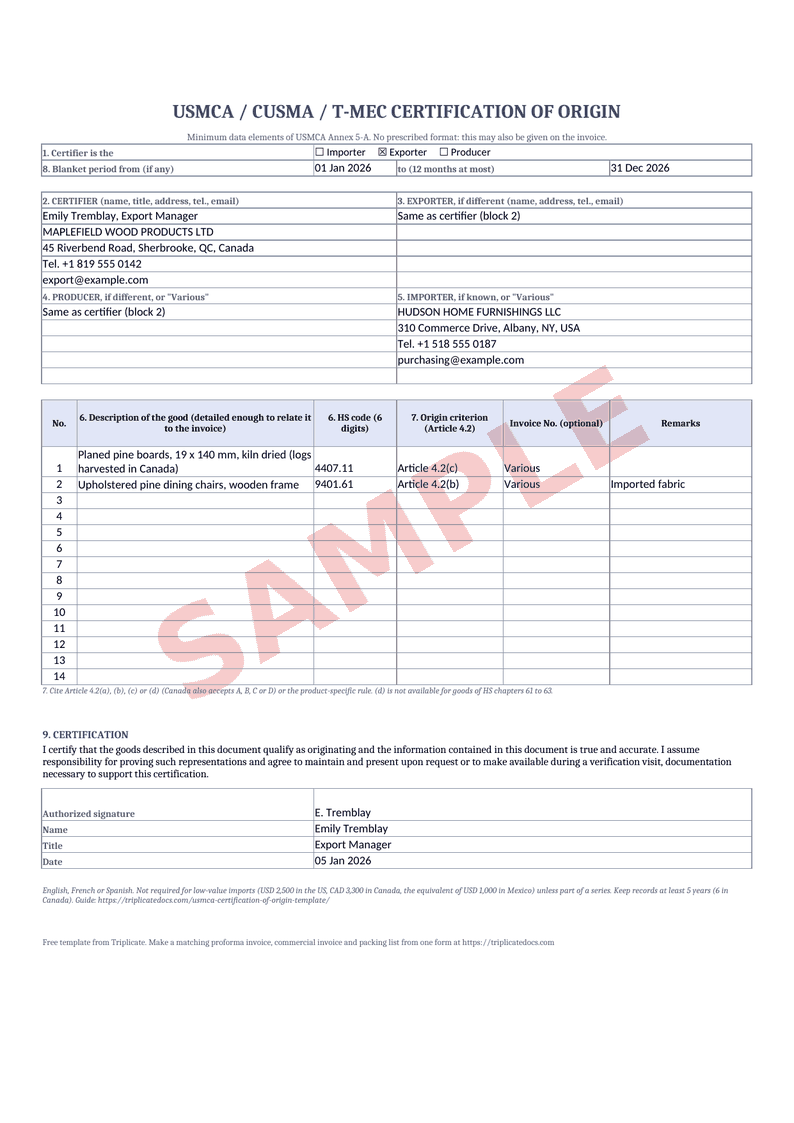
Under the USMCA, called CUSMA in Canada and T-MEC in Mexico, preferential tariff treatment is claimed with a certification of origin completed by the importer, the exporter or the producer. There is no official form: any document with the nine minimum data elements is accepted, on the invoice or separately, on paper or electronically. This sheet lays them out with the certifying statement.
Download .xlsxAll free templates →
What the template covers
- Who certifies: the importer, the exporter or the producer
- Certifier's name, title, address with country, telephone and email
- Exporter and producer, if different from the certifier, or Various where several
- Importer, if known, with an address in a USMCA country
- Description of each good, detailed enough to match the invoice, and its HS code to 6 digits
- Origin criterion under Article 4.2 (a) to (d) for each good
- Blanket period of up to 12 months when several shipments of identical goods are covered
- Certifying statement, authorized signature and date
Sources
- USTR, USMCA Chapter 5 (Origin Procedures): Article 5.2, Article 5.5, Article 5.8 and Annex 5-A
- USTR, USMCA Chapter 4 (Rules of Origin): Article 4.2
- eCFR, 19 CFR Part 182 (USMCA): 182.12 certification of origin, 182.14 when not required, 182.15 records
- U.S. Customs and Border Protection, USMCA frequently asked questions
- Canada Border Services Agency, CUSMA: certification of origin
- Canada Border Services Agency, Memorandum D11-4-14
- Mexico, Reglas de Carácter General relativas a la aplicación del T-MEC (DOF, 30 June 2020)
- U.S. International Trade Administration, Mexico certification of origin update (2024)
Guides on this topic
The nine data elements
Annex 5-A of the agreement lists the minimum data: whether the certifier is the importer, exporter or producer; the certifier's details; the exporter, producer and importer where they differ or are known; a description and 6-digit HS classification of each good; the origin criterion; the blanket period, if any; and the authorized signature, date and certifying statement. It can be on the invoice or any other document, in English, French or Spanish, and the importing country may ask for a translation if it is not in one of its languages.
Choosing the origin criterion
Article 4.2 gives four ways a good can be originating: (a) wholly obtained or produced in the USMCA countries; (b) produced there using non-originating materials that meet the product-specific rule in Annex 4-B; (c) produced there exclusively from originating materials; or (d) for certain goods whose parts cannot change classification, a regional value content of at least 60% (transaction value method) or 50% (net cost method), not available for HS chapters 61 to 63. Canada's CBSA prefers a reference to the article, such as Article 4.2(b), and also accepts the letters A to D.
Value thresholds, validity and records
A certification is not required for low-value imports: up to USD 2,500 of originating goods in the United States, CAD 3,300 in Canada and the equivalent of USD 1,000 in Mexico, unless the shipment is one of a series arranged to avoid the rules. A certification is accepted for four years, a blanket period cannot exceed 12 months, and records must be kept for at least five years (six in Canada). The certifier must be able to prove that the goods are originating.
Common questions
Is there an official USMCA certificate of origin form?
No. The certification need not follow a prescribed format; any document with the nine minimum data elements is accepted, including the commercial invoice. The old NAFTA certificate (CBP Form 434) is not required.
Who can complete the USMCA certification of origin?
The importer, the exporter or the producer of the good. Mexico has accepted certifications by the importer since 1 January 2024.
Can one certification cover several shipments?
Yes. A blanket certification can cover multiple shipments of identical goods within a period of up to 12 months stated on the certification.
Do I need a certification for a small shipment?
Usually not: the United States waives it for commercial imports of originating goods up to USD 2,500, Canada up to CAD 3,300 and Mexico up to the equivalent of USD 1,000, unless the shipment is part of a series meant to avoid the rules.
What language should the certification be in?
English, French or Spanish. If it is not in a language of the importing country, customs may ask the importer for a translation, for example into Spanish for Mexico.
More free tools
Triplicate is free and keeps getting better. Found it useful? Support Triplicate ♥
Prefer no ads? Pro removes all ads · $1/month