Free repair and return invoice template (goods sent for repair)
When you ship goods abroad for repair, or send faulty goods back to the supplier, customs still needs an invoice that describes them, gives a value and says why they are moving. This template is for those shipments, not for sales. Whether you pay duty when the goods come back depends on the customs procedure you use, not on the invoice alone.
Download .xlsxAll free templates →
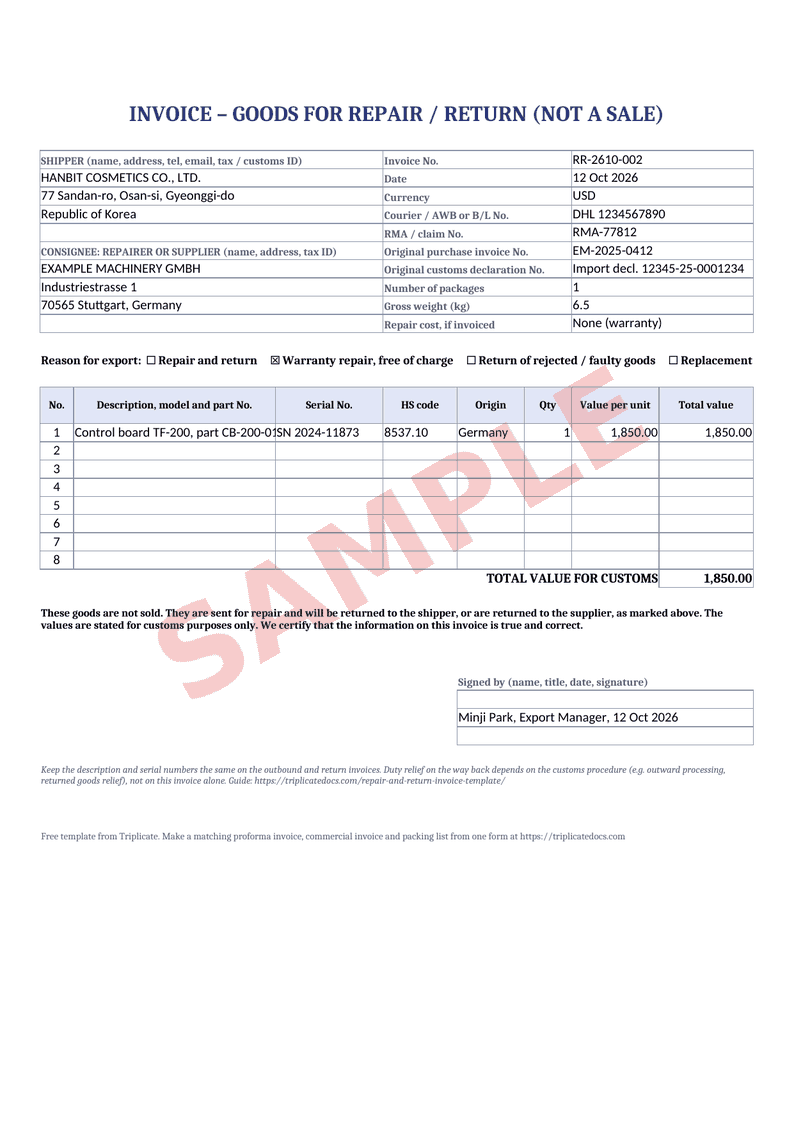
What the template covers
- Shipper and consignee (the repairer or supplier) with addresses and tax or customs IDs
- Reason for export: repair and return, warranty repair free of charge, return of rejected goods, or replacement
- Each item with model, part and serial numbers, HS code if known and country of origin
- Value for customs and currency, and the repair cost when the repairer invoices it
- References: the original purchase invoice, the original import or export declaration and the RMA or claim number
- Number of packages, weight and the transport document number
- A statement that the goods are not sold and will be returned, or are returned to the supplier
- Name, title, date and signature of the person certifying the invoice
Sources
- GOV.UK, Using outward processing to process or repair your goods
- HMRC, Notice 236: Returned goods relief
- Union Customs Code, Regulation (EU) No 952/2013, article 203: returned goods (legislation.gov.uk copy)
- European Commission, Special procedures other than transit (quick info)
- 19 CFR 10.8: articles exported for repairs or alterations (eCFR)
- 19 CFR 10.1: American goods returned (Cornell LII)
- GOV.UK, Find out which goods an ATA Carnet will cover
Guides on this topic
Repairs abroad: the procedure matters, not just the invoice
Bringing goods back after a repair abroad without paying duty on their full value usually needs a customs procedure. In the UK, outward processing needs an authorisation whose number goes on the export and the import declaration, and duty is then charged on the repair costs; goods repaired free of charge under a guarantee pay no duty if you can show the guarantee terms. In the EU, no duty is due under outward processing where goods are repaired free of charge, otherwise duty is charged on the added value. In the US, the dutiable value of articles repaired abroad is limited to the cost of the repairs, supported by declarations from the repairer and from the owner or importer (19 CFR 10.8).
Returned goods: unaltered and usually within 3 years
Goods that come back unaltered, such as rejected goods returned by a customer, can often re-enter without duty under returned goods relief: in the EU and UK, generally if they return within 3 years of export in the same state (Union Customs Code article 203; HMRC Notice 236), and for UK VAT relief the exporter and the importer must be the same person. In the US, American goods returned without being advanced in value use heading 9801.00.10, with declarations for shipments over $2,500 (19 CFR 10.1). Keep the original export declaration, invoice and transport document as proof.
What to write on the invoice
Carriers ask for a full description with model, part and serial numbers, the reason for export (for example returned for repair), a value in one currency and the HS code if known. Say that the goods are not sold, keep the description and serial numbers identical on the outbound and return invoices, and ask the repairer for an invoice showing the repair cost, which is usually what duty is based on when the goods come back. An ATA Carnet does not cover goods imported for processing or repair (UK guidance).
Common questions
What value should I put on a repair and return invoice?
Give a value for customs and a currency for every item, and state the reason for the shipment. How the value is assessed differs by country, so ask your broker or carrier; when repaired goods come back, duty under a repair procedure is usually based on the repair cost shown on the repairer's invoice.
Do I pay duty when repaired goods come back?
It depends on the procedure. Under outward processing (UK, EU) or US heading 9802, duty is generally charged only on the repair cost, and repairs done free of charge under a guarantee can be duty-free, if the conditions and paperwork are met. Without such a procedure, the goods may be treated like any other import.
What is the difference between repair and return and returned goods relief?
Repair and return is for goods exported to be repaired and brought back. Returned goods relief is for goods that come back unaltered, for example rejected goods, generally within 3 years in the EU and UK.
Should the serial numbers be on the invoice?
Yes. Model, part and serial numbers let customs match the goods that come back with the goods that left, which repair and returned goods reliefs rely on.
Can I use an ATA Carnet for goods sent for repair?
No. UK guidance lists goods temporarily imported for processing or repair as not covered by an ATA Carnet; repair procedures such as outward or inward processing apply instead.
More free tools
Triplicate is free and keeps getting better. Found it useful? Support Triplicate ♥
Prefer no ads? Pro removes all ads · $1/month