Free freight invoice template for forwarders
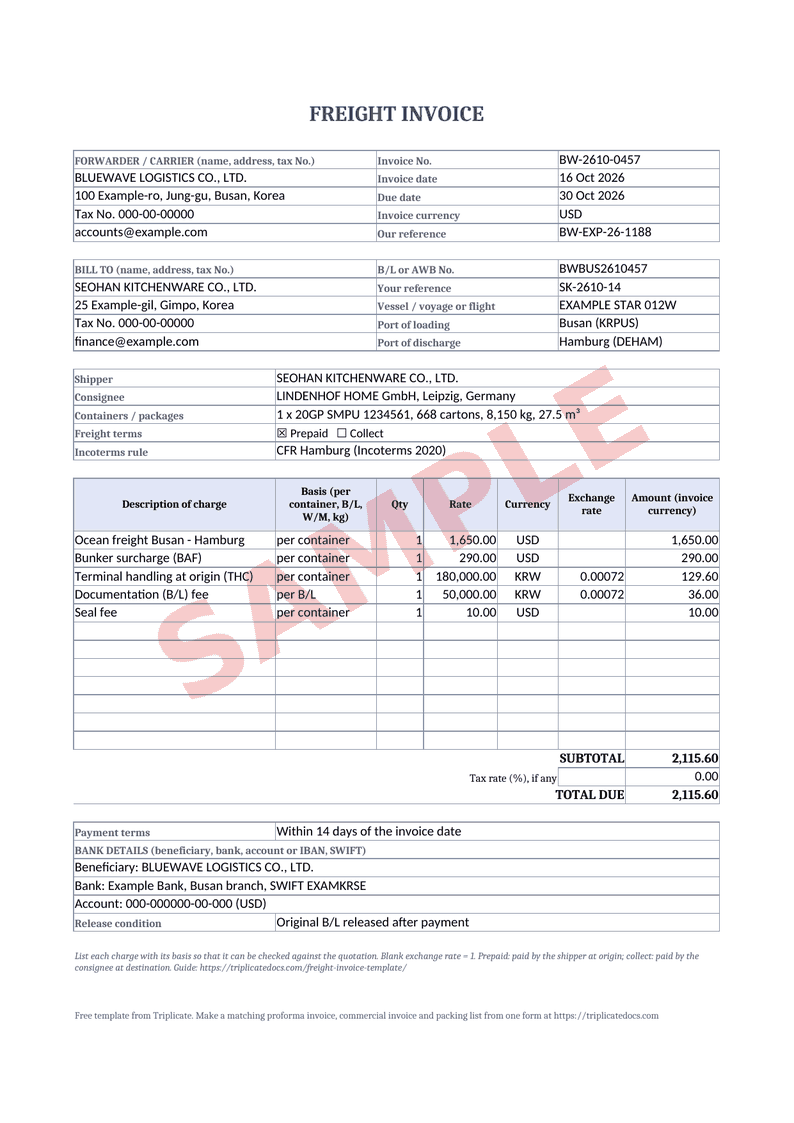
A freight invoice is the forwarder's or carrier's bill for moving a shipment: the main freight, surcharges and the local charges at origin or destination, billed to whoever pays under the freight terms. This sheet ties the invoice to the bill of lading or air waybill and lists each charge with its basis, quantity, rate and currency, with totals by formula.
Download .xlsxAll free templates →
What the template covers
- Forwarder or carrier with tax number, and the party billed with address and tax number
- Invoice number and date, due date, your reference and the customer's reference
- B/L or AWB number, shipper and consignee, vessel or flight, port of loading and port of discharge
- Container numbers and sizes, or packages, gross weight and volume for LCL and air
- Freight terms: prepaid or collect, and the Incoterms rule if known
- Charge lines with description, basis (per container, per B/L, per W/M or per kg), quantity, rate, currency and amount by formula
- Subtotal, tax and total by formula, with the exchange rate used if charges are in two currencies
- Payment terms, bank details and the release condition (for example, release of the B/L after payment)
Sources
Guides on this topic
What a freight invoice should show
Each invoice should point to one shipment: the bill of lading or air waybill number, the containers or packages, the route and the vessel or flight. List every charge on its own line with the basis on which it is calculated, such as per container, per bill of lading, per revenue ton (W/M) or per kilogram, so that the customer can check it against the quotation. Show the currency of each charge, and the exchange rate if you convert, the tax treatment, the payment terms and the bank details.
Common charge names
Ocean or air freight is the main carriage. Surcharges include the bunker or fuel surcharge (BAF), currency adjustment (CAF) and peak season or security surcharges. Local charges at each end include terminal handling (THC), documentation or B/L fees, seal fees, CFS charges for LCL cargo, customs clearance and trucking, and at destination the delivery order (D/O) fee. Demurrage and detention are charged only if containers are kept beyond the free time. Names and amounts vary by carrier and port, so use the names in your quotation.
Who pays: prepaid, collect and Incoterms
Freight prepaid means the shipper pays at origin; freight collect means the consignee pays at destination, usually before the cargo is released. The Incoterms rule in the sales contract decides which party bears which costs: under FOB the buyer pays the main carriage and the seller the costs until the goods are on board, while under CFR and CIF the seller pays the freight to the destination port. Bill local charges to the party that bears them, and check each line against the quotation before paying.
Common questions
What is a freight invoice?
The bill from a freight forwarder or carrier for transporting a shipment, listing the freight, surcharges and local charges with the bill of lading or air waybill it relates to.
What is the difference between freight prepaid and freight collect?
Prepaid freight is paid by the shipper at origin; collect freight is paid by the consignee at destination, usually before the carrier releases the cargo.
What does W/M mean on a freight invoice?
Weight or measurement: LCL freight is charged per revenue ton, which is the greater of the gross weight in metric tons and the volume in cubic metres.
Who pays THC at the port of loading?
It depends on the Incoterms rule and the carriage contract. Under FOB, costs until the goods are on board are for the seller, so origin THC is normally billed to the shipper; check how your quotation splits the charges.
Can I compare the invoice with the freight quotation?
Yes. Put the quoted and invoiced amounts side by side line by line; the freight quote comparison tool on this site also shows lines that appear in one quote but not in another.
More free tools
Triplicate is free and keeps getting better. Found it useful? Support Triplicate ♥
Prefer no ads? Pro removes all ads · $1/month