Demurrage and Detention Explained: Meaning, Free Time and How to Calculate the Charges
Demurrage is charged when a full container stays inside the terminal beyond its free time; detention is charged when you keep the carrier's container outside the terminal beyond its free time. To calculate either, count the days in that phase the way the carrier's tariff counts them, subtract the free days and multiply the remaining days by the daily rate of each tier. In the United States, a demurrage or detention invoice must be issued within 30 calendar days of the date the charge was last incurred, or the billed party does not have to pay it (46 CFR 541.7).
Checked against official sources: 2026-10
At a glance
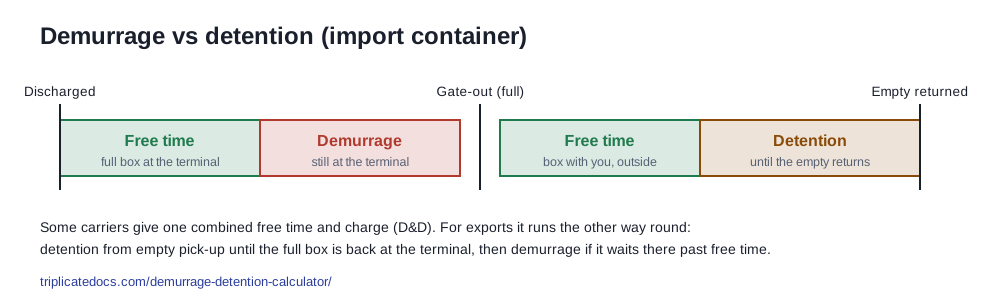
Demurrage, detention, combined free time and storage
The words differ slightly by carrier and port, so read the carrier's own demurrage and detention tariff. Maersk's published terms are a typical example: demurrage is payable when the merchant holds the carrier's container inside the terminal, port or depot beyond the agreed free time; detention is payable when the merchant holds it outside the terminal, port or depot beyond the free time; and combined demurrage and detention uses one free time for the whole period inside and outside.
Storage is a different charge: it pays for the terminal's or depot's space and can be billed by the terminal on top of the carrier's demurrage, including for containers the shipper owns. In the United States, container use charges are often called "per diem", and the FMC's rules treat per diem charges as demurrage or detention.
When the clock starts and stops
Free time runs from a set event to another set event. In Maersk's terms:
- Import demurrage: from discharge at the port, or from gate-in full at an inland depot, until the full container is picked up (gate-out).
- Import detention: from gate-out of the full container until the empty is returned to the agreed terminal or depot.
- Import combined: from discharge until the empty is returned.
- Export detention: from gate-out of the empty container until the full container is delivered (gate-in) to the agreed terminal or depot.
- Export demurrage: from gate-in until the container is loaded on the ship.
How to calculate demurrage and detention
Find four things in the tariff, service contract or arrival notice: the free days, the daily rates and the days each rate applies to (tiers), whether the first day counts as day 1, and whether weekends and public holidays are excluded. Then:
- Count the days in each phase, from the start event to the end event, the way the tariff counts them.
- Subtract the free days to get the chargeable days. The last free day is the last day you can pick up or return the container without charge.
- Multiply the chargeable days by the daily rate of each tier, then by the number of containers.
- Example (rates for illustration only): a container is discharged on 1 March, picked up on 11 March and returned empty on 18 March. The tariff gives 4 free days of demurrage and 4 of detention in calendar days, counting the first day as day 1. Demurrage costs 100 per day for the first 5 chargeable days and 150 after that; detention costs 80 per day.
- Demurrage: the free days are 1 to 4 March, so 5 to 11 March are chargeable: 7 days, 5 × 100 + 2 × 150 = 800.
- Detention: counting the gate-out day as day 1, the free days are 11 to 14 March, so 15 to 18 March are chargeable: 4 days × 80 = 320. The total is 1,120 per container.
- Here the gate-out day counts as the last demurrage day and the first detention day. Tariffs differ on this, and on whether weekends count, so check yours; Triplicate's demurrage and detention calculator lets you set these options.
United States: FMC billing rules (46 CFR 541)
Since 2024, ocean carriers, marine terminal operators and NVOCCs that bill demurrage or detention in the United States must follow the Federal Maritime Commission's billing rule in 46 CFR part 541:
- The invoice must be issued within 30 calendar days from the date on which the charge was last incurred. If it is not, the billed party is not required to pay the charge (541.7).
- The invoice must show identifying information (bill of lading and container numbers, port of discharge, the basis for the billed party's liability), timing information (invoice and due dates, the free time allowed, its start and end, the container availability and return dates and the dates charged), the rates and the tariff or contract rule they come from, how to dispute the charge, and certifications that the charges follow FMC rules and that the billing party's own performance did not cause them (541.6).
- Missing any required information eliminates the billed party's obligation to pay the charge (541.5).
- The billed party must have at least 30 calendar days from the invoice date to request mitigation, refund or waiver, and the billing party must try to resolve the request within 30 calendar days of receiving it, or later if both agree (541.8).
- Section 541.4, which barred billing motor carriers, was removed in December 2025 after a federal appeals court set it aside; the other sections remain in force.
When charges may be unreasonable in the US
The FMC's interpretive rule on demurrage and detention (46 CFR 545.5) looks at whether the charges serve their purpose, which is to give an incentive to move cargo and return equipment promptly. Detention charged when empty containers cannot be returned, for example because the depot will not accept them, is likely to be found unreasonable, and the FMC also considers how charges handle cargo availability, the notice that cargo is available and government inspections. If you are charged in those situations, keep the evidence, such as refused appointments or terminal notices, and use it in your dispute.
How to avoid demurrage and detention
- Ask for enough free time when you book, or agree it in your service contract, especially for ports where clearance is slow.
- Send the documents early: an original bill of lading that arrives late, or a missing release, keeps the container at the terminal. A telex release or sea waybill avoids waiting for paper originals.
- File customs entries and any required permits before the ship arrives, and book the truck for the first free days.
- Work out the last free day for pick-up and for empty return as soon as you know the arrival date.
- Return the empty to the depot the carrier names, and keep the gate receipt or equipment interchange receipt (EIR) as proof of the return date.
- Check every invoice against the tariff, your dates and, in the US, the 46 CFR 541 contents, and dispute within the stated window.
Demurrage in charter parties
In chartering, demurrage means something else: under BIMCO's Laytime Definitions for Charter Parties 2013, it is an agreed amount payable to the shipowner for delay to the ship once the laytime, the time allowed for loading or discharging, has expired. Despatch is the opposite, an amount the owner pays if loading or discharging finishes early. This note is about container demurrage and detention.
Step by step
- Find the free days, daily rates, tiers and counting rules in the carrier's tariff, service contract or arrival notice.
- Note the discharge date, the pick-up (gate-out) date and the empty return date, or the export equivalents.
- Work out the last free day for pick-up and for empty return, and plan customs clearance and trucking before it.
- Return the empty to the named depot and keep the gate receipt or EIR.
- Check each invoice against your dates and the tariff, and dispute it within the stated window.
Documents you usually need
- Arrival notice with the free time and the container availability date
- The carrier's demurrage and detention tariff or your service contract
- Delivery order and customs release
- Gate-out and gate-in records or equipment interchange receipts (EIR)
- The demurrage, detention or storage invoice
Common problems and how to avoid them
What to do: File the entry and documents before arrival, ask the carrier for extra free time or a waiver, and in the US cite the FMC's position on government inspections (46 CFR 545.5).
What to do: Keep proof of the refused return, such as appointment screenshots or depot notices, and dispute the detention: the FMC treats detention charged when empties cannot be returned as likely unreasonable.
What to do: Check the dates: if it was issued more than 30 calendar days after the charge was last incurred, you are not required to pay it (46 CFR 541.7).
What to do: Send originals by courier as soon as they are issued, or agree on a telex release or sea waybill for future shipments.
Sources
- 46 CFR Part 541: Demurrage and Detention Billing Requirements Electronic Code of Federal Regulations (eCFR)
- Demurrage and Detention Billing Requirements: Properly Issued Invoices Provision Set Aside by Court (final rule) Federal Maritime Commission, Federal Register
- Interpretive Rule on Demurrage and Detention Under the Shipping Act (46 CFR 545.5) Federal Maritime Commission, Federal Register
- Terms for Detention and Demurrage A.P. Moller - Maersk
- Laytime Definitions for Charter Parties 2013 BIMCO
Rules change often. This note is practical guidance based on the sources above, not legal advice. Confirm current requirements with the authority, your importer or a licensed customs broker before you ship.
Trade notes
Common questions
How do you calculate demurrage?
Count the days the full container stayed at the terminal, from discharge to pick-up, the way the carrier's tariff counts them, subtract the free days, and multiply the chargeable days by the daily rate of each tier. Detention is calculated the same way, from pick-up to empty return.
What is the difference between demurrage, detention and storage?
Demurrage is for keeping the carrier's container inside the terminal beyond the free time, detention for keeping it outside the terminal beyond the free time, and storage is the terminal's charge for its space. Some carriers combine demurrage and detention into one free time.
What is per diem in container shipping?
In the United States, per diem is a common name for the daily charge for using a carrier's container outside the terminal. The FMC's rules treat per diem charges as demurrage or detention, so the same billing rules apply.
Who pays demurrage and detention?
The party the carrier bills under its terms, usually the consignee or importer at destination and the shipper at origin. Who bears the cost between seller and buyer depends on the sales contract and the Incoterms rule.
Can I dispute a demurrage or detention invoice?
Yes. Check the dates, free time, rates and counting rules against the tariff and your gate records. In the United States, you have at least 30 calendar days from the invoice date to request mitigation, refund or waiver, and an invoice missing required information or issued late need not be paid.
More free tools
Triplicate is free and keeps getting better. Found it useful? Support Triplicate ♥
Prefer no ads? Pro removes all ads · $1/month