Free RFQ (request for quotation) template for importers
A request for quotation asks suppliers to price the same thing on the same terms, so that their answers can be compared. This sheet sets out the products and specifications, quantities, the Incoterms rule and place, packing and labelling, certificates and tests, samples, the delivery date and the deadline for replies, with columns where the supplier fills in prices.
Download .xlsxAll free templates →
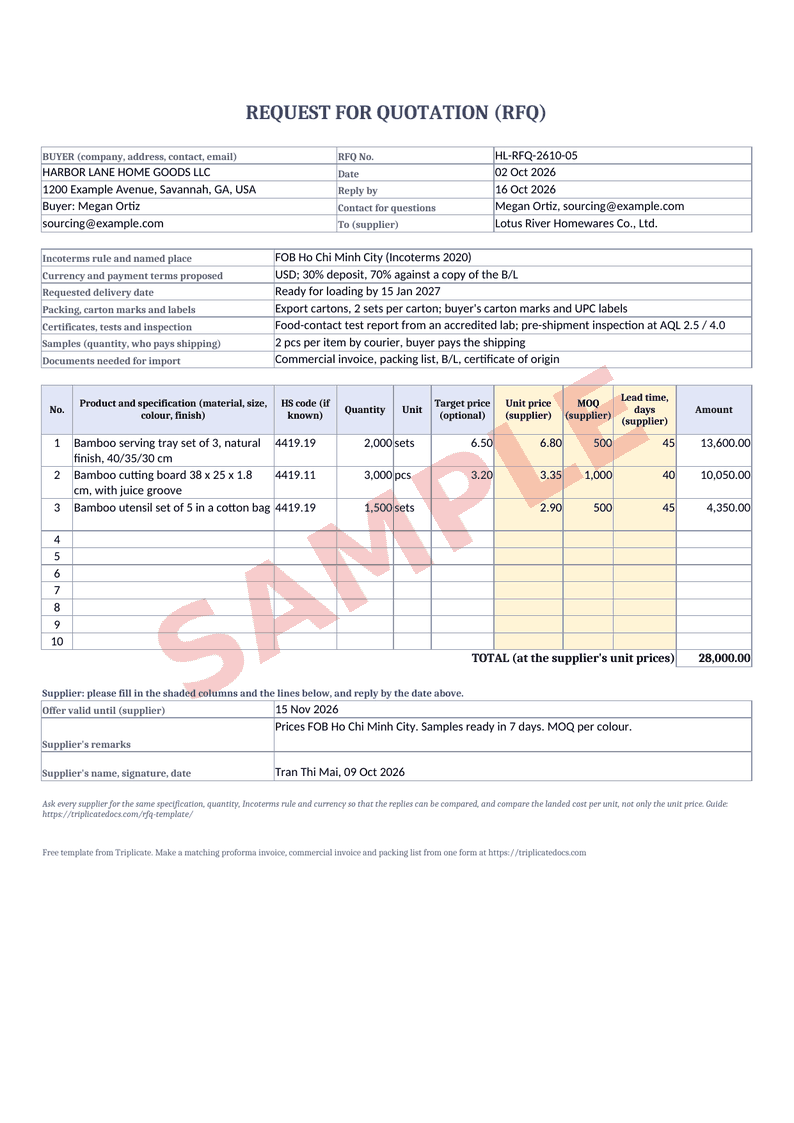
What the template covers
- Buyer, RFQ number and date, the reply deadline and the contact for questions
- Products with specification, material, size, colour, HS code if known and drawings or photos
- Quantities per order or per year and the target price, if you want to share one
- Incoterms rule and named place, currency and the payment terms you propose
- Packing, carton marks and labels, and the documents you will need for import
- Certificates, tests and inspection required, and samples to be sent
- Requested delivery date and the lead time the supplier can offer
- Supplier's reply columns: unit price, MOQ, lead time and validity of the offer
Sources
Guides on this topic
Ask for prices on the same basis
Quotes can only be compared if every supplier prices the same thing: the same specification, quantity, packing, Incoterms rule and named place, and currency. Give each product a clear description with material, size and finish, attach drawings or photos, and say which certificates, tests and labels the goods need for your market. Ask for the unit price, the minimum order quantity (MOQ), the lead time and how long the offer is valid.
Incoterms, payment and samples
Choose the Incoterms rule and the named place before sending the RFQ: a price FOB at the supplier's port leaves the freight, insurance and import costs to you, while a DAP or DDP price includes more of them. Propose payment terms, for example a deposit and balance against documents, and ask for samples or a pre-production sample before the order, with who pays for samples and their shipping.
After the replies arrive
Put the answers side by side and compare the landed cost per unit, not only the unit price: add freight, insurance, duties and other costs for the Incoterms rule of each quote. Check the MOQ, lead time and payment terms, ask the supplier about any line that is unclear, and confirm the final terms in a purchase order or sales contract.
Common questions
What should an RFQ include?
The product specifications, quantities, Incoterms rule and named place, currency, packing and labelling, certificates and tests, samples, the delivery date, and the deadline and format for the supplier's reply.
What is the difference between an RFQ and a purchase order?
An RFQ asks suppliers for prices and terms; a purchase order is the buyer's order once a supplier has been chosen, and it should repeat the agreed price, quantity, specification and terms.
Should I give a target price in the RFQ?
It is optional. A target price can speed up negotiations, but it may also anchor the suppliers' offers; many buyers give it only for repeat items or after the first round of quotes.
Which Incoterms rule should I ask for?
Ask all suppliers for the same rule and named place so the prices are comparable, for example FOB at their main port or FCA at their warehouse, and add your own freight quote to compare the landed cost.
How many suppliers should receive the RFQ?
Enough to compare prices and terms: buyers often send the same RFQ to several suppliers and shortlist the best replies for samples and negotiation.
More free tools
Triplicate is free and keeps getting better. Found it useful? Support Triplicate ♥
Prefer no ads? Pro removes all ads · $1/month