Free import document checklist template (customs clearance tracker)
An import is released only when the importer of record, usually through a customs broker, has the right documents and filings in place: the supplier's commercial invoice and packing list, the transport document, proof of origin for a preferential rate, permits for regulated goods, advance cargo data, and the customs declaration with duty and import VAT or GST paid. This sheet lists them for one shipment, records who provides each and when it was requested, received and checked, and counts what is still open.
Download .xlsxAll free templates →
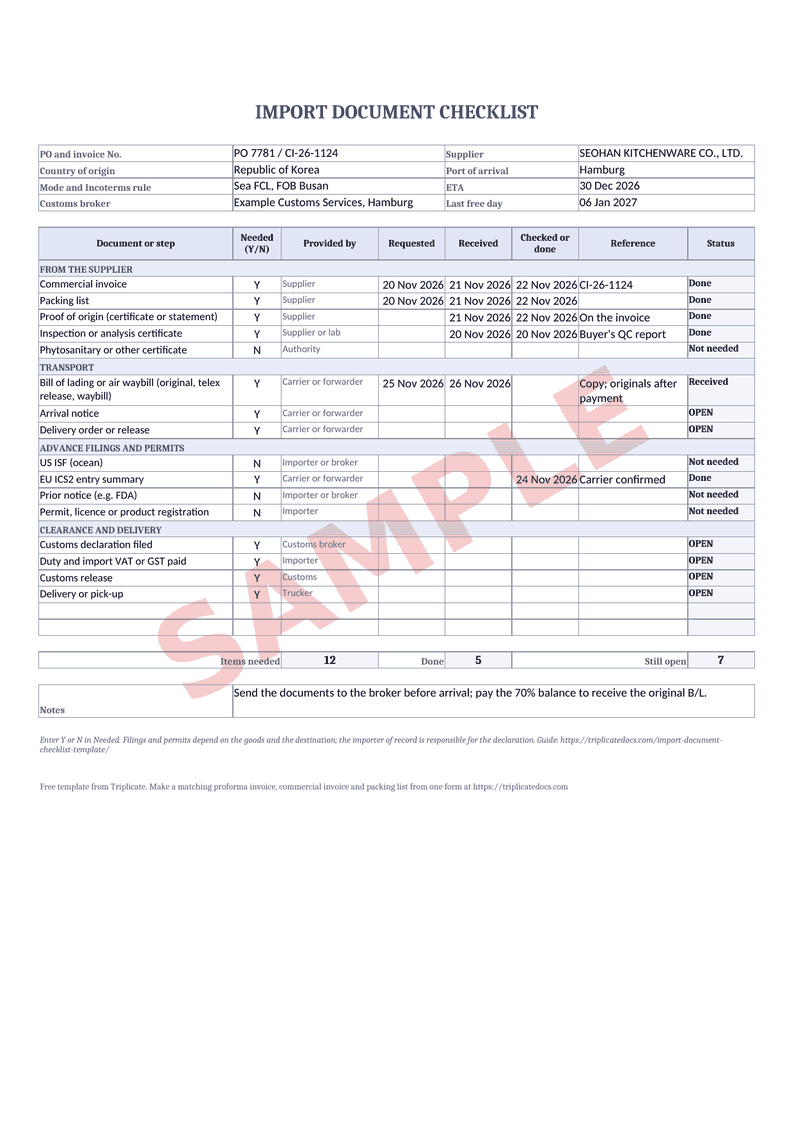
What the template covers
- Shipment: PO and invoice number, supplier, country of origin, port of arrival, mode, Incoterms rule, ETA and customs broker
- From the supplier: commercial invoice, packing list, proof of origin, inspection, analysis or phytosanitary certificates
- Transport: bill of lading or air waybill (original, telex release or waybill), arrival notice, delivery order
- Advance filings where they apply: US ISF, EU ICS2 entry summary, prior notices such as FDA
- Permits, licences and product registrations for regulated goods
- Customs declaration, duty and import VAT or GST, release, and delivery or pick-up with the last free day
- For each line: needed or not, provided by, requested, received, checked or done, reference, and a status by formula
- Number of items still open, and notes
Guides on this topic
What the importer needs before arrival
Customs clearance is the responsibility of the importer of record, usually handled through a licensed customs broker. The broker builds the declaration from the supplier's documents and needs them before the goods arrive: the commercial invoice, the packing list, the transport document, proof of origin if a preferential rate is claimed, and any permit or certificate the goods need. Ask the supplier for drafts early and check that the documents agree with each other.
Advance filings and permits
Some data must reach customs before the goods do: for ocean cargo to the United States the ISF at least 24 hours before loading, in the European Union the ICS2 entry summary, and for regulated goods notices such as FDA prior notice for food. Permits, licences and product registrations depend on the goods and the destination; check them for the product's tariff code before the supplier ships.
Release, delivery and records
Once the declaration is accepted and duty and import VAT or GST are paid or secured, customs releases the goods. Collect the delivery order or release from the carrier, note the last free day to avoid demurrage and detention charges, and arrange delivery. Keep the entry records, for example for 5 years from the date of entry in the United States.
Common questions
What documents are needed for import customs clearance?
Usually the commercial invoice, the packing list and the transport document, plus proof of origin for a preferential rate, permits or certificates for regulated goods, and any advance filings such as the US ISF.
Who is responsible for import clearance?
The importer of record, which declares the goods and pays the duties and import taxes, usually through a licensed customs broker acting as its agent.
When should the documents reach the customs broker?
Before the goods arrive, so that the broker can prepare the declaration and any problem can be fixed without delaying release.
What is the last free day?
The last day on which a container can stay at the terminal, or with the importer, without demurrage or detention charges, as set by the carrier or the terminal.
Does the template count what is still open?
Yes. Each line marked as needed shows its status from the dates you enter, and the sheet counts the items that are still open.
More free tools
Triplicate is free and keeps getting better. Found it useful? Support Triplicate ♥
Prefer no ads? Pro removes all ads · $1/month