Free arrival notice template for forwarders and carriers
An arrival notice tells the consignee and the notify party that their cargo is about to arrive: which bill of lading, vessel and ETA, where the containers will be, what is due and what is needed to release them. Sending it early gives the importer time to arrange customs clearance and pickup before the free time runs out.
Download .xlsxAll free templates →
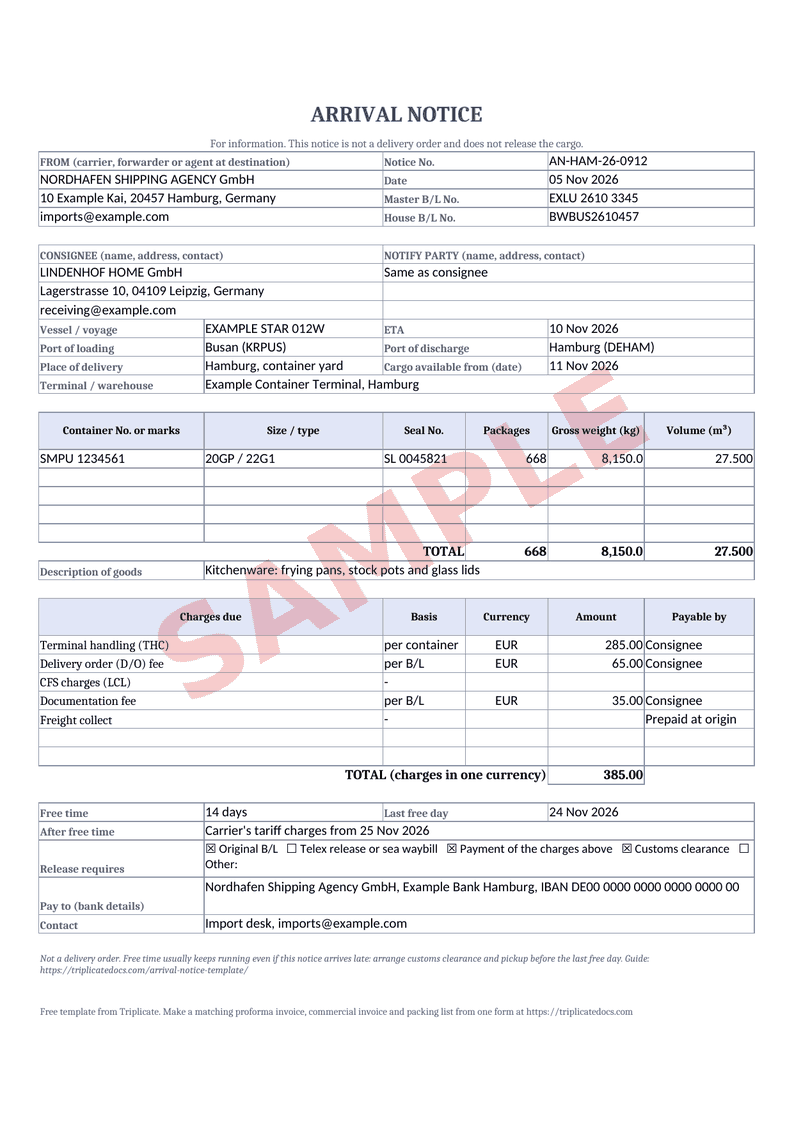
What the template covers
- Issuer (carrier, forwarder or agent at destination) with the notice number and date
- Consignee and notify party with contact details
- Master and house B/L numbers, vessel and voyage, port of loading, port of discharge and place of delivery
- ETA, the terminal or warehouse where the cargo will be, and the date it is available
- Containers with size and seal, or packages, gross weight and volume, and a description of the goods
- Charges due at destination with currency and the total by formula, including any freight collect
- Free time, last free day and the demurrage and detention terms after it
- Documents and steps for release: original B/L, telex release or sea waybill, payment, customs clearance and the delivery order
Sources
Guides on this topic
What an arrival notice contains
The carrier or the forwarder at destination sends the notice to the consignee and the notify party shown on the bill of lading, usually a few days before the vessel arrives. It identifies the shipment by bill of lading number, vessel and voyage, containers and packages, gives the ETA and the place where the cargo will be available, and lists the charges to be paid before release. An arrival notice is for information: it is not a delivery order and does not release the cargo.
Release: bill of lading, payment and customs
To obtain a delivery order, the consignee normally surrenders an original bill of lading, or the carrier confirms a telex release or the shipment moves on a sea waybill, and pays the charges due and any freight collect. Customs clearance is a separate step done by the importer or its customs broker. With a forwarder's house bill of lading, both the forwarder's release and the carrier's release must be in place before the container can be picked up.
Free time and charges
Free time is the number of days a container can stay at the terminal (demurrage) or be kept outside it (detention) without extra charges; the notice should state the last free day. Destination charges usually include terminal handling, the delivery order fee and, for LCL, CFS charges; who pays them depends on the Incoterms rule and the freight terms. Check the charges against the quotation and pick up before the last free day.
Common questions
Who sends the arrival notice?
The carrier, or for a house bill of lading the freight forwarder or its agent at destination. It goes to the consignee and the notify party on the bill of lading.
Is an arrival notice the same as a delivery order?
No. The arrival notice informs the consignee about the shipment and the charges due; the delivery order is issued after release and allows the cargo to be collected from the terminal or warehouse.
What if I do not receive an arrival notice?
Ask the carrier or forwarder, quoting the bill of lading number, and track the container. Not receiving a notice does not usually stop the free time from running, so check the vessel's arrival date yourself.
What is the last free day?
The last day a container can stay at the terminal, or be kept, without demurrage or detention charges under the free time agreed with the carrier. Charges start the next day.
Who pays the destination charges?
Usually the consignee, but it depends on the Incoterms rule and the freight terms: under DAP the seller pays the carriage to the named place, while unloading and import clearance are generally for the buyer. Check the sales contract and the quotation.
More free tools
Triplicate is free and keeps getting better. Found it useful? Support Triplicate ♥
Prefer no ads? Pro removes all ads · $1/month