Free landed cost template (import costing sheet)
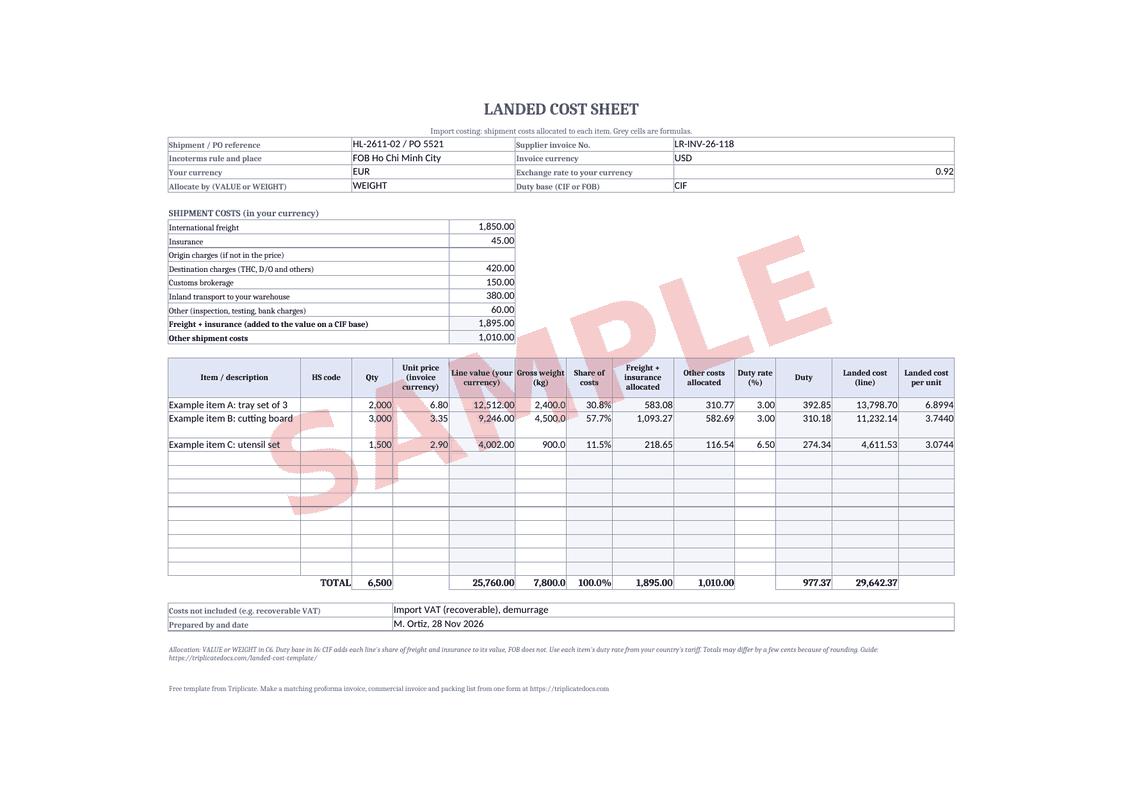
The landed cost of an imported product is its purchase price plus everything paid to get it to your warehouse. This sheet takes the shipment's costs, such as freight, insurance, origin and destination charges, customs brokerage and trucking, spreads them over the items by value or by weight, adds duty at each item's rate and gives the landed cost per line and per unit.
Download .xlsxAll free templates →
What the template covers
- Shipment reference, supplier invoice, Incoterms rule, invoice currency, your currency and the exchange rate
- International freight and insurance, kept apart because some countries charge duty on them
- Origin charges, destination charges, customs brokerage, inland transport and other costs
- Allocation method: by value or by gross weight
- Item lines with HS code, quantity, unit price, line value in your currency and gross weight
- Each line's share of the shipment costs, its duty rate and duty on a CIF or FOB base
- Landed cost per line and per unit, and the totals, by formula
- Notes on costs left out, such as import VAT or GST that you can recover
Sources
Guides on this topic
What goes into landed cost
Start with the price on the supplier's invoice, converted to your currency. Add the costs that the Incoterms rule leaves to you: for an EXW or FOB purchase that is the international freight and insurance, plus origin charges for EXW; for CIF, the destination charges. Then add customs brokerage, inland transport, inspection or testing and bank charges, and the import duty. Import VAT or GST is usually left out because businesses that are registered can normally recover it; include it if you cannot.
Allocating costs by value or by weight
Shipment costs have to be shared between the items before you can price each one. Allocating by value is simple and suits goods of similar density; allocating by weight is fairer when heavy, low-value items share a container with light, expensive ones, because freight follows weight and volume. Pick one method for the sheet and keep it for comparable shipments.
Duty on a CIF or FOB value
Customs value is not the same everywhere. The European Union and many other countries include transport and insurance to the point of entry (a CIF value), while the United States excludes international freight and insurance (a FOB-type value). The sheet applies each item's duty rate to its value plus, on a CIF base, its share of freight and insurance. Use the rate for the item's HS code in your country's tariff, including any preference you are entitled to.
Common questions
What is landed cost?
The total cost of an imported product delivered to your warehouse: purchase price plus freight, insurance, duties, taxes you cannot recover, customs brokerage, inland transport and other import costs.
Should I allocate freight by value or by weight?
By weight when the items differ a lot in density or value per kilogram, because freight follows weight and volume; by value when the goods are similar. Use the same method for comparable shipments.
Is import VAT part of landed cost?
Usually not for VAT-registered businesses, which can normally recover import VAT or GST. If you cannot recover it, add it as a cost.
Is duty charged on the CIF or the FOB value?
It depends on the importing country: the EU and many others use a CIF value, while the United States uses a value that excludes international freight and insurance. Choose the base in the sheet accordingly.
How is this different from the landed cost calculator?
The calculator on this site gives a quick estimate in the browser; this Excel sheet handles a full shipment with several items, allocates the costs to each line and stays with your records.
More free tools
Triplicate is free and keeps getting better. Found it useful? Support Triplicate ♥
Prefer no ads? Pro removes all ads · $1/month