Free documentary collection instruction template (D/P, D/A)
When you are paid by documentary collection, your bank sends the shipping documents to the buyer's bank with a collection instruction that says what to collect and on what terms. Under URC 522 the banks follow that instruction and do not examine the documents for instructions, so it has to be complete. Fill in this template, or use it to check your bank's own form.
Download .xlsxAll free templates →
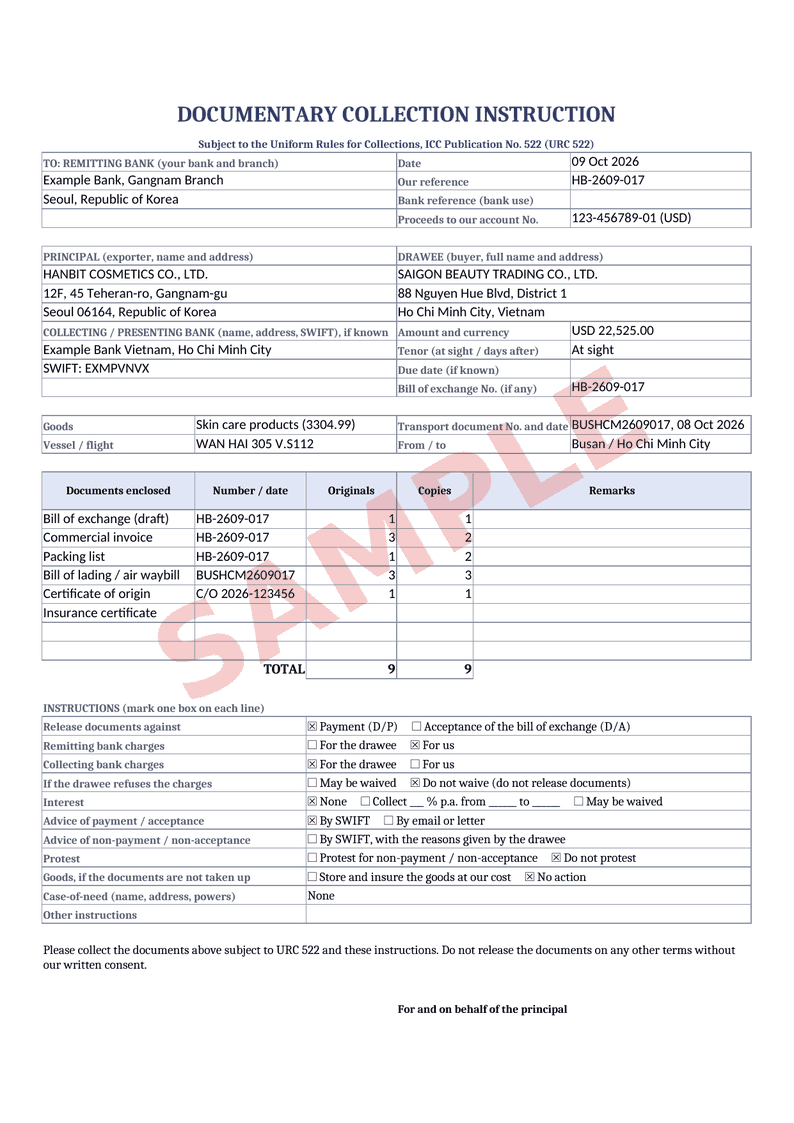
What the template covers
- Principal (exporter), your bank (remitting bank) and the account for the proceeds
- Drawee (buyer) with full address, and the collecting or presenting bank if you know it
- Amount and currency, and the tenor: at sight or a number of days after sight or the B/L date
- Shipment details: goods, vessel or flight, ports and transport document date
- Documents enclosed, with the number of originals and copies of each
- Release against payment (D/P) or against acceptance (D/A)
- Who pays each bank's charges, whether they may be waived, and any interest to collect
- What to do on non-payment or non-acceptance (protest or not, advice, storage and insurance of the goods), case-of-need, and your signature
Sources
Guides on this topic
What the collection instruction must say
Under the ICC Uniform Rules for Collections (URC 522, article 4), every collection must travel with an instruction stating that it is subject to URC 522 and giving complete and precise instructions: the principal, the drawee and the presenting bank, the amount and currency, the documents and how many of each, the terms of payment or acceptance, the charges and interest and whether they may be waived, how to pay and advise, and what to do on non-payment, non-acceptance or non-compliance. Banks will not examine the documents to look for instructions.
D/P or D/A
With documents against payment (D/P) the buyer gets the documents, and with them the goods, only when it pays. With documents against acceptance (D/A) it gets them when it accepts a bill of exchange payable later, so you lose control of the goods before you are paid. URC 522 (article 7) advises against combining a bill payable at a future date with D/P instructions; if the bill is payable later, say clearly whether documents are released against acceptance or payment.
The risks to keep in mind
In a documentary collection the banks handle the documents but do not guarantee payment, and they have no obligation to act in respect of the goods (URC 522 article 10). If the buyer does not pay, the goods may wait at the port, so give instructions on protest, storage and insurance, and name a case-of-need representative if you have one. Do not consign the goods to a bank without that bank's prior agreement. For more protection, a letter of credit or payment in advance may suit better.
Common questions
What is a documentary collection instruction?
The exporter's written instruction to its bank for a documentary collection: whom to present the documents to, the amount, whether to release them against payment or acceptance, the charges and what to do if the buyer does not pay. Under URC 522 it must accompany every collection.
What is the difference between D/P and D/A?
Documents against payment (D/P): the buyer receives the documents when it pays. Documents against acceptance (D/A): the buyer receives them when it accepts a bill of exchange payable at a later date, so it gets the goods before paying.
Do banks guarantee payment in a documentary collection?
No. The remitting and collecting banks only handle the documents according to the instruction; unlike under a letter of credit, no bank promises to pay. If the buyer does not pay, the documents are held or returned as you instruct. Note that with an air waybill or a bill of lading made out directly to the buyer, the goods can usually be released to the buyer without the documents.
Should I ask the bank to protest if the buyer does not pay?
Give a clear instruction either way. URC 522 (article 24) says the instruction should give specific instructions about protest in case of non-payment or non-acceptance; without them, the banks have no obligation to protest. Protest can matter for legal action in some countries but costs money.
Can I use my bank's own form instead?
Yes. Most banks have their own collection form and may require it. This template helps you prepare the same information and check that nothing is missing before you fill in the bank's form.
More free tools
Triplicate is free and keeps getting better. Found it useful? Support Triplicate ♥
Prefer no ads? Pro removes all ads · $1/month