Free bank details letter template (payment instructions)
Before the first payment, many customers ask for your bank details on company letterhead, signed by an authorised person. This sheet lays out what an international transfer needs: the account holder's name and address, the bank, the IBAN or account number, the SWIFT/BIC code and, where needed, an intermediary bank and a local bank code. It also tells the customer how to check the details, because fake 'change of bank details' emails are a common fraud.
Download .xlsxAll free templates →
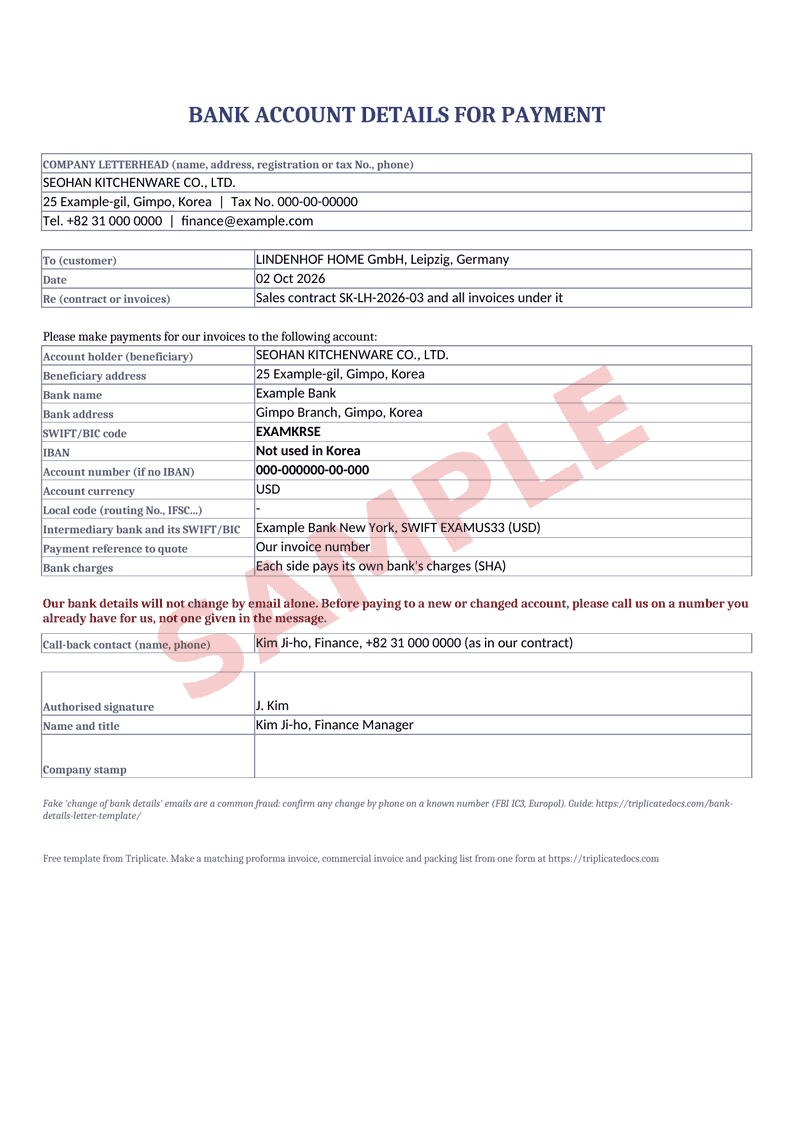
What the template covers
- Company letterhead with name, address, registration or tax number and phone
- Customer, date and a reference to the contract or invoices
- Account holder (beneficiary) name exactly as the bank holds it, and address
- Bank name and address, and the SWIFT/BIC code (8 or 11 characters)
- IBAN, or the account number where IBANs are not used, and the account currency
- Intermediary bank and local codes (for example a routing number, IFSC or CLABE) where needed
- Payment reference to quote, and who bears the bank charges
- Authorised signature, and a call-back contact for confirming the details by phone
Sources
- FBI Internet Crime Complaint Center (IC3), Business Email Compromise: The $55 Billion Scam (PSA, 11 September 2024)
- FBI, business email compromise (how to protect yourself)
- Europol, invoice fraud (leaflet)
- Action Fraud (UK), mandate fraud
- UK Finance, Take Five: invoice and mandate fraud
- European Central Bank, Instant Payments Regulation (verification of payee from 9 October 2025 in the euro area)
- Pay.UK, Confirmation of Payee
Guides on this topic
What an international transfer needs
Most banks ask for the beneficiary's name and address, the bank's SWIFT/BIC code and the IBAN, or the account number where IBANs are not used, as in the United States. Some countries add their own codes, such as the IFSC in India or the CLABE in Mexico, and some currencies are routed through an intermediary bank. Ask your bank which details to give for each currency, and show them the same way on every invoice.
Fake bank detail changes
In payment-diversion or business email compromise (BEC) fraud, criminals send an email or letter that looks as if it comes from a supplier and ask for future payments to go to a new account. The FBI's Internet Crime Complaint Center (IC3) reported more than US$55 billion in exposed losses from such scams between October 2013 and December 2023. Europol's advice: do not use the contact details on the letter or email requesting the change.
How to confirm the details safely
Customers should confirm a new or changed account by calling a number they already have on file, not one given in the request, and be wary of pressure to pay quickly. Suppliers help by stating in the letter that their bank details will not change by email alone and by giving a known contact for checks. In the euro area, banks have offered verification of payee since 9 October 2025, warning the payer if the payee's name does not match the IBAN of a euro transfer; the UK has a similar Confirmation of Payee service for UK payments.
Common questions
What should a bank details letter include?
The account holder's name and address, the bank name, the SWIFT/BIC code, the IBAN or account number, the currency, any intermediary bank or local code, the payment reference and an authorised signature on company letterhead.
What is a SWIFT/BIC code?
The international code that identifies a bank in cross-border payments; it has 8 characters, or 11 with a branch code.
Do I need an IBAN for every country?
No. IBANs are used in Europe and many other countries, but not in the United States and some others, where the account number and other bank codes are used instead.
What should I do if a supplier emails new bank details?
Do not pay to the new account until you have confirmed the change by calling the supplier on a number you already have on file, not one in the email. Companies rarely change their bank details.
What if I have already paid a fraudster?
Contact your bank immediately and ask it to recall the funds, then report the fraud to the police or your national reporting centre, such as IC3 in the United States.
More free tools
Triplicate is free and keeps getting better. Found it useful? Support Triplicate ♥
Prefer no ads? Pro removes all ads · $1/month