Free supplier routing guide (shipping instructions to your supplier)
When you buy FOB or FCA, you choose the forwarder and your supplier has to hand the goods over the way you need them. A routing guide tells the supplier, in one place, who to book with and when, how to pack and label the cartons, which documents to prepare and by when, and whom to contact. This sheet covers those points for each order or as a standing instruction.
Download .xlsxAll free templates →
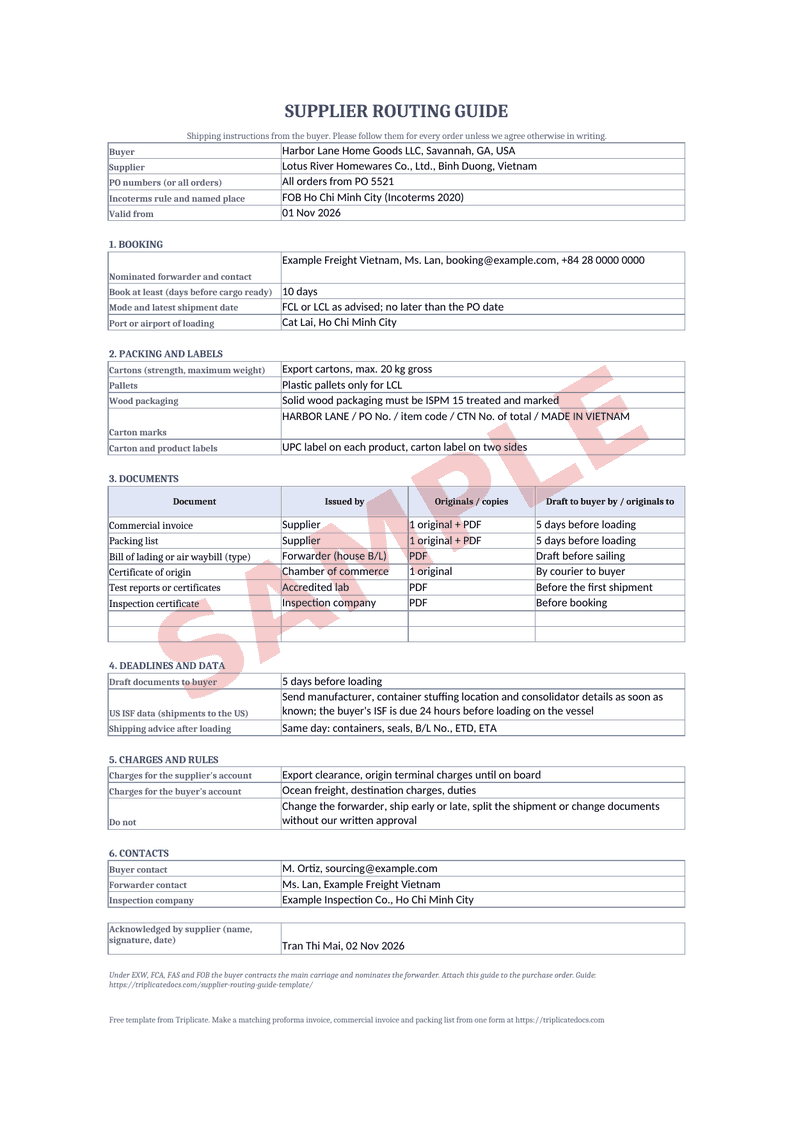
What the template covers
- Buyer, supplier and PO numbers, Incoterms rule and named place
- Nominated forwarder with contact, and how many days before the cargo ready date to book
- Cargo ready date, mode (FCL, LCL or air) and the latest shipment date
- Packing, pallets and wood packaging rules, carton marks and labels
- Documents to prepare: commercial invoice, packing list, bill of lading type, certificate of origin and others, with copies
- Deadlines for document drafts, originals and data such as US ISF details
- Who pays which charges, and what the supplier must not do (for example change the forwarder)
- Contacts at the buyer, the forwarder and the inspection company
Sources
Guides on this topic
Why importers send a routing guide
Under FOB or FCA the buyer contracts the main carriage, so the supplier must book with the buyer's forwarder, not its own, and deliver the goods packed and documented as agreed. Without written instructions, suppliers fall back on their usual habits: a different forwarder, cartons without your labels, an invoice that does not match the purchase order. A routing guide set once and attached to every order avoids most of these problems.
Packing, labels and documents
Say how cartons must be marked and labelled, whether pallets are needed, and that any solid wood packaging must be ISPM 15 treated and marked. List the documents you need for import and payment, the number of originals and copies, who issues each one and when drafts must reach you for checking, so that the bill of lading and invoice match before the goods sail.
Data your country needs in advance
Some destinations need data before loading. For ocean shipments to the United States, the importer's ISF must be filed no later than 24 hours before the cargo is laden aboard the vessel at the foreign port, and part of the data, such as the manufacturer and the container stuffing location, comes from the supplier. Put these deadlines in the routing guide and use a worksheet to collect the data.
Common questions
What is a supplier routing guide?
A set of shipping instructions from an importer to its suppliers: which forwarder to book with, packing and labelling rules, documents to prepare, deadlines and contacts.
When does the buyer choose the forwarder?
Under EXW, FCA, FAS and FOB the buyer contracts the main carriage and usually nominates the forwarder; under the C and D rules the seller arranges the main carriage.
What documents should the routing guide list?
Those you need for import and payment, such as the commercial invoice, packing list, bill of lading or air waybill, certificate of origin and any certificates or test reports, with the number of originals and copies.
Should the supplier send draft documents first?
Yes. Ask for drafts of the invoice, packing list and bill of lading before shipment so that you can correct mistakes before the originals are issued.
Is a routing guide part of the contract?
It is binding only if the sales contract or purchase order refers to it, so attach it to the order or the contract and keep it up to date.
More free tools
Triplicate is free and keeps getting better. Found it useful? Support Triplicate ♥
Prefer no ads? Pro removes all ads · $1/month