Free ISF 10+2 data worksheet for US ocean imports
For cargo arriving in the United States by vessel, the ISF Importer (the goods' owner, purchaser, consignee or an agent such as a licensed customs broker) must file the Importer Security Filing electronically before the cargo is loaded. Much of the data comes from the overseas supplier and the forwarder. This worksheet collects the ten elements in one place for whoever files; it does not file anything.
Download .xlsxAll free templates →
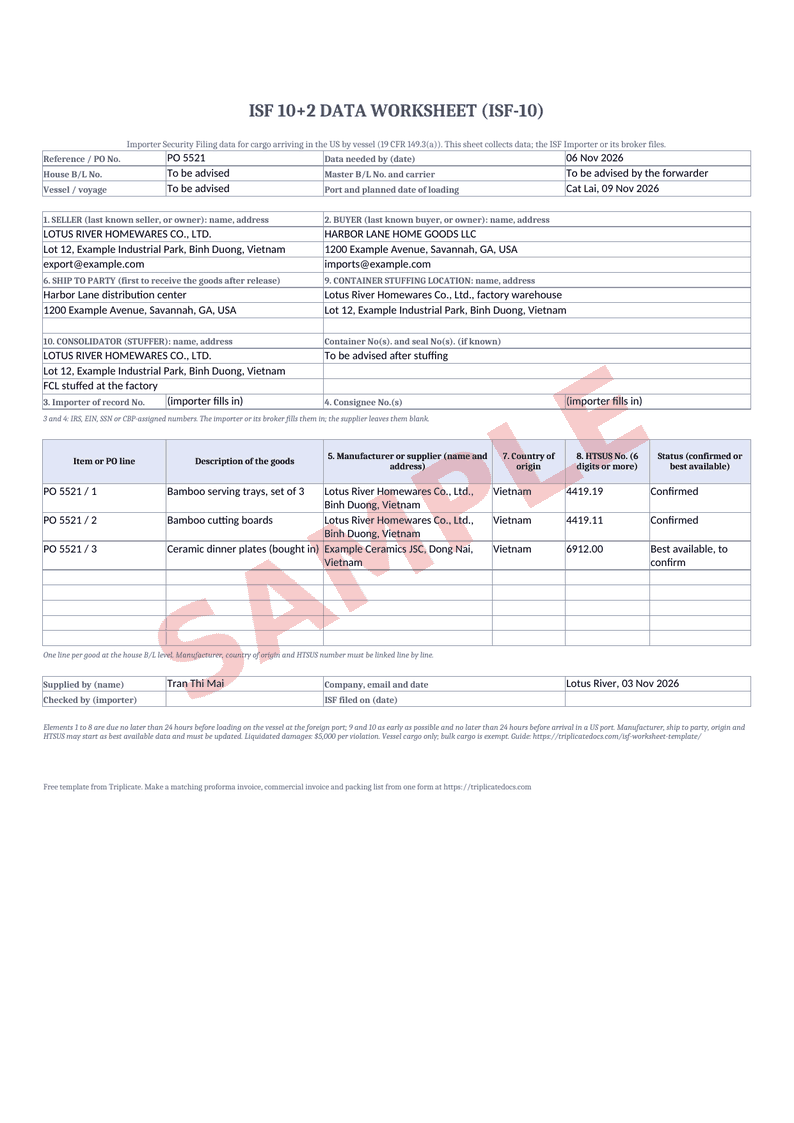
What the template covers
- Seller and buyer: name and address of the last known parties to the sale, or the owner if there is no purchase
- Importer of record number and consignee number (IRS, EIN, SSN or CBP-assigned), filled in by the importer
- Manufacturer or supplier name and address for each line
- Ship to party: the first party to receive the goods after release from customs
- Country of origin and HTSUS number to at least six digits for each line, linked to the manufacturer
- Container stuffing location and consolidator (stuffer), which may follow later
- House and master bill of lading numbers, vessel, port of loading and the planned loading date
- Status of each line (confirmed or best available data) and who supplied the data
Sources
- eCFR, 19 CFR Part 149 (Importer Security Filing): 149.1 ISF Importer, 149.2 timing and flexibility, 149.4 bulk cargo
- eCFR, 19 CFR 149.3 data elements
- eCFR, 19 CFR 113.62 basic importation bond, paragraph (j): ISF liquidated damages
- U.S. Customs and Border Protection, ISF frequently asked questions (November 2018)
- U.S. Customs and Border Protection, CBP enters next phase of Importer Security Filing (June 2013)
- Cornell LII, 19 CFR 4.7c vessel stow plan
- Federal Register, Accuracy of Importer of Record Data Submitted to CBP (19 August 2026)
Guides on this topic
Who files, and when
The ISF is required for cargo arriving in the United States by vessel; bulk cargo is exempt, and it does not apply to goods arriving by air, truck or rail. The ISF Importer, usually the US importer or its customs broker, files it through a CBP-approved electronic system; the overseas supplier only provides data. Eight elements are due no later than 24 hours before the cargo is laden aboard the vessel at the foreign port. The container stuffing location and the consolidator may follow as early as possible, and no later than 24 hours before arrival in a US port.
The ten elements and the +2
The importer provides seller, buyer, importer of record number, consignee number, manufacturer or supplier, ship to party, country of origin, HTSUS number, container stuffing location and consolidator for each good at the house bill of lading level, with manufacturer, origin and HTSUS number linked line by line. A widely recognised commercial identification number may replace the name and address of several parties. For manufacturer, ship to party, origin and HTSUS number, the first filing may use the best data available and must be updated when better data exists; CBP prefers the actual manufacturer when it is known. The +2 are the carrier's vessel stow plan and container status messages, not the importer's job.
Liquidated damages and accuracy
The customs bond conditions provide for liquidated damages of $5,000 for each violation, such as a late, inaccurate or incomplete filing, and CBP may hold cargo that arrives without an ISF. CBP has been in the full ISF enforcement phase since 9 July 2013. Check that the importer of record number belongs to an accurate importer record: from 18 September 2026, CBP may void importer numbers whose CBP Form 5106 information is incomplete or inaccurate. Cargo that remains on board (FROB) or moves in bond for immediate exportation or transportation and exportation uses a five-element filing (ISF-5) instead.
Common questions
Who is responsible for filing the ISF?
The ISF Importer: for most shipments the goods' owner, purchaser, consignee or an agent such as a licensed customs broker. The overseas supplier and the forwarder provide data but do not file the importer's ISF.
When must the ISF be filed?
No later than 24 hours before the cargo is laden aboard the vessel at the foreign port. The container stuffing location and the consolidator may be sent later, but no later than 24 hours before arrival in a US port.
Does the ISF apply to air freight?
No. The ISF applies to cargo arriving in the United States by vessel, and bulk cargo is exempt. Goods arriving by air, truck or rail are not covered by the ISF.
What is the penalty for a late or wrong ISF?
The bond conditions provide for liquidated damages of $5,000 for each violation, and CBP may hold cargo that arrives without an ISF. Update the filing when information changes.
Does this worksheet file the ISF?
No. It only collects the data from the supplier and the forwarder. The ISF Importer or its customs broker files it through a CBP-approved electronic system.
More free tools
Triplicate is free and keeps getting better. Found it useful? Support Triplicate ♥
Prefer no ads? Pro removes all ads · $1/month