Free pre-shipment inspection request and report template
A pre-shipment inspection, also called a final random inspection, is arranged by the buyer when production is finished and most goods are packed, so that problems are found before the goods leave the factory. This workbook has two sheets: a request to send to the inspection company and the supplier, and a report with defects found against the agreed AQL, the checks performed and an overall result.
Download .xlsxAll free templates →
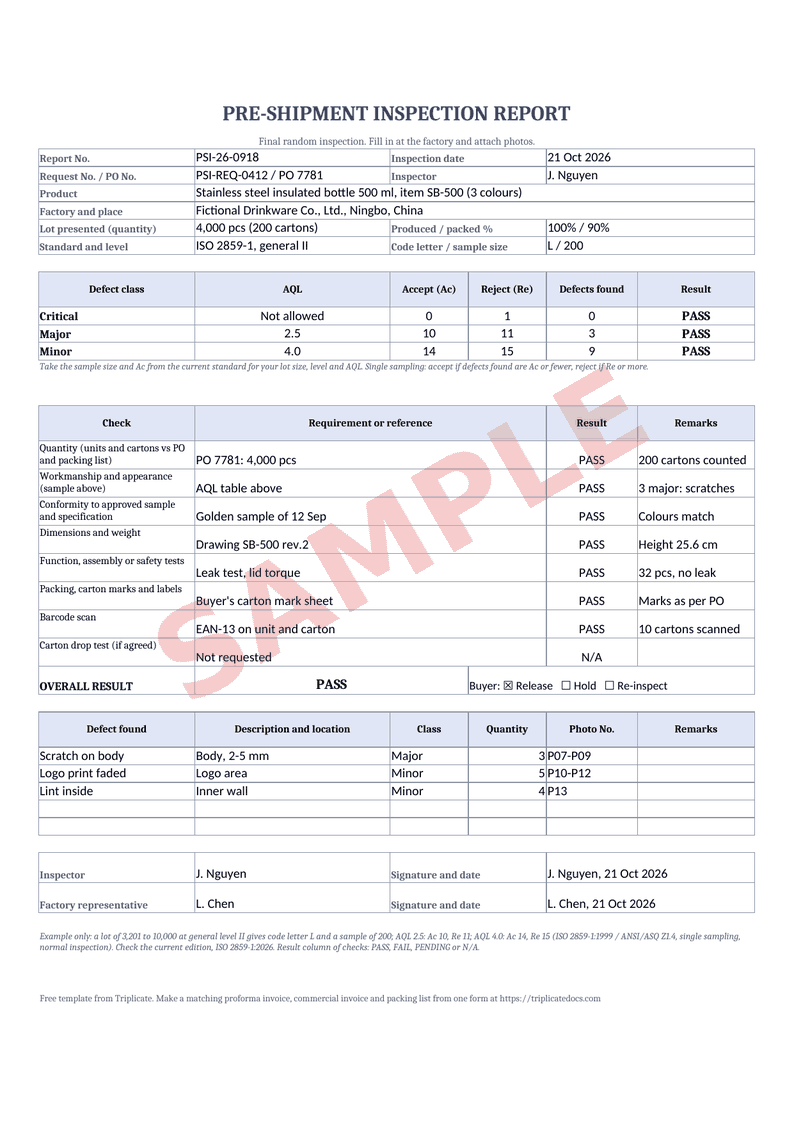
What the template covers
- Buyer, supplier and factory address with a contact person at the place of inspection
- Inspection type, requested inspection date and planned shipping date
- PO numbers, products, order quantities and the share produced and packed
- Sampling plan: standard, inspection level and AQL for critical, major and minor defects
- Checks requested and reference documents: approved sample, specification, artwork and an agreed defect list
- Report: lot size, sample size, accept and reject numbers and defects found, with PASS or FAIL by formula
- Results of the quantity, workmanship, conformity, dimension, function, packing and barcode checks, with an overall result
- Defects found with class, quantity and photo reference, and the names of the inspector and the factory representative
Sources
- ISO 2859-1:2026, sampling procedures for inspection by attributes indexed by AQL (replaces the 1999 edition)
- ASQ, ANSI/ASQ Z1.4 sampling procedures and tables for inspection by attributes
- QIMA, acceptable quality limit (AQL) and defect classes
- QIMA, pre-shipment inspection
- V-Trust, pre-shipment inspection (80% packed, level II, AQL 2.5 / 4.0)
- Intertek, consumer goods inspections
- WTO, Agreement on Preshipment Inspection
- Kenya Bureau of Standards, PVoC manual (version 15)
Guides on this topic
When to book and what is checked
Inspection companies commonly ask for production to be complete and at least about 80% of the goods packed, so that the product and its packaging can be checked together; book a few working days ahead. A typical final random inspection counts the quantity, checks workmanship on a random sample, compares the goods with the approved sample and the specification, measures dimensions and weight, runs function tests and checks packing, carton marks, labels and barcodes. A carton drop test is often added when agreed.
AQL, inspection levels and accept and reject numbers
Most consumer-goods inspections use the single sampling plans for normal inspection in ISO 2859-1 or ANSI/ASQ Z1.4. The lot size and the inspection level (general level II unless otherwise specified) give a sample size code letter; the code letter and the AQL give the sample size and the accept (Ac) and reject (Re) numbers. A defect class passes if the defects found do not exceed Ac. For example, a lot of 3,201 to 10,000 units at level II gives code letter L and a sample of 200, with Ac 10 and Re 11 at AQL 2.5 and Ac 14 and Re 15 at AQL 4.0 (values of the 1999 edition and Z1.4). Take your plan from the current edition, ISO 2859-1:2026. AQL is the worst tolerable process average over a series of lots, not a target and not a promise about one lot.
Defect classes, and what this is not
Critical defects make the product unsafe or non-compliant, major defects affect function or appearance enough to cause returns, and minor defects are small departures that do not reduce usability. A common starting point is no critical defects allowed, AQL 2.5 for major and 4.0 for minor defects, but the classes and limits are for buyer and supplier to agree, ideally with a defect list. This is a quality inspection arranged by the buyer. It is not the government preshipment inspection that some importing countries require under the WTO Agreement on Preshipment Inspection to verify quality, quantity, price or customs classification, such as Kenya's PVoC, and it does not replace any certificate the destination requires.
Common questions
When should a pre-shipment inspection be done?
Usually when production is finished and at least about 80% of the goods are packed, a few days before loading, so that problems can still be fixed before shipment. This is a common practice of inspection companies rather than a rule.
What AQL should I use?
A common starting point for consumer goods is no critical defects, AQL 2.5 for major and AQL 4.0 for minor defects, at general inspection level II. Stricter values are used for high-value or sensitive products; agree them with the supplier before production.
How do I find the sample size and the accept and reject numbers?
From the sampling tables of ISO 2859-1 or ANSI/ASQ Z1.4: the lot size and inspection level give a code letter, and the code letter and AQL give the sample size and the Ac and Re numbers. Enter them in the report and the sheet shows PASS or FAIL.
Is this the same as a government pre-shipment inspection?
No. Some importing countries require inspection by an appointed company to verify quality, quantity, price or customs classification before shipment, for example Kenya's PVoC. This template is for a quality inspection arranged by the buyer.
What does the inspector need from me?
The factory address and a contact person, the PO and quantities, the approved sample or photos, the specification, artwork and labels, the sampling plan and any special tests or defect list agreed with the supplier.
More free tools
Triplicate is free and keeps getting better. Found it useful? Support Triplicate ♥
Prefer no ads? Pro removes all ads · $1/month