Free VGM declaration template (verified gross mass)
Under SOLAS, a packed export container cannot be loaded on a ship until the shipper has given the carrier its verified gross mass (VGM), signed by a person the shipper has authorized. There is no international form, and many carriers take the VGM through their own portal, EDI or the forwarder, so use this sheet where a written declaration is accepted, or to work out the figures and keep a record.
Download .xlsxAll free templates →
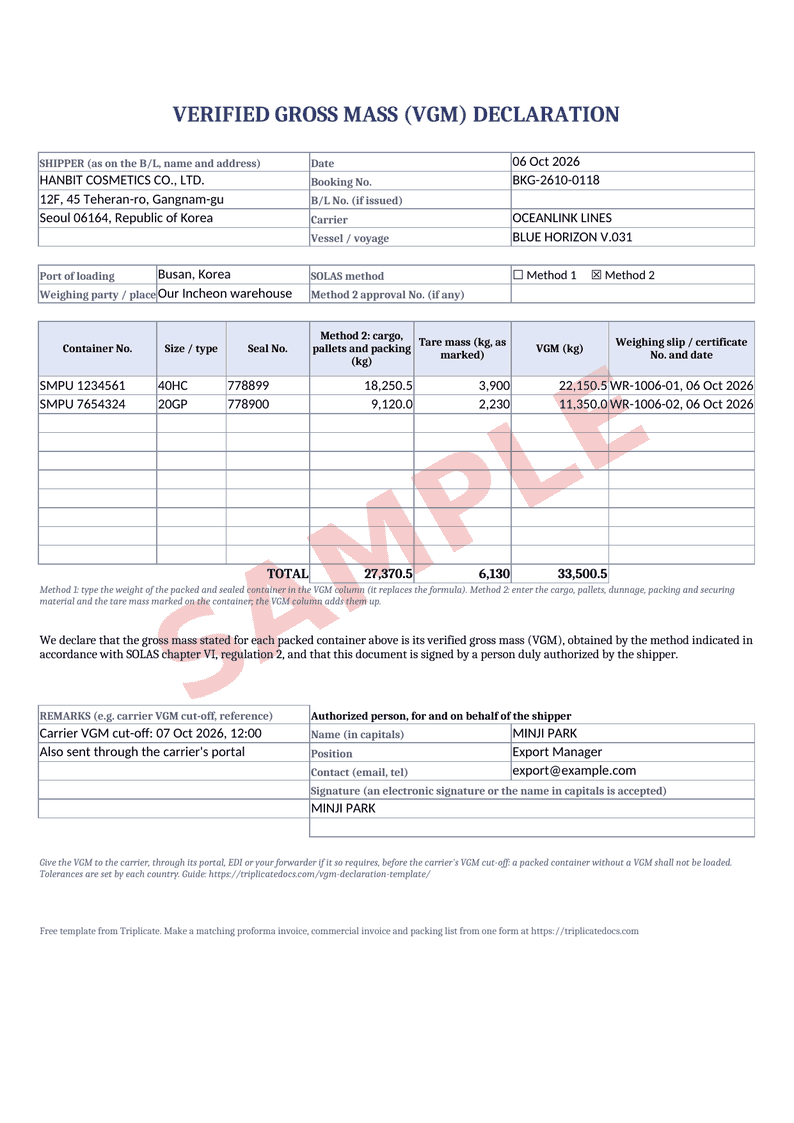
What the template covers
- Shipper as named on the bill of lading, and the carrier
- Booking number, B/L number if issued, vessel and voyage, port of loading
- SOLAS method 1 or 2, and the Method 2 approval number where the country requires one
- Container number, size and type, and seal number
- For Method 2: cargo, pallets, dunnage, packing and securing material plus the tare mass marked on the container, added up by formula
- VGM in kg for each container, and the weighing slip or certificate number and date
- A statement that the figures are the verified gross mass under SOLAS chapter VI regulation 2
- Name in capitals, position and signature of the person authorized by the shipper
Sources
- IMO, Resolution MSC.380(94): amendments to SOLAS chapter VI, regulation 2 (verified gross mass)
- IMO, MSC.1/Circ.1475: Guidelines regarding the verified gross mass of a container carrying cargo
- GOV.UK (Maritime and Coastguard Agency), Verified gross mass of containers
- Transport Canada, TP 15330: Canadian procedure for obtaining the verified gross mass of packed containers
- Hong Kong Marine Department, Guidelines on the verified gross mass of containers
- AMSA, Container weight verification: tolerance, enforcement and delays
- Maritime NZ, Container weight FAQs
- TT Club, ICHCA, WSC and Global Shippers' Forum, VGM supplementary FAQs (2016)
Guides on this topic
Method 1 or Method 2
Method 1: weigh the packed and sealed container on calibrated and certified equipment, such as a weighbridge. Method 2: weigh all packages and cargo items, including pallets, dunnage and other packing and securing material, and add the tare mass of the container, using a method certified by the competent authority of the country where the container was packed; the tare is marked on the container door. Method 2 is not suitable for bulk cargo such as scrap metal or unbagged grain, and an estimate is not a VGM.
Signature, cut-off, and no VGM, no loading
The shipping document must state clearly that the figure is the verified gross mass and be signed by a person duly authorized by the shipper; an electronic signature, or the person's name in capitals, is accepted. It must reach the carrier and the terminal early enough for the stowage plan, which in practice means before the carrier's VGM cut-off shown on the booking confirmation. A packed container without a VGM shall not be loaded on the ship.
Tolerances differ by country
SOLAS sets no tolerance; each country decides. The UK MCA applies ±5% or ±500 kg, whichever is greater; Canada 5%, but not more than 500 kg; Hong Kong ±5% above 10 tonnes and ±0.5 tonne at or below 10 tonnes; Australia, New Zealand and Singapore specify none. Where the declared and verified weights differ, the verified gross mass, or the terminal's own weighing, is used. Keep the weighing records as long as local rules require.
Common questions
What is a VGM declaration?
The shipper's signed statement of the verified gross mass of a packed container, required under SOLAS chapter VI regulation 2 before the container can be loaded on a ship. It can be a document, an entry in the carrier's portal or an EDI message.
Who signs the VGM declaration?
A person duly authorized by the shipper named on the bill of lading. A forwarder may obtain and send the VGM if the shipper authorizes it, but the shipper remains responsible.
How do I calculate the VGM with Method 2?
Add the weights of all packages and cargo items, pallets, dunnage and other packing and securing material to the tare mass marked on the container. Method 2 must be approved or certified in the country where the container is packed.
Is there an official VGM form?
No. The IMO sets no international template, so each carrier states what it accepts: its portal, EDI, an Excel or PDF form, or a signed document like this one. Check the carrier's instructions and cut-off.
What happens if the VGM is missing or wrong?
A packed container without a VGM should not be loaded until one is obtained; the master or the terminal may obtain it on the shipper's behalf, with the costs settled commercially. If the declared and verified figures differ, the verified gross mass is used.
More free tools
Triplicate is free and keeps getting better. Found it useful? Support Triplicate ♥
Prefer no ads? Pro removes all ads · $1/month