Free cargo claim letter template (notice of loss or damage)
A cargo claim letter, or notice of loss or damage, tells the carrier in writing that goods arrived damaged, short or not at all, and that you hold it responsible. Sent in time, it protects your claim against the carrier, and your cargo insurer will expect it. Note the damage on the delivery receipt as well, and use the email version when the first notice has to go out in minutes.
Download .xlsxAll free templates →
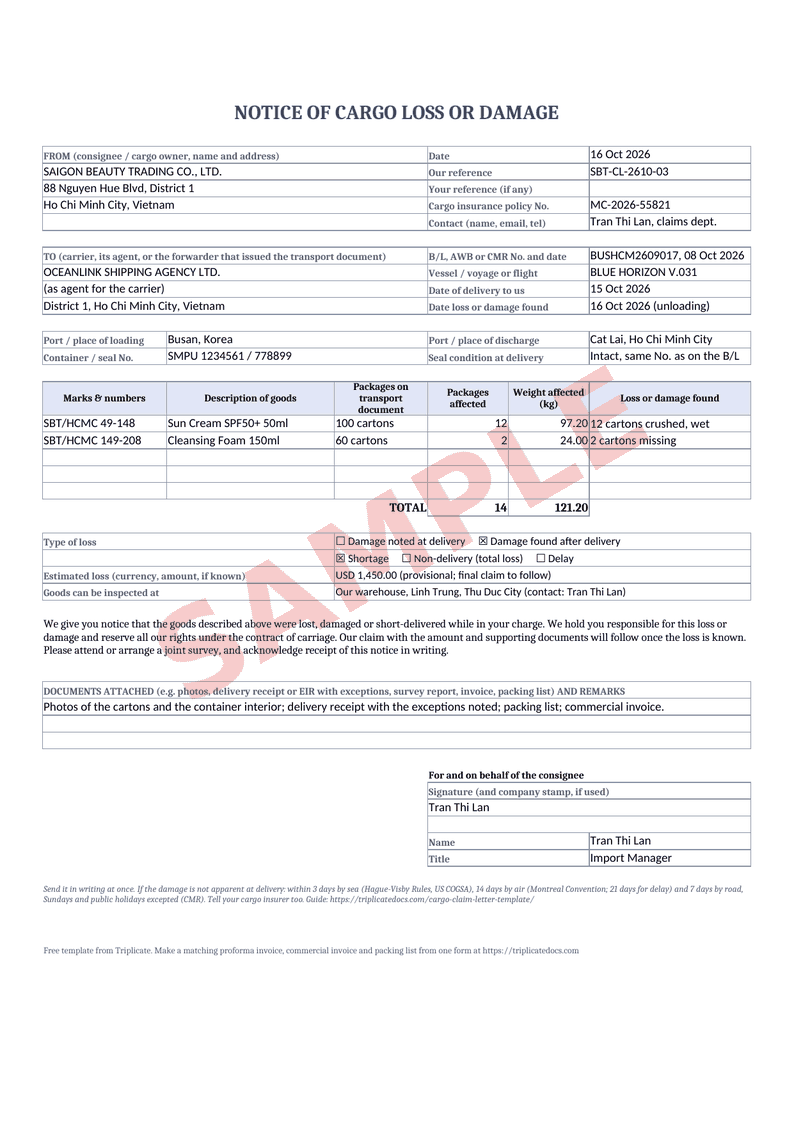
What the template covers
- Consignee or cargo owner, and the carrier, its agent or the forwarder that issued the transport document
- Bill of lading, air waybill or CMR consignment note number and date, vessel and voyage or flight
- Container and seal numbers, the seal condition at delivery, places of loading and discharge
- Date of delivery and the date the loss or damage was found
- Marks, goods description, packages on the transport document and packages affected
- Type of loss (damage, shortage, non-delivery or delay) and the estimated amount if known
- Where the goods can be inspected, for a joint survey
- Documents attached, such as photos and the delivery receipt with exceptions, and the signature
Sources
- UK Carriage of Goods by Sea Act 1971, Schedule (Hague-Visby Rules), article III rule 6
- US Carriage of Goods by Sea Act, note to 46 U.S.C. 30701 (Cornell LII)
- UNCITRAL, United Nations Convention on the Carriage of Goods by Sea, 1978 (Hamburg Rules)
- Canadian Transportation Agency, decision 17-C-A-2022 (Montreal Convention article 31)
- Dawson v Thomson Airways [2014] EWCA Civ 845 (Montreal Convention article 35)
- UK Carriage of Goods by Road Act 1965, Schedule (CMR Convention), articles 30 and 32
- If P&C Insurance, Check list on receipt of goods
Guides on this topic
Sea freight: notice within three days
Under the Hague-Visby Rules (article III rule 6) and US COGSA, give written notice of loss or damage to the carrier or its agent at the port of discharge when the goods are handed over, or within three days if the damage is not apparent. Without it, taking delivery is prima facie evidence that the goods arrived as described in the bill of lading, which makes the claim harder to prove. No notice is needed if the goods were jointly surveyed at receipt. The Hamburg Rules allow until the next working day, or 15 consecutive days for damage that is not apparent.
Air and road: 14 days, 7 days, and 21 for delay
For air cargo under the Montreal Convention (article 31), complain in writing as soon as the damage is found and at the latest within 14 days of receipt, or 21 days for delay; without a complaint in time no action lies against the carrier, except in case of fraud. For road transport under the CMR Convention (article 30), make reservations at delivery for apparent loss or damage, in writing within seven days, Sundays and public holidays excepted, if it is not apparent, and in writing within 21 days for delay.
Keep the evidence and watch the time bar
Write the damage or shortage on the delivery receipt or the equipment interchange receipt, photograph the cargo, packing and container, keep the seal, and invite the carrier to a joint survey. Tell your cargo insurer at once: the Institute Cargo Clauses require you to keep your rights against carriers properly preserved. The notice does not stop the time bar: under Hague-Visby and US COGSA suit must be brought within one year of delivery, under CMR one year in most cases, and under the Montreal Convention two years from arrival, so if the claim is not settled in time, start proceedings or, for sea claims, ask the carrier in writing to extend the time.
Common questions
What is a cargo claim letter?
A written notice to the carrier, its agent or the forwarder that issued the transport document, saying that goods were lost, damaged or short-delivered and that you hold the carrier responsible. The full claim with the amount and documents can follow once the loss is known.
How soon must I notify the carrier of cargo damage?
At delivery if the damage is visible. If it is not apparent: within 3 days by sea under Hague-Visby or US COGSA, 14 days by air under the Montreal Convention, and 7 days by road under CMR, Sundays and public holidays excepted. Check the terms of your transport document as well.
Should I write the damage on the delivery receipt?
Yes. A clean receipt makes the claim harder to prove. Note the damage or shortage on the delivery receipt or equipment interchange receipt, take photos and keep the seal, then send this written notice.
Who should the notice go to: the carrier or the forwarder?
To the party that issued your transport document, such as the shipping line or airline, or a forwarder that issued a house bill of lading, or its agent at the place of delivery. If you are not sure which one is responsible, send it to both.
Is there an email version?
Yes. The cargo damage notice email template gives the same points in a short message for the first notice; use this sheet when a formal signed letter is needed, or to follow up the email.
More free tools
Triplicate is free and keeps getting better. Found it useful? Support Triplicate ♥
Prefer no ads? Pro removes all ads · $1/month