Free cost breakdown sheet template (supplier quote breakdown)
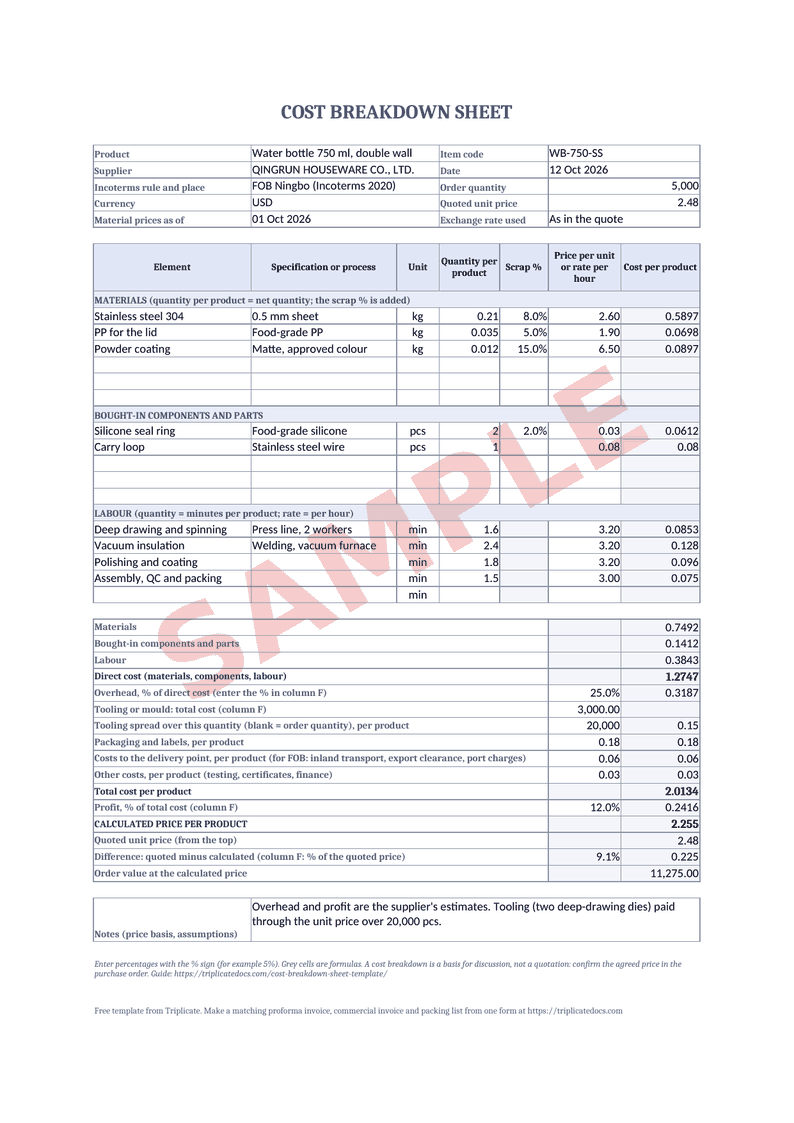
A cost breakdown shows what a quoted price is made of: materials, components, labour, overhead, tooling, packaging, the costs to deliver at the agreed point and the supplier's profit. Buyers ask for one to understand a quote, to discuss price changes when material costs move and to compare suppliers on the same basis. This sheet lists each element, works out the cost per product and compares the total with the quoted unit price.
Download .xlsxAll free templates →
What the template covers
- Product, item code, supplier, date, Incoterms rule and place, order quantity, currency and the quoted unit price
- Materials: quantity per product, scrap allowance and material price, with the cost per product by formula
- Bought-in components and parts with quantity per product and unit price
- Labour by process: minutes per product and rate per hour
- Overhead as a percentage of direct cost, and tooling or mould cost spread over a quantity
- Packaging and labels, costs to the delivery point (for FOB: inland transport, export clearance, port charges) and other costs per product
- Profit as a percentage, the calculated price per product and the difference from the quoted price, by formula
- Date of the material prices, exchange rate used and notes
Guides on this topic
Why ask for a cost breakdown
A single unit price says little about how it was built. With a breakdown, buyer and supplier discuss the same numbers: which materials drive the price, how much scrap is assumed, how long each process takes and what is added for overhead and profit. It helps when a supplier asks for a price increase because a material became more expensive, and when two suppliers quote very different prices for the same specification.
What a breakdown usually includes
Materials with the quantity used per product (the net quantity plus a scrap or waste allowance) and the material price; bought-in components; direct labour by process; overhead; tooling or moulds spread over the expected quantity; packaging and labels; the costs to deliver at the point named in the quote, such as inland transport and export clearance for FOB; and the profit. Note the date of the material prices and the exchange rate used, so that later changes can be traced.
Use it to discuss, not to dictate
Suppliers may not want to share their margin or exact rates, and estimates of overhead differ from factory to factory. Treat the breakdown as a basis for discussion: check the quantities against the specification and the approved sample, compare material prices with market prices where they are published, and agree in the contract how changes in the price of key materials will be handled. Confirm the agreed price in the purchase order.
Common questions
What is a cost breakdown sheet?
A table that splits the price of a product into its cost elements, such as materials, components, labour, overhead, tooling, packaging, delivery costs and profit, usually per product.
Does a supplier have to provide a cost breakdown?
No, unless the buyer and the supplier agree to it. Many suppliers share one on request, sometimes without the exact margin, especially for custom products or large orders.
What is a scrap allowance?
The extra material used in production beyond what ends up in the finished product, for example offcuts. The sheet adds it as a percentage to the net quantity.
How is tooling cost included?
Either spread the tooling or mould cost over the quantity you expect to order, or pay it separately. The sheet divides it by the quantity you enter, or by the order quantity if you leave it blank.
Does the template calculate the price?
Yes. It adds up the cost per product for each element, applies the overhead and profit percentages and shows the difference between the calculated price and the quoted unit price.
More free tools
Triplicate is free and keeps getting better. Found it useful? Support Triplicate ♥
Prefer no ads? Pro removes all ads · $1/month