Free HS code classification worksheet (product information for customs)
An HS code is decided from facts about the product, not from its name. Brokers and customs ask the same questions again and again: what is it, what does it do, what is it made of and in what proportions, how is it made, presented and packed, and how is it used. This worksheet collects those facts from the supplier and the product team, records the codes considered with the reasons and the rulings checked, and keeps the decision and who approved it. It does not choose the code for you.
Download .xlsxAll free templates →
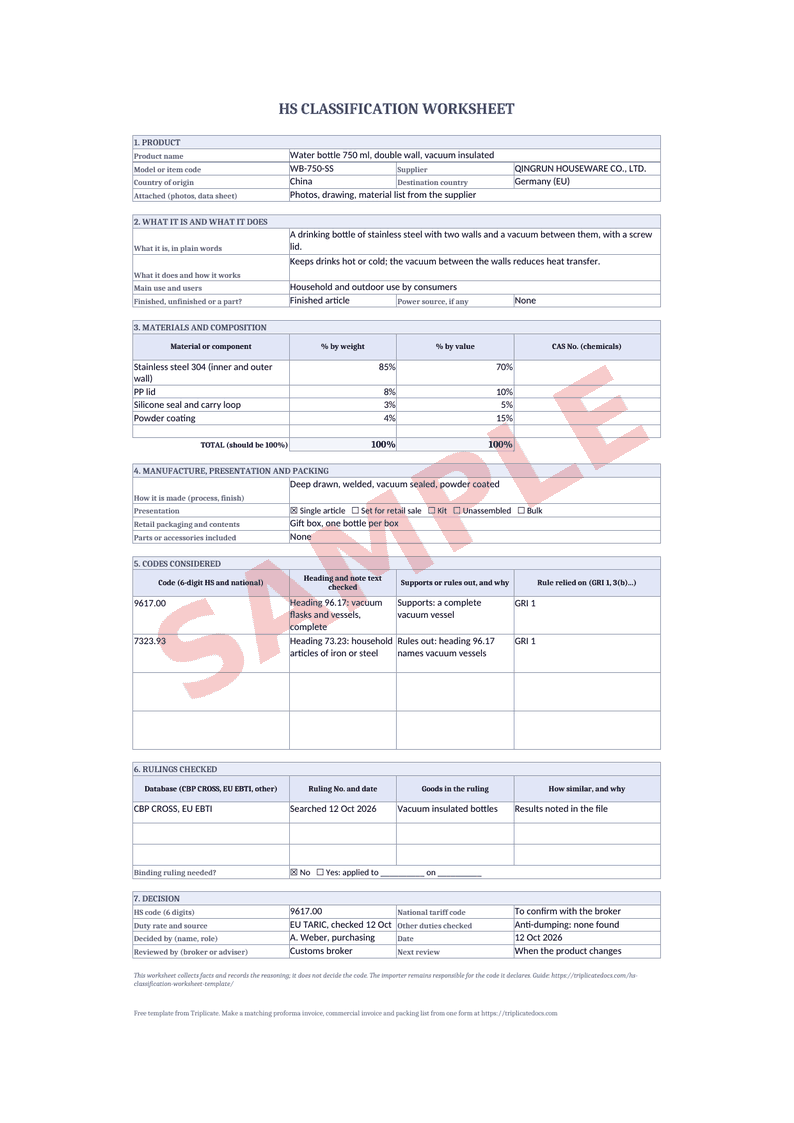
What the template covers
- Product name, model or item code, supplier, country of origin and destination country
- What the product is and what it does, in plain words, with photos or a data sheet attached
- Materials and composition by weight or value, and for chemicals the CAS numbers and percentages
- How it is made, finished, presented and packed (set, kit, retail packaging, unassembled)
- Main use and users, and any parts or accessories shipped with it
- Codes considered (6-digit HS and the national code), with the heading and note text and the reason for each
- Rulings checked (CBP CROSS, EU EBTI and others) and whether a binding ruling is needed
- Final code, source of the duty rate, decided by, reviewed by and date
Sources
Guides on this topic
Facts first, code second
Classification follows the terms of the headings and the section and chapter notes, then the General Rules of Interpretation in order. Much of that depends on facts: the material that gives the product its essential character, whether it is a part or a finished article, whether several items are a set put up for retail sale. Get these facts in writing from the supplier and the product team before you look at codes, and attach photos, drawings or data sheets.
Record the reasoning
Write down every code you considered, the heading and note text that supports it or rules it out, and the rule you relied on, for example GRI 1 or GRI 3(b) for essential character. Search published rulings for similar goods: the US Customs Rulings Online Search System (CROSS) and the EU EBTI database are free. A written record helps when customs asks questions, and in the United States importers must use reasonable care.
When to ask for a binding ruling
If two headings with different duty rates could apply, if a trade agreement preference depends on the code, or if your broker and your buyer disagree, consider a binding ruling from the customs of the importing country, such as EU Binding Tariff Information or a CBP ruling. Customs decide from the facts you give, so the worksheet is a good base for the request. The importer remains responsible for the code it declares.
Common questions
Does this worksheet tell me the HS code?
No. It collects the facts and records the reasoning. The code is decided by the importer or its customs broker, or by customs in a binding ruling.
What information does a customs broker need to classify a product?
What the product is and does, its materials and composition, how it is made, presented and packed, its use, and photos or data sheets; for chemicals, the composition with CAS numbers.
Why record the codes I rejected?
Because the reasons show how you reached the decision. If customs questions the code, you can show which headings, notes and rulings you checked.
Are the first 6 digits the same in every country?
The 6-digit HS code is shared by more than 200 countries and economies, but each country adds its own digits, so check the national code of the destination.
When should I ask for a binding ruling?
When the code is uncertain and the difference matters, for example for the duty rate, an additional duty or a trade agreement preference.
More free tools
Triplicate is free and keeps getting better. Found it useful? Support Triplicate ♥
Prefer no ads? Pro removes all ads · $1/month