Free remittance advice template (payment advice for suppliers)
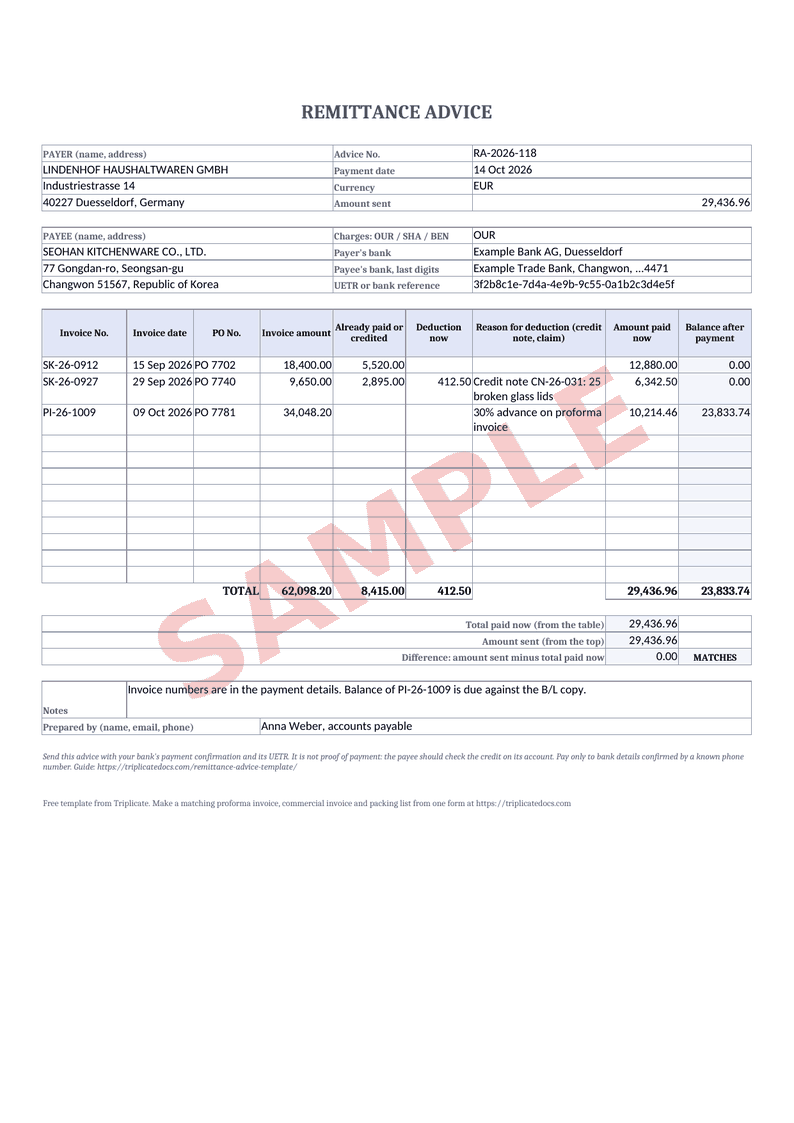
When one bank transfer pays several invoices, or less than an invoice because of a credit note or a claim, the supplier needs to know what the money is for. A remittance advice tells it: which invoices are paid, how much, what was deducted and why, and how the payment can be traced. This sheet lists each invoice with the amounts already paid, deductions and the amount paid now, works out the balance and checks that the lines add up to the amount sent.
Download .xlsxAll free templates →
What the template covers
- Payer and payee, advice number, payment date, currency and the amount sent
- Bank charges option (OUR, SHA or BEN), payer's bank, payee's bank and the last digits of the account
- UETR or the bank's payment reference
- Each invoice paid: number, date, PO number and invoice amount
- Amounts already paid or credited, deductions and the reason (credit note, claim, discount)
- Amount paid now and the balance of each invoice, by formula
- Totals and a check that the lines add up to the amount sent
- Notes and the name and contact of the person who prepared it
Guides on this topic
Why send a remittance advice
A transfer often reaches the supplier with only a short reference, and the amount may not match any single invoice. Without an advice the supplier's accounts team has to guess, may apply the money to the wrong invoice and may send reminders for invoices you have already paid. Send the advice on the day you pay, and put the invoice numbers in the payment details as well.
Deductions and bank charges
List every deduction with its reason and document, such as a credit note number or an agreed quality claim, so that the supplier can match it to its own records. State the charges option you chose: with OUR the payer pays all bank charges; with SHA each side pays its own bank's charges, and the amount received can be reduced by fees along the way; with BEN the payee bears all charges, which are taken from the amount transferred. A small shortfall on arrival is often a bank fee, not an error.
Proof of payment and safety
Attach your bank's payment confirmation and give its UETR, the unique reference that lets the supplier's bank trace a SWIFT payment. A remittance advice or a payment copy only says what you paid; the supplier should still check the credit on its account. Pay only to bank details you have confirmed with the supplier by a known phone number, never to new details received only by email.
Common questions
What is a remittance advice?
A note from the payer to the payee that lists the invoices a payment covers, the amounts paid and any deductions, so the payee can match the payment to its invoices.
Is a remittance advice proof of payment?
No. It says what the payer has paid. The payee should check that the money has been credited to its account; the bank's confirmation and the UETR help trace the payment.
What do OUR, SHA and BEN mean?
They are the bank charges options for an international transfer: with OUR the payer pays all charges, with SHA each party pays its own bank's charges, and with BEN the payee bears all charges, which are deducted from the amount transferred.
How do I show a credit note or a claim?
Enter it as a deduction on the invoice it relates to, with the credit note number or the reason, so that the balance shows what is still open.
Does the template check the totals?
Yes. It works out the balance of each invoice, totals the lines and compares the total paid now with the amount sent.
More free tools
Triplicate is free and keeps getting better. Found it useful? Support Triplicate ♥
Prefer no ads? Pro removes all ads · $1/month