Free shipping booking form template (booking request to a forwarder)
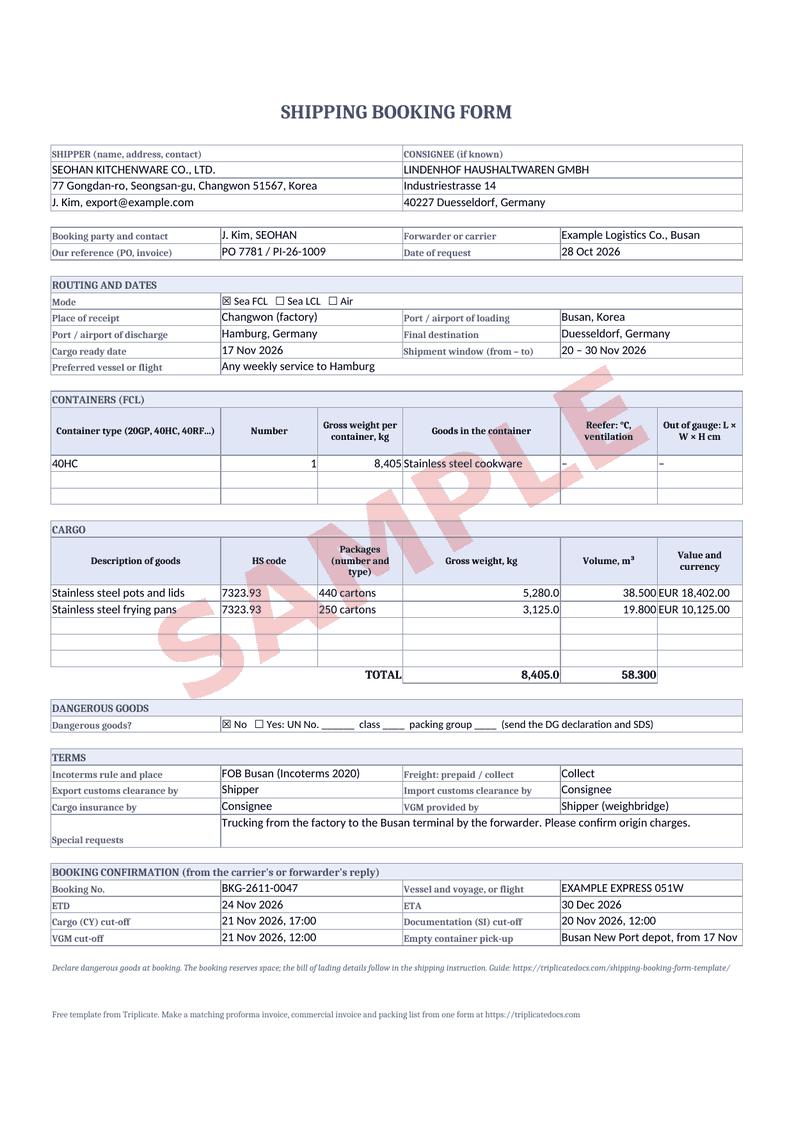
A booking request asks a carrier or forwarder to reserve space for your cargo. When the request is complete, the booking confirmation comes back faster and with fewer surprises at the terminal. This sheet collects what carriers usually ask for: parties, routing, dates, containers or loose cargo, weights and volume, cargo description and HS code, dangerous goods, reefer and out-of-gauge details, Incoterms, freight terms and special requests.
Download .xlsxAll free templates →
What the template covers
- Shipper, consignee if known, booking party and forwarder or carrier, with references
- Mode (sea FCL, sea LCL, air), place of receipt, port of loading, port of discharge and final destination
- Cargo ready date, earliest and latest shipment date, and preferred vessel or flight
- Containers by type and number, or for loose cargo the packages, weight and volume
- Cargo description, HS code, gross weight and value, with dangerous goods details (UN number, class, packing group) if any
- Reefer temperature and ventilation, and out-of-gauge dimensions
- Incoterms rule, freight prepaid or collect, and who arranges insurance and customs clearance
- Special requests, and the booking confirmation to fill in: booking number, vessel or flight, cut-off times
Guides on this topic
Booking request and booking confirmation
The booking request reserves space; it is not the bill of lading. The carrier or forwarder answers with a booking confirmation that gives the booking number, the vessel and voyage or the flight, the cut-off times for cargo, documents and VGM, and where to collect the empty container. The bill of lading details follow later in the shipping instruction.
What carriers need to know
Describe the goods clearly with the HS code, give realistic weights and the number and type of containers, and always declare dangerous goods with the UN number, class and packing group: undeclared dangerous goods put the ship and crew at risk and can lead to penalties. Say whether the cargo needs a reefer setting or is out of gauge, and agree who will provide the verified gross mass (VGM) that SOLAS requires before a packed container is loaded.
After the confirmation
Check the confirmation against your request, note the cut-off times and pass the booking number to the factory and the trucker. Send the shipping instruction before the documentation cut-off and the VGM before its deadline. For ocean shipments to the United States, the importer's security filing (ISF) must be submitted at least 24 hours before the cargo is loaded at the foreign port.
Common questions
What is a shipping booking form?
A request from the shipper or its forwarder to a carrier to reserve space for a shipment, with the routing, dates, containers and cargo details.
What is the difference between a booking and a shipping instruction?
The booking reserves space before the cargo is loaded. The shipping instruction comes later and gives the details for the bill of lading, such as shipper, consignee, marks and the cargo description.
What are cut-off times?
Deadlines set by the carrier or terminal: the container must be at the terminal by the cargo (CY) cut-off, the shipping instruction must reach the carrier by the documentation cut-off and the VGM by the VGM cut-off.
Do I have to declare dangerous goods when booking?
Yes. Dangerous goods must be declared to the carrier with their UN number, class and packing group, and the carrier has to accept them before they are loaded.
Can I use this form for LCL and air freight?
Yes. Choose the mode and, for loose cargo, give the number of packages, the gross weight and the volume instead of containers.
More free tools
Triplicate is free and keeps getting better. Found it useful? Support Triplicate ♥
Prefer no ads? Pro removes all ads · $1/month