Free dangerous goods declaration template (multimodal DG form)
For sea freight, the shipper of dangerous goods must give the carrier the dangerous goods transport information with a signed declaration, and the person who packs the container signs a container packing certificate (IMDG Code chapter 5.4). The IMDG Code gives a model Multimodal Dangerous Goods Form whose layout is recommended, not compulsory, and this Excel sheet follows its boxes. Carriers may ask for their own form or portal; for air cargo use the airline's or IATA's declaration.
Download .xlsxAll free templates →
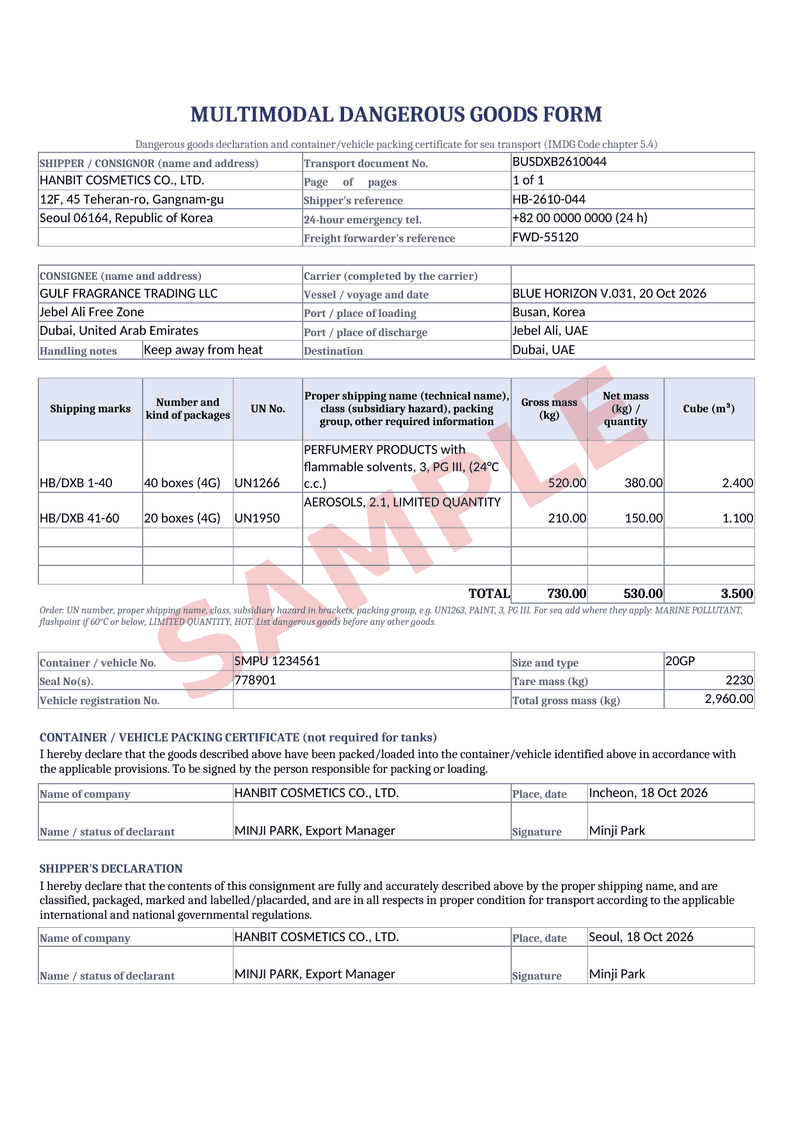
What the template covers
- Shipper, consignee, carrier, transport document number and page numbers
- Shipper's and forwarder's references, and a 24-hour emergency telephone number
- Vessel and voyage, places of loading and discharge, destination and handling information
- Shipping marks, number and kind of packages, gross and net mass, and volume
- UN number, proper shipping name, class, subsidiary hazard and packing group, in that order, with the extra entries for sea
- Container or vehicle number, seal, size and type, tare and total gross mass
- Container packing certificate signed by the person responsible for packing or loading
- Shipper's declaration with the company, the declarant's name and status, place, date and signature
Sources
- IMO, IMDG Code 2024 Edition (Amendment 42-24)
- IMO, Resolution MSC.556(108): amendments to the IMDG Code (Amendment 42-24)
- AMSA, Multimodal dangerous goods form (AMSA 250)
- GOV.UK (Maritime and Coastguard Agency), Dangerous goods declaration note
- eCFR, 49 CFR 172.204: Shipper's certification
- eCFR, 49 CFR 172.203: Additional description requirements (vessel shipments)
- IATA, Shipper's Declaration for Dangerous Goods
Guides on this topic
How to describe each dangerous good
Give the UN number with the letters UN, the proper shipping name (with the technical name in brackets where the entry requires it), the class or division, any subsidiary hazard in brackets and the packing group, in that order, for example UN1263, PAINT, 3, PG III. For sea transport add, where they apply, MARINE POLLUTANT, the flashpoint if it is 60°C or below, LIMITED QUANTITY (or LTD QTY), and HOT for goods carried at an elevated temperature, and state the number and kind of packages and the total quantity.
Two signatures: packing certificate and declaration
The shipper signs the declaration that the goods are fully and accurately described by the proper shipping name and are classified, packaged, marked, labelled and in proper condition for transport. The person responsible for packing or loading the container or vehicle signs the packing certificate, which is not needed for tanks. Both can be on one document, or on two documents attached to each other. Electronic transmission is allowed only if the carrier agrees, and the information must be available on paper without delay.
Training, air cargo and the US
Staff who prepare dangerous goods documents need training suited to their duties (IMDG Code chapter 1.3), and the person who signs remains responsible for the declaration. Air cargo needs the IATA Shipper's Declaration for Dangerous Goods, which has its own format; get it from IATA or the airline. For shipments under US rules, 49 CFR 172.204 sets the shipper's certification and the shipping paper must show an emergency response telephone number (172.201(d)).
Common questions
What is a dangerous goods declaration?
The shipper's document that describes dangerous goods for transport, with the UN number, proper shipping name, class and packing group, and a signed statement that they are correctly classified, packaged, marked, labelled and in proper condition for transport.
Is the multimodal dangerous goods form mandatory?
Its content is, its layout is not: the IMDG Code keeps the layout of the model form recommendatory. A document with all the required information and statements is acceptable, but carriers may ask for their own form, portal or EDI.
Who signs the container packing certificate?
The person responsible for packing or loading the container or vehicle, for example the shipper if it loaded the container itself, or the consolidator or forwarder for groupage. It is not required for tanks.
Can I use this form for air cargo?
No. Air shipments need the IATA Shipper's Declaration for Dangerous Goods in the format set by the IATA Dangerous Goods Regulations; get it from IATA or the airline.
What must the declaration show for sea transport?
The UN number, proper shipping name, class, subsidiary hazard and packing group, the number and kind of packages and the total quantity, and where they apply MARINE POLLUTANT, the flashpoint if 60°C or below, LIMITED QUANTITY and HOT, with the shipper's signed declaration.
More free tools
Triplicate is free and keeps getting better. Found it useful? Support Triplicate ♥
Prefer no ads? Pro removes all ads · $1/month