EU €3 Parcel Duty and Product Identifiers C127, C128, C129, Y081
Since 1 July 2026, distance sales into the EU in consignments with an intrinsic value up to EUR 150 pay a flat EUR 3 customs duty per item, under any VAT method, until 1 July 2028. Because of current IT systems, customs charge it per declaration line. From 1 November 2026, each product in these declarations also needs product identifiers: the seller's own code, the manufacturer's code and, where one exists, a standard code such as an EAN.
Checked against official sources: 2026-10
At a glance
Add product codes to your invoice in the generator →
What the EUR 3 duty is
Council Regulation (EU) 2026/382 of 11 February 2026 removed the customs duty relief for low-value imports. In its place, a temporary EUR 3 customs duty applies per item in a consignment whose intrinsic value does not exceed EUR 150 in total.
It covers distance sales: goods located outside the EU when sold, and sent by or on behalf of the seller to a buyer in the EU who does not account for VAT on the purchase, such as a consumer. The Commission says it applies from 1 July 2026 to 1 July 2028, the date scheduled for the launch of the EU Customs Data Hub.
Intrinsic value is the price of the goods themselves, excluding transport and insurance costs unless they are included in the price.
The duty applies whatever VAT method is used: IOSS, Special Arrangements or standard import VAT. The Commission's guidance says all goods imported using IOSS are subject to it. The VAT schemes themselves are not changed.
Item versus declaration line
An item is one or more goods in a consignment that share the same tariff classification, description and, where applicable, origin. Due to the limits of current IT systems, the EUR 3 is applied automatically per declaration line, irrespective of quantity, as long as the goods in the declaration total no more than EUR 150.
The number of lines depends on the declaration type. The low-value H7 declaration uses a 6-digit HS code, H6 uses an 8-digit CN code and H1 uses a 10-digit TARIC code. In the Commission's example, three goods with the same 8-digit CN code but different 10-digit TARIC codes pay EUR 3 under H6 or H7 but generate three lines and EUR 9 under H1.
Austrian customs give a similar example: 2 pairs of plastic sports shoes, 5 cotton T-shirts and 2 cotton blouses are declared as 3 goods items, for a total duty of EUR 9.
Grouping and splitting
- Declaring goods from one consignment that fall under different tariff subheadings together under one tariff code (the Article 177 UCC simplification) is not allowed where the EUR 3 duty applies.
- If customs find individual distance sales grouped together to reduce the number of lines, they must treat them as separate sales and apply the duty to each.
- Indicators the Commission lists include individual labels or references with different final destinations in one consignment, how often the same operator files such declarations, and inconsistencies between the declared buyer and the actual sale.
Product identifiers from 1 November 2026
Product identifiers (PIDs) must be declared to customs for import distance sales from 1 November 2026. They could be provided voluntarily from 1 July 2026. The Commission says the aim is better traceability of e-commerce goods and easier customs controls.
They go in data element 12 03 000 000 'Supporting document' whenever additional procedure code F48, F49 or F53 is used. The PID of each product declared under an item is reported. The declarant provides them, so it needs them from the seller, marketplace or platform.
- C127, merchant PID (M-PID): assigned by the online seller, marketplace or platform. Mandatory in all cases.
- C128, non-standardised manufacturer PID (NS-PID): assigned by a manufacturer, producer or product supplier, not based on an international standard. Mandatory in all cases.
- C129, standardised manufacturer PID (S-PID): EAN, ISBN or other standard code, where it exists.
- Y081: declares that no standardised manufacturer identifier exists for the product.
A separate EUR 2 handling fee from 1 November 2026
The customs reform adds a Union handling fee on top of the EUR 3 duty. The Commission's customs reform page says that from 1 November 2026 the EU will apply the EUR 2 Union handling fee, that its amount is based on the costs of customs supervision, and that it is set in a delegated act, Commission Delegated Regulation C(2026) 6694.
CLECAT, the European freight forwarders' association, reports that the act sets the fee at EUR 2 per item, payable by the entity responsible for the other customs charges on the item. The Council announced on 3 September 2026 that the fee would be introduced by 1 November 2026. Check with your carrier or marketplace how it will be billed to you.
Generic descriptions are not enough
The Commission states that product information must flow fully and accurately from the seller, marketplace or platform to the customs declarant, and that a generic product description will no longer be enough.
Description is also part of the definition of an item, next to tariff classification and origin. In practice, each product needs its own specific description, tariff code, origin and identifiers in the data you pass to the declarant.
Step by step
- Check which parcels are in scope: sales to EU consumers, sent by you or on your behalf, with an intrinsic value up to EUR 150 per consignment.
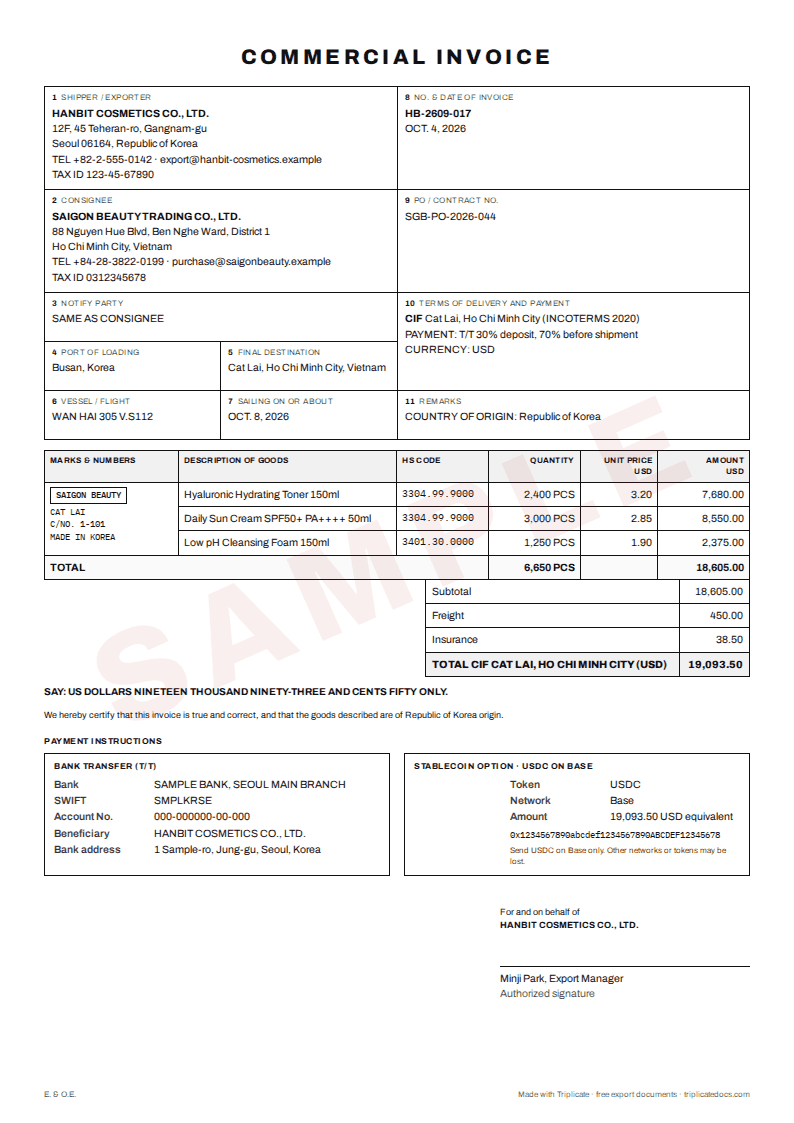
- Classify each product and keep one invoice line per product, with a specific description, HS code, origin, quantity and price.
- For every product, record your own product code, the manufacturer's code and its EAN or ISBN, or note that no standard code exists (Y081).
- Pass these identifiers with each order to your carrier, marketplace, IOSS intermediary or customs representative, and confirm which code numbers their system expects.
- Count the declaration lines per parcel and price in EUR 3 per line. Triplicate's invoice generator prints the seller's product code, manufacturer's code and GTIN under each item and counts the EUR 3 lines for EU consumer parcels.
- Do not combine different customers' orders into one consignment to reduce lines.
Documents you usually need
- Commercial invoice with one line per product
- Product identifier list: merchant code, manufacturer code, EAN or ISBN (or Y081)
- Import declaration (H7, H6 or H1) with code F48, F49 or F53
- IOSS number, where IOSS is used
Common problems and how to avoid them
What to do: Give each product its own specific description, tariff code and identifiers. The Commission says a generic description will no longer be enough.
What to do: Ask your supplier for its model or part number for C128. If the product has no EAN, ISBN or other standard code, declare Y081 instead of C129.
What to do: Label each identifier by type, not only by code. Commission guidance maps C127 to the merchant code and C129 to the standard code; Finnish and Austrian customs pages list C127 and C129 the other way round. Confirm with your declarant.
What to do: Each declaration line pays EUR 3. Under H1 the 10-digit TARIC code can split goods into more lines than under H6 or H7.
What to do: Customs may treat them as separate distance sales and charge the duty on each. Ship and declare each sale separately.
Sources
- EU applies €3 customs duty per item on low-value e-commerce consignments European Commission, Access2Markets
- Customs guidance on the EUR 3 customs duty (version of 2 June 2026) European Commission, DG TAXUD
- Guidance and legal text on temporary flat fee on low-value imports which will apply until 1 July 2028 European Commission, DG TAXUD
- EU Customs Reform European Commission, DG TAXUD
- Council Regulation (EU) 2026/382 of 11 February 2026 amending Regulation (EC) No 1186/2009 EUR-Lex
- Commission Delegated Regulation C(2026) 2760 amending Delegated Regulation (EU) 2015/2446 (Council document 8820/26) Council of the European Union
- Declaring goods of low value (no more than 150 euros) Finnish Customs
- Informationen zum Wegfall der 150 Euro Zollfreigrenze und Einführung des 3 Euro Zolls mit 1. Juli 2026 Austrian Federal Ministry of Finance
- EU customs: Council greenlights landmark reform (3 September 2026) Council of the European Union
- Commission sets Union handling fee at EUR 2 per item CLECAT (European Association for Forwarding, Transport, Logistics and Customs Services)
Rules change often. This note is practical guidance based on the sources above, not legal advice. Confirm current requirements with the authority, your importer or a licensed customs broker before you ship.
Weekly email: trade rule changes
One short email a week: new and changed import and export rules from official sources, plus our new guides and tools. Free, unsubscribe at any time.
Trade notes
Common questions
Is the EUR 3 charged per parcel or per product?
Per item: goods sharing the same tariff classification, description and origin. Because of current IT limits it is charged per declaration line, whatever the quantity on that line.
I collect VAT through IOSS. Does the EUR 3 still apply?
Yes. It applies whether VAT is handled through IOSS, Special Arrangements or standard import VAT.
Who pays the EUR 3?
The Commission's guidance says the main debtor is the declarant. Under indirect representation, the person the representative acts for is also a debtor. Agree with your carrier or marketplace who bears the cost.
Is the EUR 3 the only new charge?
No. The Commission's customs reform page says the EU will apply a separate EUR 2 Union handling fee from 1 November 2026. Ask your carrier how it is charged.
More free tools
Triplicate is free and keeps getting better. Found it useful? Support Triplicate ♥
Prefer no ads? Pro removes all ads · $1/month