UPS dimensional weight calculator
Enter your box sizes in inches and weights in pounds to see the UPS dimensional weight (L × W × H ÷ 139 at daily rates, ÷ 166 at retail rates) and the billable weight: the higher of the dimensional and the actual weight.
Divisors are the carriers' published standards: DHL Express and FedEx ÷5000 cm³/kg, FedEx and UPS daily rates ÷139 in³/lb, UPS retail rates ÷166, air cargo 1:6, rail 1:3, sea LCL 1 m³ = 1,000 kg. Chargeable weights are rounded up to the next 0.5 kg or whole pound; carriers' own rounding and contract divisors can differ, so check your quote.
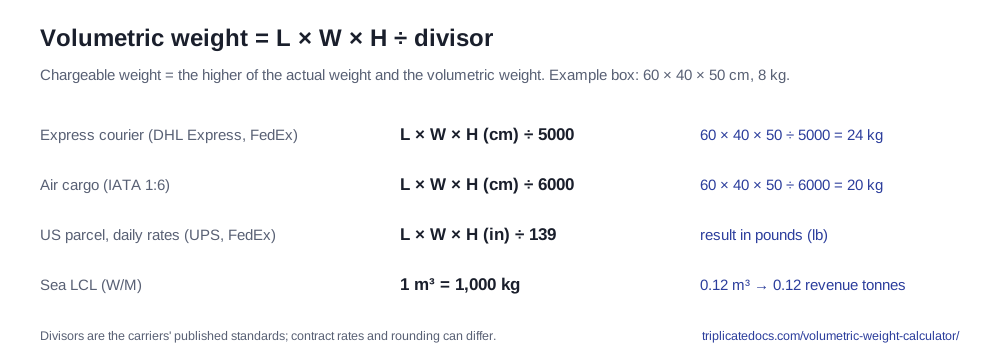
Volumetric weight by carrier
Guides on this topic
How UPS works out the chargeable weight
UPS multiplies length × width × height in inches and divides by 139 for daily rates or 166 for retail rates, giving a dimensional weight in pounds. The billable weight is the higher of that and the actual weight, rounded up to the next whole pound. Contract rates can use a different divisor, so check your UPS account or quote.
Worked example
A 60 × 40 × 50 cm box weighing 8 kg is 120,000 cm³. By express courier: 120,000 ÷ 5000 = 24 kg, so you pay for 24 kg, not 8 kg. By air cargo: 120,000 ÷ 6000 = 20 kg. By sea LCL the box is 0.12 m³, so it is charged as 0.12 revenue tonnes (W/M).
How to lower the chargeable weight
Use the smallest box that still protects the goods, avoid oversized outer cartons and empty space, and combine several small boxes into one where you can. For heavier shipments compare air cargo with express courier, and for large volumes compare sea LCL or a full container.
Common questions
What is the UPS dimensional weight divisor?
139 for daily rates and 166 for retail rates, with sizes in inches and weight in pounds. Example: a 24 × 16 × 20 in box is 7,680 in³: 55.3 lb at daily rates (billed as 56 lb) and 46.3 lb at retail rates (billed as 47 lb).
Is volumetric weight the same as chargeable weight?
No. Volumetric weight comes from the size of the box. The chargeable weight is what the carrier bills: the higher of the actual weight and the volumetric weight, after the carrier's rounding.
Why does air cargo use 6000 but courier 5000?
Air cargo generally uses the IATA ratio of 1:6, 6000 cm³ per kg (about 167 kg per m³). Express couriers use 5000, so the same box counts as 20% heavier by courier than by air cargo.
More free tools
Triplicate is free and keeps getting better. Found it useful? Support Triplicate ♥
Prefer no ads? Pro removes all ads · $1/month